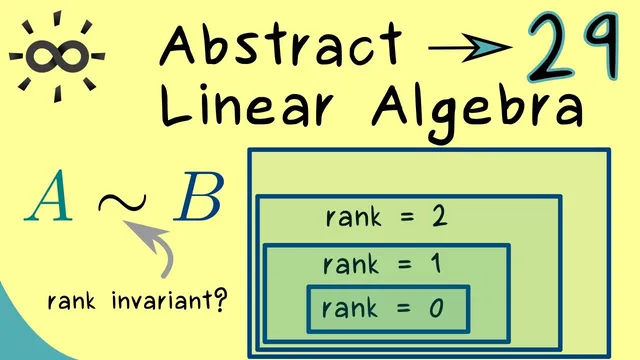
Abstract Linear Algebra 29 | Rank gives Equivalence
Based on The Bright Side of Mathematics's video on YouTube. If you like this content, support the original creators by watching, liking and subscribing to their content.
Equivalent matrices satisfy B = S A T for invertible S and T, reflecting base changes in domain and codomain.
Briefing
Equivalent matrices—those related by changes of bases in the domain and codomain—can represent the same linear map even though their entries differ. The key question is what stays unchanged under the equivalence operation: if two matrices A and B are equivalent, they satisfy B = S A T for invertible matrices S and T. While it’s tempting to look for invariants like the kernel or the range, those subspaces generally do not survive the transformation unchanged.
For the kernel, the transformation B = S A T forces a relationship between solutions of Bx = 0 and solutions of Ax = 0. Because S is invertible, the condition S A T x = 0 is equivalent to A(Tx) = 0. That means vectors in the kernel of B correspond to vectors whose T-images lie in the kernel of A. In short, the kernel changes by the invertible map T: ker(B) = T^{-1} ker(A) (equivalently, ker(A) = T ker(B)). The range behaves similarly: invertibility of T lets the image of B be rewritten in terms of the image of A, but again the subspace itself shifts under the transformation. So neither kernel nor range is invariant under equivalence.
What does remain invariant is the dimension of these spaces. Since multiplying by an invertible matrix is a bijection, it cannot change the dimension of a subspace. Therefore, if A and B are equivalent, the rank of A equals the rank of B. Rank is defined as the dimension of the range, and nullity is the dimension of the kernel; both dimensions stay fixed under equivalence. The rank-nullity theorem then links these quantities: rank(A) + nullity(A) always equals the number of columns n, so knowing the rank automatically determines the nullity.
The discussion then turns to the converse: if two matrices have the same rank, must they be equivalent? Yes. The equivalence classes are completely determined by rank. The route to this conclusion uses Gaussian elimination, which performs row and column operations that correspond to multiplying by invertible matrices—exactly the kind of operations allowed in the equivalence relation. Gaussian elimination reduces any matrix A to a row echelon (and ultimately a canonical) form containing an identity block whose size equals the rank R of A. If another matrix B has the same rank, it can be reduced to the same canonical form. By transitivity of equivalence, A and B are equivalent.
The practical payoff is twofold. First, rank is the invariant that classifies equivalence under base changes. Second, because all matrix representations of a linear map are equivalent, the rank of the linear map is well-defined: it does not depend on which matrix representation is chosen. If two matrices have different ranks, they cannot be equivalent; if they share a rank, they can be transformed into one another through invertible row and column operations.
Cornell Notes
Equivalent matrices are connected by B = S A T with invertible S and T, reflecting changes of bases in the domain and codomain. Kernel and range subspaces generally change under this operation, but their dimensions do not, because invertible maps preserve dimension. As a result, equivalent matrices have the same rank and the same nullity; rank-nullity then ties these together via rank + nullity = n. The converse also holds: two matrices of the same size are equivalent if and only if they have the same rank. Gaussian elimination justifies this by reducing any matrix to a canonical form containing an identity block whose size equals the rank, so matching ranks force equivalence.
Why aren’t kernel and range invariants under matrix equivalence B = S A T?
What quantity is invariant under equivalence, and why does invertibility matter?
How does rank-nullity reduce the need to track both kernel and range dimensions?
Why does equal rank imply equivalence of matrices?
What does the identity block size tell you in the canonical form?
Review Questions
- If A and B are equivalent via B = S A T with S and T invertible, what is the relationship between ker(B) and ker(A)?
- Why does invertibility guarantee that rank(A) = rank(B) under equivalence?
- How does Gaussian elimination connect the number of pivots to the rank, and why does that support the converse statement about equivalence?
Key Points
- 1
Equivalent matrices satisfy B = S A T for invertible S and T, reflecting base changes in domain and codomain.
- 2
Kernel and range subspaces generally change under equivalence, even though their dimensions do not.
- 3
Invertible transformations preserve dimension, so equivalent matrices have equal rank and equal nullity.
- 4
Rank-nullity links the two dimensions by rank(A) + nullity(A) = n, so tracking rank alone determines nullity.
- 5
Two matrices are equivalent if and only if they have the same rank.
- 6
Gaussian elimination uses invertible row/column operations and reduces a matrix to a canonical form with an identity block sized by the rank.
- 7
Because all matrix representations of a linear map are equivalent, the rank of the linear map is representation-independent.