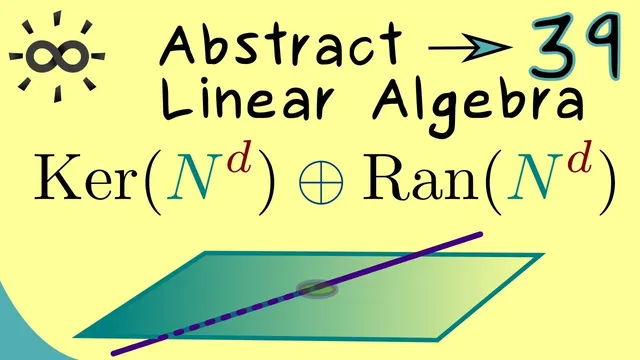
Abstract Linear Algebra 39 | Direct Sum of Subspaces
Based on The Bright Side of Mathematics's video on YouTube. If you like this content, support the original creators by watching, liking and subscribing to their content.
Direct sums require the intersection of subspaces to be exactly {0}, not just that their sum forms a subspace.
Briefing
Direct sums of subspaces are introduced as the key tool for splitting a vector space into two parts that don’t overlap except at the zero vector—and that non-overlap is exactly what makes the decomposition useful for later Jordan normal form work. Starting with two subspaces U1 and U2 inside a vector space V, simply taking their union usually fails to produce a subspace because linear combinations of vectors from the union may leave the set. The fix is to form U1 + U2, meaning all sums u1 + u2 with u1 ∈ U1 and u2 ∈ U2; this always yields a subspace.
The direct sum tightens this idea by adding a crucial condition: U1 ⊕ U2 is defined only when U1 ∩ U2 = {0}. In geometric terms, the subspaces point in completely different directions, so no nonzero vector can belong to both. Under this condition, every vector in U1 ⊕ U2 has a clean representation as a sum of one vector from each subspace, and the dimension behaves additively: dim(U1 ⊕ U2) = dim(U1) + dim(U2). A simple example in C^2 illustrates the point: taking span{(1,0)} and span{(0,1)} gives C^2 as a direct sum of two one-dimensional subspaces.
With direct sums in place, the discussion pivots to Jordan normal form. Fix a complex vector space C^n and a square matrix A. For an eigenvalue λ, define N = A − λI. Prior material established chains of generalized eigenspaces through kernels of powers of N, K(N^0) ⊆ K(N^1) ⊆ …, which stabilize at the fitting index D (so K(N^D) = K(N^{D+1}) and similarly for larger powers). The same fitting index also appears in the corresponding chain of ranges: R(N^0) ⊇ R(N^1) ⊇ …, with stabilization at D.
At the fitting index level, the space C^n can be decomposed as a direct sum of the kernel and the range: C^n = K(N^D) ⊕ R(N^D). The argument for “direct” hinges on proving the intersection is trivial. If X lies in K(N^D) ∩ R(N^D), then X = N^D u for some u (because X is in the range) and also N^D X = 0 (because X is in the kernel). Substituting X = N^D u gives N^D(N^D u) = N^{2D}u = 0, which forces u into K(N^D) once stabilization at the fitting index is used. Then X = N^D u becomes 0, so the intersection contains only the zero vector.
Finally, the decomposition is shown to cover all of C^n. Since the direct sum has dimension equal to dim(K(N^D)) + dim(R(N^D)), the rank-nullity theorem supplies the total as n. An n-dimensional subspace of C^n must be the whole space, so K(N^D) ⊕ R(N^D) = C^n. This kernel–range splitting for each eigenvalue is presented as the structural ingredient that feeds directly into the Jordan normal form construction in the next step.
Cornell Notes
The direct sum U1 ⊕ U2 is defined by the condition U1 ∩ U2 = {0}, ensuring the two subspaces overlap only at the zero vector. Under this condition, every vector in U1 ⊕ U2 can be written as a sum of one vector from each subspace, and dimensions add: dim(U1 ⊕ U2) = dim(U1) + dim(U2). For a matrix A and eigenvalue λ, letting N = A − λI and D be the fitting index, the space C^n decomposes as C^n = Ker(N^D) ⊕ Range(N^D). The intersection is proved trivial by using X ∈ Ker(N^D) ∩ Range(N^D) ⇒ X = N^D u and N^D X = 0, then applying stabilization at the fitting index. Rank-nullity then shows the sum has dimension n, so it equals C^n.
Why doesn’t U1 ∪ U2 usually form a subspace, and what replaces it?
What extra condition turns U1 + U2 into a direct sum U1 ⊕ U2?
In the Jordan-normal-form setup, what are N and D, and how do they arise?
How is the intersection Ker(N^D) ∩ Range(N^D) proved to be {0}?
Why does Ker(N^D) ⊕ Range(N^D) equal all of C^n?
Review Questions
- State the definition of a direct sum of subspaces and explain the role of the condition U1 ∩ U2 = {0}.
- Given N = A − λI and fitting index D, outline the steps that show Ker(N^D) ∩ Range(N^D) = {0}.
- How does rank-nullity force Ker(N^D) ⊕ Range(N^D) to equal C^n?
Key Points
- 1
Direct sums require the intersection of subspaces to be exactly {0}, not just that their sum forms a subspace.
- 2
For U1 ⊕ U2, dimensions add: dim(U1 ⊕ U2) = dim(U1) + dim(U2).
- 3
For an eigenvalue λ of A, setting N = A − λI creates kernel and range chains whose stabilization index is the fitting index D.
- 4
At the fitting index, C^n splits as C^n = Ker(N^D) ⊕ Range(N^D).
- 5
The intersection Ker(N^D) ∩ Range(N^D) is proved trivial by writing X = N^D u and using N^D X = 0 plus stabilization.
- 6
Rank-nullity ensures the kernel-plus-range direct sum has dimension n, forcing it to equal C^n.