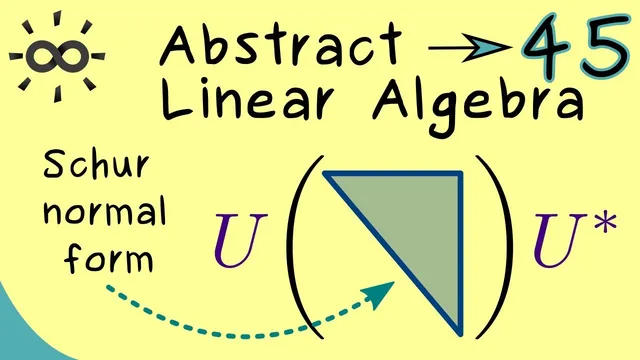
Abstract Linear Algebra 45 | Schur Decomposition
Based on The Bright Side of Mathematics's video on YouTube. If you like this content, support the original creators by watching, liking and subscribing to their content.
Schur decomposition states that every complex square matrix A is unitarily similar to an upper triangular matrix R: U*AU = R.
Briefing
Schur decomposition guarantees that every complex square matrix can be turned—using a unitary change of basis—into an upper triangular matrix. That matters because it preserves eigenvalues while putting them in a simple, readable form: the eigenvalues of the original matrix appear exactly on the diagonal of the triangular matrix. The key upgrade over Jordan normal form is the requirement that the similarity transformation be unitary, meaning the change of coordinates is length- and angle-preserving.
More concretely, for any complex matrix A there exist a unitary matrix U and an upper triangular matrix R such that A is unitarily similar to R: U*AU = R (equivalently, A = URU*). Here U* denotes the adjoint of U, and because U is unitary, its inverse is just U*—a practical advantage when doing computations. The matrix R is called the Schur normal form, and while it is upper triangular, it is not generally unique; different choices of U can lead to different valid R matrices for the same A.
The decomposition is closely related to Jordan normal form, which also produces an upper triangular structure after a similarity transform. The difference is that Jordan form allows an arbitrary invertible matrix X, whereas Schur form insists on unitarity. This restriction is what makes Schur decomposition especially useful in numerical linear algebra: unitary transformations are stable and avoid amplifying errors.
The transcript also notes an eigenvalue consequence that follows immediately from triangular structure: since R is triangular, its diagonal entries are exactly the eigenvalues. Because A and R are similar, they share the same eigenvalues, so all eigenvalues of A can be read off from the diagonal of R.
A full proof is built by induction on the matrix size n. The starting point is n = 1, where the statement is trivial. For the induction step, one picks an eigenvalue λ1 of A and a corresponding eigenvector x1, then normalizes x1 to have unit length. The construction extends x1 to an orthonormal basis of C^n (using tools like Steinitz exchange lemma and Gram–Schmidt orthonormalization), and the basis vectors become the columns of a unitary matrix U1. Conjugating A by U1 forces λ1 into the top-left corner of the transformed matrix, while everything below it in the first column becomes zero.
What remains is a smaller (n−1)×(n−1) matrix in the bottom-right block, call it A2. The same argument applies to A2, producing a unitary U2 that isolates another eigenvalue λ2 into the next diagonal position. Repeating until the dimension shrinks to 1 yields a sequence of unitary matrices U1, U2, …, Un. These are assembled into one global unitary matrix U by embedding each smaller unitary into the appropriate block of the identity. Multiplying all the conjugations together produces an overall upper triangular matrix R with zeros below the diagonal and the eigenvalues λ1, …, λn along the diagonal. The construction not only proves existence but also provides a concrete procedure for building U and R in practice.
Cornell Notes
Schur decomposition says that every complex n×n matrix A is unitarily similar to an upper triangular matrix R: U*AU = R for some unitary U. The unitary condition is crucial because U* = U^{-1}, making the similarity transform easy to compute and numerically stable. The upper triangular form forces the eigenvalues of A to appear on the diagonal of R, since similar matrices share eigenvalues and triangular matrices place eigenvalues on their diagonal. A constructive proof uses induction: pick an eigenvalue λ1 with a normalized eigenvector x1, extend x1 to an orthonormal basis to form U1, conjugate to isolate λ1 in the top-left corner, then repeat on the remaining (n−1)×(n−1) block. Repeating yields R upper triangular with λ1,…,λn on the diagonal.
Why does Schur decomposition put eigenvalues on the diagonal of R?
What is the practical advantage of using a unitary matrix U instead of an arbitrary invertible matrix?
How does the induction step isolate one eigenvalue at a time?
Why is it possible to extend a single eigenvector into an orthonormal basis?
How are multiple smaller unitary matrices combined into one global U?
Review Questions
- In Schur decomposition, what relationship between U and its inverse makes computations easier?
- During the induction proof, what happens to the first column of the conjugated matrix after choosing an eigenvector x1?
- Why does the final upper triangular matrix R contain all eigenvalues of A on its diagonal?
Key Points
- 1
Schur decomposition states that every complex square matrix A is unitarily similar to an upper triangular matrix R: U*AU = R.
- 2
The transformation matrix U is unitary, so U^{-1} equals U* (the adjoint), simplifying calculations.
- 3
The Schur normal form R is generally not unique, even though it is always upper triangular.
- 4
Similarity preserves eigenvalues, and triangular matrices place eigenvalues on their diagonal, so eigenvalues of A appear on the diagonal of R.
- 5
A constructive proof uses induction on n by isolating one eigenvalue at a time using a normalized eigenvector and an orthonormal basis.
- 6
Each induction step reduces the problem to a smaller (n−1)×(n−1) block, continuing until reaching a 1×1 case.
- 7
Smaller unitary matrices from each step are embedded into block matrices with identity padding so their product forms the final global unitary U.