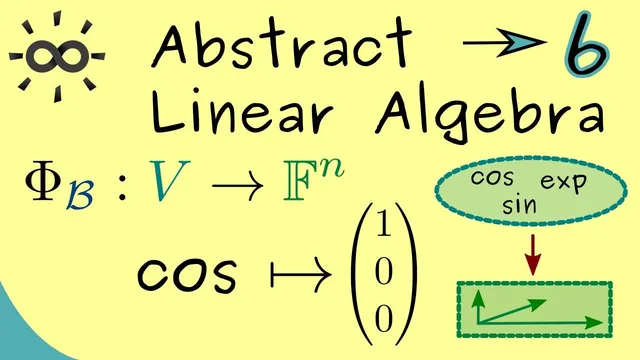
Abstract Linear Algebra 6 | Example of Basis Isomorphism
Based on The Bright Side of Mathematics's video on YouTube. If you like this content, support the original creators by watching, liking and subscribing to their content.
Define U = span{cos, sin, exp} and note that generating is automatic by construction.
Briefing
A three-function subspace of real-valued functions—spanned by cos(x), sin(x), and e^x—is shown to have a basis, and that basis enables a clean “coordinate transfer” into R^3. The key payoff is that every function in this subspace can be represented by a unique triple of coefficients, so computations with functions reduce to ordinary vector arithmetic in three dimensions.
Start with the function space F_R and pick three specific functions: cosine, sine, and the exponential function. Let U be their span, U = span{cos, sin, exp}. The central question is whether these three functions form a basis for U. Generating is immediate because U is defined as their span. The hard part is linear independence: if a linear combination α1 cos(x) + α2 sin(x) + α3 e^x = 0 produces the zero function, then linear independence requires α1 = α2 = α3 = 0.
To test this, the argument uses the fact that an equality of functions means the equality holds for every real x. So instead of treating the equation abstractly, it plugs in carefully chosen points. It selects x = 0, x = π/2, and a third point chosen as a large negative multiple of 2π so that the exponential term becomes very small while avoiding sign complications. At these three x-values, the function equation becomes a 3×3 linear system in the unknowns α1, α2, α3.
The resulting coefficient matrix has a structure built from the trigonometric values at 0 and π/2, plus the exponential value at the third point. The determinant of this matrix is computed using a “rule of Sarrus” style expansion, and it comes out as a nonzero number (described as close to −1). Because the determinant is nonzero, the system has a unique solution—namely the trivial one—so the only way the linear combination equals the zero function is when all coefficients are zero. That proves cos(x), sin(x), and e^x are linearly independent, hence they form a basis for U.
With a basis in hand, the basis isomorphism from the previous part becomes concrete. The basis B = (cos, sin, exp) is mapped into the canonical basis of R^3: cos ↦ (1,0,0), sin ↦ (0,1,0), and exp ↦ (0,0,1). Any function in U, such as V(x) = 7 cos(x) + 2 sin(x) + exp(x), corresponds to the coefficient vector (7,2,1) in R^3. The essential message is that U is completely represented by R^3 through this isomorphism, preserving all information while replacing function calculations with vector calculations. The freedom to choose a different basis in U is flagged as the next step for later videos.
Cornell Notes
The subspace U of F_R defined by U = span{cos, sin, exp} is proved to be 3-dimensional by showing the three functions are linearly independent. Linear independence is tested by assuming α1 cos(x) + α2 sin(x) + α3 e^x equals the zero function and then evaluating at three carefully chosen inputs (x = 0, x = π/2, and a large negative multiple of 2π). This turns the functional equation into a 3×3 linear system in α1, α2, α3. The coefficient matrix has a nonzero determinant (computed via a Sarrus-style rule), so the system has only the trivial solution, forcing α1 = α2 = α3 = 0. Therefore (cos, sin, exp) is a basis for U, enabling a basis isomorphism that maps U to R^3 by sending each basis function to a canonical unit vector.
Why does checking linear independence require more than just knowing U is the span of the three functions?
What’s the key move for turning a functional equation into a solvable linear system?
How does the determinant test confirm linear independence?
How does the basis isomorphism map functions in U into vectors in R^3?
Why is the choice of a “very negative” third input helpful even though the exact value isn’t needed?
Review Questions
- Given α1 cos(x) + α2 sin(x) + α3 e^x = 0 as a zero function, what does it mean to “restrict to x = 0” and why is that legitimate?
- What determinant condition guarantees a 3×3 linear system has only the trivial solution, and how does that connect to linear independence?
- If a function in U has the form a cos(x) + b sin(x) + c e^x, what vector in R^3 corresponds to it under the basis isomorphism?
Key Points
- 1
Define U = span{cos, sin, exp} and note that generating is automatic by construction.
- 2
Prove linear independence by assuming a linear combination equals the zero function and forcing all coefficients to be zero.
- 3
Use the principle that equality of functions holds for every x, then substitute x-values to convert the problem into ordinary linear equations.
- 4
Choose x = 0 and x = π/2 to exploit simple trigonometric values, and pick a third x-value (a large negative multiple of 2π) to keep the exponential term controlled.
- 5
Form a 3×3 coefficient matrix from the substituted equations and compute its determinant.
- 6
A nonzero determinant implies the only solution is α1 = α2 = α3 = 0, so (cos, sin, exp) is a basis for U.
- 7
Use the basis isomorphism to map each basis function to a canonical unit vector in R^3, turning function computations into vector computations.