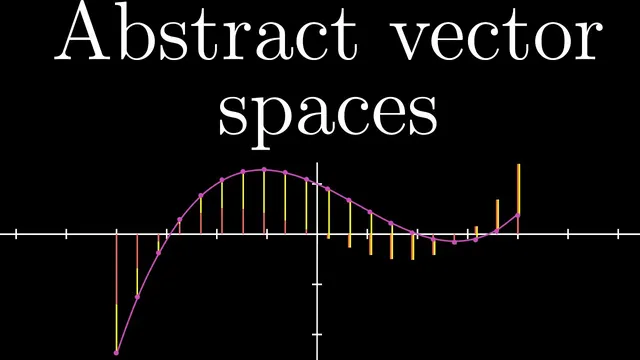
Abstract vector spaces | Chapter 16, Essence of linear algebra
Based on 3Blue1Brown's video on YouTube. If you like this content, support the original creators by watching, liking and subscribing to their content.
Vectors are defined by the operations they support—addition and scalar multiplication—not by whether they look like arrows or lists.
Briefing
Linear algebra’s core move is to treat “vectors” as anything that supports two operations—addition and scaling—so long as they obey a fixed set of rules. That shift matters because it explains why the same concepts (determinants, eigenvectors, linear transformations) keep working even when the objects stop looking like arrows on graph paper. Once vectors are defined by their behavior rather than their appearance, the subject becomes portable: the same toolkit applies to higher dimensions, different coordinate choices, and even non-geometric objects.
The discussion starts by challenging the usual intuition that a vector is fundamentally either (1) an arrow in a plane or (2) a list of numbers. Coordinates can change when the basis changes, yet key quantities remain invariant. Determinants still measure how a transformation scales areas, and eigenvectors still correspond to directions that survive a transformation unchanged up to scaling—regardless of how coordinates are chosen. That invariance raises a deeper question: what does “space” mean if the underlying structure doesn’t depend on the coordinate system?
To build toward the answer, the focus turns to functions, described as “vector-ish” because they can be added and scaled pointwise. If f and g are functions, then (f+g)(x)=f(x)+g(x), and (αf)(x)=α·f(x). This mirrors coordinate-by-coordinate vector addition and scalar multiplication, except functions have infinitely many “coordinates” (one for each input). The next step is to define linear transformations for functions—operations that preserve addition and scaling. The derivative becomes the central example: differentiating a sum equals the sum of the derivatives, and differentiating a scaled function equals scaling the derivative. These are exactly the additivity and scaling properties that characterize linear transformations.
The payoff comes by translating the derivative into matrix form. By restricting attention to polynomials and choosing the power basis {1, x, x², x³, …}, each polynomial gets an infinite coordinate list with only finitely many nonzero entries. In that coordinate system, the derivative acts like an infinite matrix that shifts coefficients and multiplies by the appropriate integers. Constructing the matrix can be done systematically: differentiate each basis function and place the resulting coordinates as columns. The result is a concrete bridge between two seemingly different operations—matrix-vector multiplication and taking derivatives—showing they belong to the same linear-algebra family.
From there, the argument generalizes: linear algebra is not tied to one kind of object. Any collection of things with well-behaved addition and scaling forms a vector space. Modern theory formalizes this with axioms—eight conditions that guarantee the standard results apply. The axioms act as an interface: once someone defines a new “crazy” vector space (even one unrelated to arrows or functions), they only need to verify the axioms to unlock the entire linear-algebra toolbox. That’s why textbooks define linear transformations abstractly in terms of additivity and scaling rather than relying on geometric intuition.
The final takeaway is pragmatic. Mathematicians “ignore” the concrete embodiment of vectors in favor of the shared structure captured by the axioms. Arrows, coordinate lists, functions, and other embodiments are all different realizations of the same underlying concept: a vector space. The series encourages starting with visual intuition, but it frames abstraction as the reason the subject scales to new settings without losing its power.
Cornell Notes
Vectors aren’t fundamentally arrows or coordinate lists; they’re objects that behave like vectors because they support addition and scalar multiplication. Functions qualify: (f+g)(x)=f(x)+g(x) and (αf)(x)=αf(x), so linear transformations on functions are defined by preserving those two operations. The derivative is a concrete example of such a linear transformation, since d/dx(f+g)=f’+g’ and d/dx(αf)=αf’. Using the power basis {1, x, x², …} for polynomials, the derivative becomes an infinite matrix acting on an infinite coordinate vector with finitely many nonzero entries. This illustrates why linear algebra’s tools apply broadly: any structure satisfying the vector-space axioms supports the same theory.
Why does changing coordinates (changing basis) not break key linear-algebra quantities like determinants and eigenvectors?
How do functions become “vectors” in this framework?
What does it mean for a transformation to be linear, and how does the derivative fit?
How can the derivative be represented as matrix multiplication?
Why do mathematicians define vector spaces using axioms instead of focusing on arrows or functions?
Review Questions
- What two properties define linearity, and how do they translate into the behavior of the derivative?
- Using the power basis {1, x, x², x³, …}, what happens to the coefficient of x^k when differentiating a polynomial?
- Why does the vector-space axioms approach make it possible to apply linear algebra to unfamiliar “vector-like” objects?
Key Points
- 1
Vectors are defined by the operations they support—addition and scalar multiplication—not by whether they look like arrows or lists.
- 2
Coordinate choices (basis changes) can change how vectors are represented, but linear-algebra invariants like determinants and eigenvector behavior remain tied to the underlying transformation.
- 3
Functions form a vector space under pointwise addition and pointwise scalar multiplication.
- 4
A linear transformation is characterized by preserving addition and scaling; the derivative satisfies both properties.
- 5
With an appropriate basis (the power basis for polynomials), the derivative becomes an infinite matrix acting on an infinite coordinate vector.
- 6
Matrix-vector multiplication and differentiation are both instances of the same linear-algebra structure when expressed in coordinates.
- 7
Vector-space axioms provide a checklist that lets linear-algebra results transfer to any setting that satisfies the rules.