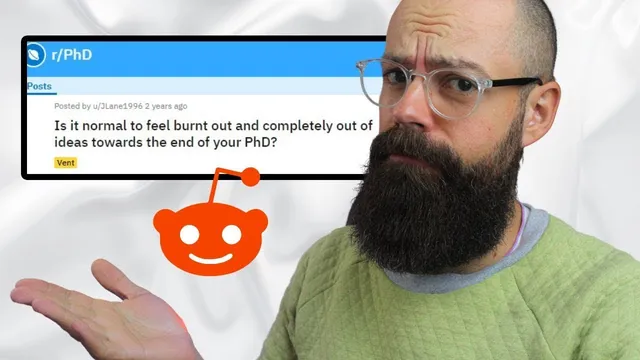
Academic answers heartbreaking PhD questions from Reddit - is this NORMAL?
Based on Andy Stapleton's video on YouTube. If you like this content, support the original creators by watching, liking and subscribing to their content.
Burnout and feeling out of ideas are common near the end of a PhD because thesis writing and final experiments concentrate workload into the last months.
Briefing
Burnout and uncertainty late in a PhD are not signs of failure—they’re a predictable part of finishing a long research marathon. As the end approaches, the work shifts toward thesis writing, closing gaps with final experiments, and compressing everything into roughly the last six months when mental energy is already depleted. Rage-finishing is described as common too: some people simply want the PhD to end, regardless of how it happens. The practical takeaway is to treat exhaustion as normal while still protecting capacity—prioritizing healthy sleep, taking time for oneself, and staying in close contact with a supervisor during the toughest stretch, since guidance can matter most when momentum is hardest to maintain.
After graduation, the pressure can move rather than disappear—especially when supervisors or labs still need outputs. It’s framed as “normal” for academics to reach out for help with papers, grant-related tasks, or to use a former student’s “bucket of knowledge” as a shortcut to publishing. The ethical line is clearer: if the work no longer serves a person’s new career goals, they should share the necessary data and then move on, rather than absorbing ongoing obligations by default.
A second cluster of “is this normal?” questions centers on emotional turbulence during the PhD. Hating lab work, feeling lost, and doubting whether the work is any good are treated as widespread—sometimes as brief spikes (a day or a week), sometimes as longer stress signals. If intense hatred persists for months, the advice shifts toward reassessment: consider whether the problem is the supervisor, the project, living conditions, or financial strain. Impostor syndrome is also described as near-universal and persistent, not something that fades automatically with experience. One coping strategy offered is to borrow the “middle management armor”—adopting a practiced confidence even when it feels unearned, because confidence can be learned and used as a shield while continuing the work.
Supervision quality varies widely, and feeling that a supervisor is “clueless” is presented as common in modern research, where projects span multiple fields and supervisors may only be experts in a narrow slice. The response is not to panic but to fill gaps: seek co-supervisors when possible, find skills in other lab members, or train oneself to cover missing expertise—especially if the mismatch is harming progress. Similarly, hands-off advising can be normal, but so can micromanagement; the key is matching supervision style to personal needs by asking current or prospective lab students what the relationship is actually like.
Even small behaviors—like taking a day off—are normalized. Research is portrayed as inherently fragile: sometimes the “frontier” is temporarily inaccessible, equipment fails, or progress stalls for reasons outside effort. Rather than forcing productivity through frustration, the recommendation is to stop, switch tasks, talk with others, and revisit later. The transcript also touches on academia’s communication culture: PhD “speak” can feel alien because precision requires dense, slow reading. Finally, it notes that professors socializing with students happens in some settings; it can be harmless when appropriate, but it can also drift into creepiness, so boundaries and conduct matter.
Overall, the recurring message is that PhD weirdness—burnout, doubt, supervision mismatches, stalled days, and social norms—tends to be normal. The difference is knowing when “normal” stress is just part of the marathon and when it’s time to change the route.
Cornell Notes
Burnout, doubt, and feeling lost are portrayed as normal features of PhD life—especially near the end when thesis writing and final experiments compress into the last months. After leaving academia, outreach for papers and academic outputs can still happen; sharing needed data is reasonable, but continuing unpaid obligations isn’t. Impostor syndrome is described as nearly universal and persistent, with “middle management armor” offered as a coping mindset—acting confident while building that confidence over time. Supervision problems (hands-off, micromanaging, or feeling “clueless”) are also common because research spans many fields; the solution is to find missing skills through others or training. Taking breaks is framed as productive rather than lazy when research tasks stall or equipment fails.
Why does burnout spike near the end of a PhD, and what does “normal” look like in that final stretch?
What should someone do if a former supervisor contacts them for extra work after they’ve left academia?
How can a student tell the difference between a temporary phase of hating the work and a signal to rethink the path?
What’s the recommended response when a supervisor seems clueless or doesn’t match the student’s needs?
How does the transcript justify taking a day off during a PhD?
What coping approach is offered for impostor syndrome?
Review Questions
- Which late-PhD pressures (writing, final experiments, time compression) most directly contribute to burnout, and why?
- What boundary does the transcript recommend when a former supervisor requests continued academic work after graduation?
- How should a student respond if intense hatred of the work persists for months rather than days or weeks?
Key Points
- 1
Burnout and feeling out of ideas are common near the end of a PhD because thesis writing and final experiments concentrate workload into the last months.
- 2
Rage-finishing—wanting the PhD to end quickly—is described as a normal coping pattern when exhaustion peaks.
- 3
After leaving academia, it’s reasonable for labs to request help, but it’s also reasonable to set boundaries by sharing needed data and moving on.
- 4
Short spikes of hatred or frustration are normal in a PhD; persistent hatred for months is a cue to reassess supervisor, project, living situation, and finances.
- 5
Impostor syndrome is portrayed as widespread and persistent; adopting “middle management armor” (practiced confidence) is offered as a way to keep functioning.
- 6
Supervision mismatches are common in interdisciplinary research; students should fill expertise gaps through co-supervisors, lab peers, or self-training.
- 7
Taking a day off can be productive when research tasks stall due to complexity, equipment issues, or temporary dead ends.