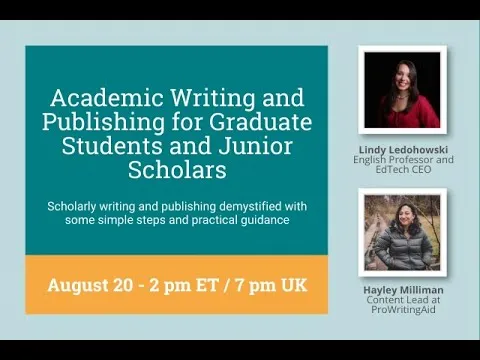
Academic Writing and Publishing for Graduate Students and Junior Scholars, with Lindy Ledohowski
Based on ProWritingAid's video on YouTube. If you like this content, support the original creators by watching, liking and subscribing to their content.
Academic publishing is peer-reviewed scholarship (journal articles, monographs, edited collections, and chapters), and it requires writing that fits disciplinary expectations.
Briefing
Academic publishing is framed as a knowledge-production pipeline: research becomes publishable only after it’s shaped into a peer-reviewed article or book and then placed in the right scholarly “home.” For graduate students and junior scholars, the practical challenge isn’t just writing—it’s learning the expectations that make an editor and anonymous reviewers confident the work fits their field and contributes something new.
The session starts by defining what counts as academic publishing: peer-reviewed journal articles, monographs from scholarly or university presses, edited collections, and chapters in scholarly collections. It distinguishes this from popular writing and from the broader reality that scholarship spans disciplines with different norms. Ledohowski groups fields into three broad buckets—sciences (including engineering), humanities, and social sciences—then stresses that each bucket contains smaller subfields with distinct methods and writing conventions. The goal remains consistent across disciplines: produce work that advances knowledge and helps society make decisions grounded in tested information rather than propaganda, emotion, or misinformation.
From there, the guidance shifts to a concrete writing plan. Citing the well-known handbook “Writing Your Journal Article in 12 Weeks,” the emphasis lands on scheduling: set goals and deadlines early so the “blank page” becomes a sequence of manageable tasks. A key tactic is to break the research paper into component parts and treat each section as a separate deliverable. That approach reduces disorientation for newcomers who feel like outsiders in an “insider” academic culture.
The paper’s structure is presented as a repeatable template. The introduction should specify the topic with increasing specificity (from broad bucket to narrow subtopic), provide background, and articulate the problem or thesis statement—the kernel of the author’s contribution. The methodology section explains how research is produced in that field, both to establish credibility and to set up what comes next. Results and/or context follow: quantitative work reports findings, while more exploratory or theoretical work may lay groundwork and engage with what other scholars have said. The discussion and analysis is identified as the most important section because it showcases novelty—discovering something new, clarifying an idea, filling a gap, offering an alternative approach, repeating or strengthening prior findings, raising questions about standard methods, addressing systemic bias or oversights, or making a controversial claim that reframes the debate. The conclusion then summarizes significance, qualifies limitations, and points to broader implications.
Once the draft exists, the session turns to publication logistics. Because many journals sit behind paywalls, Google Scholar is recommended as a starting point to identify where similar work is being published, including by searching titles and abstracts and then narrowing based on fit. If the idea isn’t fully written yet, reading recent articles in target journals helps reveal the typical style and structure those outlets expect.
The final portion covers submission realities: papers can be rejected, requested for revise-and-resubmit, or accepted with revisions. All outcomes are treated as part of the process, with revise-and-resubmit framed as a chance to incorporate peer-review feedback and improve the work.
A practical tool is introduced through Essay Jack, described as software that breaks writing into component parts with prompts and guidance. A coupon code is offered for a month of “freeze access,” and an upcoming integration with ProWritingAid is teased. In the Q&A, the advice extends to writing in English as a second language (prioritize structure, use editing tools, consider editors for copy-level fixes), managing citations (use reference managers like Zotero, Mendeley, EndNote, or EasyBib and keep a running quote record), handling overlap with existing scholarship (treat other researchers as collaborators in a conversation, cite properly, and differentiate the contribution), and avoiding self-plagiarism (revise published material and acknowledge prior publication). The throughline is consistent: success comes from planning, structuring, and positioning scholarship so it clearly belongs—and clearly adds something new.
Cornell Notes
Academic publishing is defined as peer-reviewed scholarship—journal articles, monographs, edited collections, and chapters—produced for specific disciplinary audiences. The session argues that graduate and junior scholars can write more effectively by planning and breaking papers into component sections: introduction (topic, background, problem/thesis), methodology (how research is done and why it matters), results/context (findings or theoretical groundwork), discussion/analysis (where novelty and contribution are proven), and conclusion (significance plus limitations). It also emphasizes choosing the right publication venue by using Google Scholar to map where similar work appears. Finally, it treats peer review as an iterative process (reject, revise-and-resubmit, or accept-with-revisions) and recommends tools like Essay Jack and ProWritingAid to support drafting, editing, and citation management.
What makes academic publishing different from other kinds of writing, and why does that matter for how someone should plan their draft?
How can a writer use the “component parts” approach to make the blank page manageable?
Why is the discussion and analysis section treated as the most important part of a scholarly paper?
How should someone choose a journal or press without full database access?
What should a writer do when they find an existing article that already says what they planned to say?
How can self-plagiarism be avoided when dissertation chapters draw on previously published work?
Review Questions
- Which paper section most directly demonstrates novelty, and what are several ways novelty can be shown?
- How does the recommended approach to choosing a publication venue use Google Scholar differently depending on whether the manuscript is finished or still an idea?
- What steps can reduce the risk of losing track of quotes and sources during research and drafting?
Key Points
- 1
Academic publishing is peer-reviewed scholarship (journal articles, monographs, edited collections, and chapters), and it requires writing that fits disciplinary expectations.
- 2
A writing plan with goals and deadlines turns the blank page into a sequence of manageable tasks.
- 3
Use a repeatable paper structure: introduction (topic/background/thesis), methodology (how research is done), results/context (findings or theoretical groundwork), discussion/analysis (novel contribution), and conclusion (significance plus limits).
- 4
The discussion and analysis section is where contribution must be made explicit—through gaps, clarifications, alternatives, bias corrections, or methodological challenges.
- 5
Google Scholar can be used to map where similar work is published and to judge journal fit even when paywalled databases are unavailable.
- 6
Peer review outcomes (reject, revise-and-resubmit, accept with revisions) should be treated as iterative steps toward a stronger manuscript.
- 7
When reusing previously published work in a thesis/dissertation, revise the text and acknowledge prior publication to avoid self-plagiarism concerns.