Accomplish Everything With Mini Habits
Based on Better Than Yesterday's video on YouTube. If you like this content, support the original creators by watching, liking and subscribing to their content.
Mini habits work by shrinking daily goals until they’re doable every day, even when time and energy are low.
Briefing
Mini habits are a productivity strategy built to beat the “too much, too soon” problem: when daily goals require more time or energy than a real day allows, people stop entirely. The core fix is to shrink each habit until it’s so easy that it can be done every single day—no matter how busy, tired, or unmotivated someone feels. That consistency matters because it prevents the guilt-and-dropoff cycle that often follows missed days.
A personal example frames the method. After deciding to meditate daily, the original plan—20 minutes every day—kept failing. Missed days led to self-reproach and attempts to “make up for it” with even longer sessions, which also didn’t stick. The breakthrough came from lowering the expectation from 20 minutes to 2 minutes. With a two-minute target, excuses lost their power: even on the busiest or most exhausted days, meditation became something that could still happen. Over time, the mini version sometimes expanded—people would start with two minutes and then continue longer, occasionally reaching the original 20-minute goal.
The same logic applies to other activities. Instead of treating piano practice, reading, meditation, and exercise as hour-long commitments, the approach uses mini versions: practice piano for about 3 minutes, read one page, meditate for 2 minutes, and exercise with a few push-ups. This can sound “unproductive” at first glance, but the point is not to maximize output in a single day. It’s to build habits that survive real life, then allow momentum to carry the practice forward when motivation appears.
A key mechanism is momentum. Newton’s first law is used as an analogy: objects already in motion tend to stay in motion, while objects at rest tend to stay at rest. Procrastination often means staying stuck at rest—starting a large task feels too daunting. Mini habits reduce the friction of beginning, making it easier to continue once the first step is done. Even if someone stops after the minimum effort, they’ve still moved from zero to something.
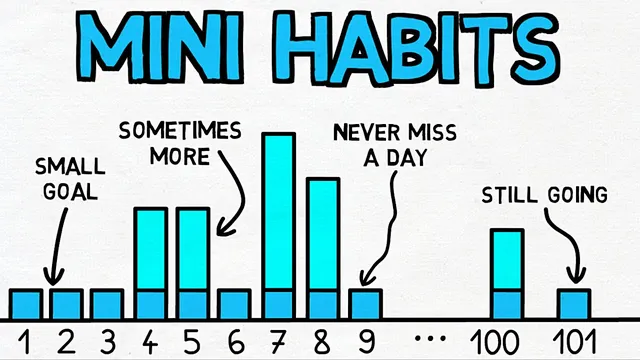
The transcript contrasts two patterns. Typical habits start with high expectations, run smoothly for a few days, then break after missed days accumulate. Mini habits flip the structure: set a goal so small it’s “super easy” to complete daily, accept that sometimes it will be only the minimum, and rely on frequency to keep the habit alive for months. The long-term payoff comes from never missing the habit, not from perfect daily intensity.
The takeaway is practical: identify a habit people keep postponing—studying, building a business, exercising, writing, meditating, cleaning—and set a minimum version so small it’s impossible to fail. Study for one minute, do one push-up, read one page. Motivation is expected to arrive after starting, not before.
Cornell Notes
Mini habits are deliberately tiny versions of desired routines designed to be completed every day without fail. When expectations are too high—like meditating for 20 minutes—missed days trigger guilt and attempts to “catch up,” which often leads to quitting. Reducing the target to something like 2 minutes removes excuses and makes starting easy; momentum then sometimes expands the mini session into longer practice. The method works across activities (piano, reading, exercise, cleaning) by trading intensity for high frequency, so the habit persists for months. Over time, consistency beats the all-or-nothing approach.
Why do high expectations often cause people to stop entirely?
How does shrinking a habit (e.g., meditation) change outcomes?
What does “mini” look like for the other activities mentioned?
Why is momentum central to the method?
How do mini habits differ from typical habit-building strategies?
What’s the practical rule for choosing a mini habit?
Review Questions
- Choose a habit you currently avoid. What would a “minimum effort” version of it look like in one minute or less?
- Explain the difference between “catching up” after a missed day and using a mini habit to prevent missed days.
- How does the momentum analogy (Newton’s first law) support the idea that starting small can lead to longer sessions?
Key Points
- 1
Mini habits work by shrinking daily goals until they’re doable every day, even when time and energy are low.
- 2
High expectations can create an all-or-nothing cycle: missed days lead to guilt and often bigger attempts that still fail.
- 3
A mini habit should be so small that excuses lose their power (e.g., meditation reduced from 20 minutes to 2 minutes).
- 4
Mini habits often expand after the start—people may do more once they’ve begun, even if the plan was minimal.
- 5
Momentum matters: starting a task for a few minutes makes it easier to continue than trying to begin a full session.
- 6
Consistency beats intensity in the long run: committing minimum effort with high frequency keeps habits alive for months.
- 7
To apply the method, pick a procrastinated habit and set a minimum version you can’t fail (study 1 minute, do 1 push-up, read 1 page).