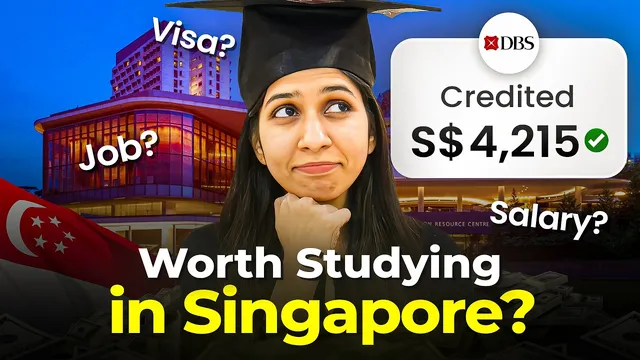
Actual Salary of NUS & NTU Graduates REVEALED! Jobs, Visa, ROI in Singapore
Based on WiseUp Communications's video on YouTube. If you like this content, support the original creators by watching, liking and subscribing to their content.
Engineering undergraduates at NUS/NTU are reported to have an 80%–90% chance of securing full-time roles, with average monthly salary packages around S$4,000–S$4,500.
Briefing
Singapore’s graduate employment outcomes and pay ranges suggest that a strong NUS/NTU profile can translate quickly into full-time work—especially in engineering and computer-science tracks—while the return on investment depends heavily on whether the degree is undergraduate, master’s, or PhD.
A 2023 graduate employment survey by Singapore’s Ministry of Education reported that for NUS and NTU undergraduates in engineering, roughly 80% to 90% of students secured full-time jobs. The average monthly salary package landed around S$4,000 to S$4,500. Business programs showed a similar employment rate and comparable pay bands. Computer science–oriented degrees—computer science, engineering, data science, and artificial intelligence—tracked slightly higher employment and higher compensation, with average monthly salary packages in the S$5,000 to S$5,500 range.
For master’s programs, the pay picture is framed as an incremental step rather than a leap. Since Singapore master’s study typically lasts only one to two years, the salary bump is described as roughly S$500 to S$1,000 above undergraduate levels, depending on prior experience. That puts MS salary ranges at about S$4,500 to S$5,500 per month. Computer-science-related MS programs are higher still, estimated at S$5,500 to S$6,500 per month.
PhD compensation is treated differently because it depends on what comes after the doctorate. In academia—such as scientist or postdoc roles—starting pay is estimated at S$5,000 to S$6,000 per month. Industry roles are expected to start higher, around S$6,000 to S$7,000 per month. The figures are presented as starting points, with the expectation that earnings rise with time, field, available funding, and job level.
Work authorization is described as a two-tier system tied to salary. After an offer letter, employers typically sponsor visas under either the S Pass or the Employment Pass (E Pass). The dividing line is stated as S$5,000 per month: salaries above that generally align with an E Pass, while lower salaries fall under the S Pass. Both are described as having about two-year validity, with renewals possible if the employee remains with the same company. If someone leaves, the work visa expires, so the recommended strategy is to secure a new offer before exiting.
Finally, the transcript quantifies how long it takes to recoup education costs. Undergraduate study is estimated at about S$200,000 total for four years (tuition plus living), or roughly S$120,000 under a service obligation scheme. With undergraduate starting salaries around S$50,000 per year, the payback window is estimated at about four to five years (or sometimes 3 to 4, depending on living expenses and salary growth). MS programs cost far less—about S$50,000 to S$60,000 for one to two years—so repayment is estimated at roughly one to two years. PhDs are framed as the strongest ROI because they are described as tuition-free with a stipend covering living expenses, sometimes even leaving room for savings; after the PhD, income is characterized as debt-free earnings.
Cornell Notes
NUS/NTU undergraduates in engineering and business show high job placement (about 80–90% landing full-time roles) with average monthly salary packages around S$4,000–S$4,500. Computer science–adjacent tracks (computer science, data science, AI, etc.) trend higher, with average monthly packages around S$5,000–S$5,500. Master’s pay is presented as a modest step up: MS typically adds about S$500–S$1,000 over undergraduate pay, with computer-science MS estimated at S$5,500–S$6,500 per month. Work visas are tied to salary via S Pass vs Employment Pass, both described as about two-year validity with renewals. ROI is fastest for MS (about 1–2 years to recoup costs) and strongest for PhD, described as tuition-free with a stipend.
What employment and salary ranges are reported for NUS/NTU undergraduates in engineering, business, and computer-science-related programs?
How does the estimated salary outlook change from undergraduate to MS in Singapore?
How are PhD salary expectations framed, and why do they vary?
What determines whether a foreign worker gets an S Pass or an Employment Pass in Singapore, and how long do these visas last?
What happens to work authorization when someone leaves a job, and what strategy is recommended?
How long does it take to recoup education costs in Singapore for undergrad, MS, and PhD based on the transcript’s estimates?
Review Questions
- Which program category is estimated to have the highest average monthly salary packages, and what range is given?
- How does the transcript’s estimated ROI timeline differ between undergraduate and MS programs?
- What salary threshold is cited for choosing between S Pass and Employment Pass, and what happens to the visa when a job ends?
Key Points
- 1
Engineering undergraduates at NUS/NTU are reported to have an 80%–90% chance of securing full-time roles, with average monthly salary packages around S$4,000–S$4,500.
- 2
Computer science–related tracks are estimated to command higher pay, with average monthly salary packages around S$5,000–S$5,500 and slightly higher employment ratios.
- 3
MS salaries are framed as a modest increase over undergraduate pay—about S$500–S$1,000—while computer-science MS is estimated at S$5,500–S$6,500 per month.
- 4
Work visas in Singapore are described as S Pass vs Employment Pass, with S$5,000/month used as the cited dividing line and both typically valid for about two years.
- 5
Visa renewals depend on staying with the same employer; leaving a company causes the work visa to expire, so securing a new offer letter before exit is critical.
- 6
Undergraduate ROI is estimated at roughly 3–5 years to recoup total costs (S$200,000 or about S$120,000 with service obligation), while MS ROI is estimated at about 1–2 years.
- 7
PhD ROI is presented as strongest because tuition is described as covered and a stipend supports living expenses, leading to debt-free earnings after graduation.