Advanced Planning in Tana
Based on CortexFutura Tools's video on YouTube. If you like this content, support the original creators by watching, liking and subscribing to their content.
Use half-year “super cycles” split into six-week “macro cycles” (with slack) to balance stability and flexibility in planning.
Briefing
Planning in Tana is framed as a way to manage uncertainty by using longer horizons—half-year “super cycles” broken into six-week “macro cycles”—and then wiring those time blocks into a connected tag system. The core idea is that four weeks is often too short for most meaningful projects, while a year is too long to plan in detail. A half-year strikes a balance: it’s long enough to absorb change, yet structured enough to keep priorities and execution aligned.
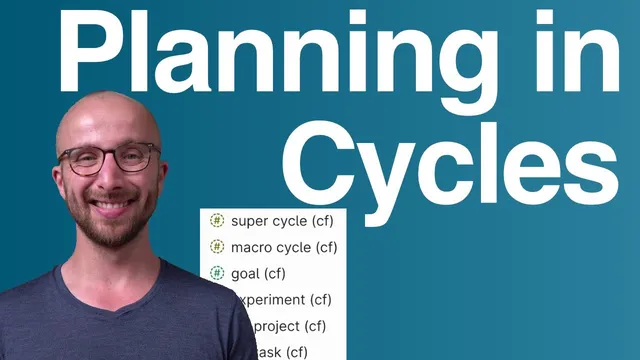
Inside Tana, the system is built around “super tags” that interlock across four layers: super cycles, macro cycles, goals/experiments, and then projects/tasks. A super cycle spans roughly six months and contains multiple macro cycles (six-week blocks) plus slack time so disruptions like sickness or vacation still fit the framework. Each super cycle note holds an overall mission statement and a live query that surfaces the macro cycles already defined for that period.
Macro cycles function as the operational bridge between strategy and execution. Each macro cycle has its own start/end dates and includes goals and experiments. Goals represent what must be achieved during that six-week window—for example, “publish one YouTube video per week” or “publish one Twitter thread per day.” Experiments sit alongside goals and are designed to be testable within the same time horizon. An experiment includes an experimental status (planning, running, concluded), plus fields for hypothesis, interventions, and results—explicitly positioned as “n equals one” testing rather than formal scientific rigor.
Projects connect goals to deliverables. A project is linked to a specific goal and carries a status (such as backlog, in progress, done, dropped) and a “final form” description that clarifies what completion should look like. Tasks then link to projects and inherit the project’s structure. Tasks include status (to do, in progress, done, dropped, archived), due dates, and plan-for dates so work can be scheduled on a day even if it isn’t technically due yet. A checkbox mapping ties the task’s status to whether it counts as “done,” and clicking the checkbox jumps directly to the appropriate status.
The system’s real power comes from live queries and semantic “part of” relationships. On a daily note, a query filters to only the super cycle or macro cycle whose date range overlaps the current day, then expands to show the active goals. Another query can retrieve all projects that “serve” the current super cycle recursively—even when there’s no direct link from a project to the super cycle—because the chain of “part of” relationships runs through goal → macro cycle → super cycle. The same logic extends to tasks, enabling grouping of currently active tasks by project within the active macro cycle.
Overall, the planning method turns time horizons into navigable structure: half-year mission, six-week execution blocks, and a linked hierarchy that keeps daily work focused on what’s currently active and what’s connected to the next measurable outcomes.
Cornell Notes
The planning system uses half-year “super cycles” split into six-week “macro cycles,” because four weeks is often too short and a year is too long to plan in detail. In Tana, super tags connect time blocks to execution: macro cycles contain goals and experiments; goals link to projects; projects link to tasks. Experiments include hypothesis, interventions, and results, with an experimental status to track whether they’re planning, running, or concluded. Live queries on daily notes filter to the super cycle/macro cycle overlapping today and then surface the active goals, projects, and tasks—using semantic “part of” relationships to find items recursively even without direct links.
Why does the system prefer half-year planning over month-by-month or year-long planning?
What are the four main layers of super tags, and how do they connect?
How does the system structure experiments inside a six-week macro cycle?
How does the daily note show only what’s currently active?
What makes the recursive search possible even without direct links?
How do task status and the checkbox mapping work together?
Review Questions
- If a macro cycle runs from a start date to an end date, what date-overlap logic would ensure it appears on the daily note only during its active window?
- Describe how a task can be found as part of the current super cycle even when there is no direct link from the task to the super cycle.
- What fields would you include to make an experiment trackable from planning through completion within a six-week macro cycle?
Key Points
- 1
Use half-year “super cycles” split into six-week “macro cycles” (with slack) to balance stability and flexibility in planning.
- 2
Build a connected super tag hierarchy: super cycle → macro cycle → goal/experiment → project → task.
- 3
Represent goals as concrete deliverables tied to macro cycles, such as weekly video output or daily thread output.
- 4
Track experiments with an experimental status (planning/running/concluded) plus hypothesis, interventions, and results.
- 5
Use task fields like due date and plan-for date to schedule work on the right day even before it becomes due.
- 6
Configure daily-note live queries to show only the super cycle/macro cycle overlapping today using start/end date overlap rules.
- 7
Leverage semantic “part of” relationships so recursive queries can surface projects and tasks tied to the current time horizon without direct links.