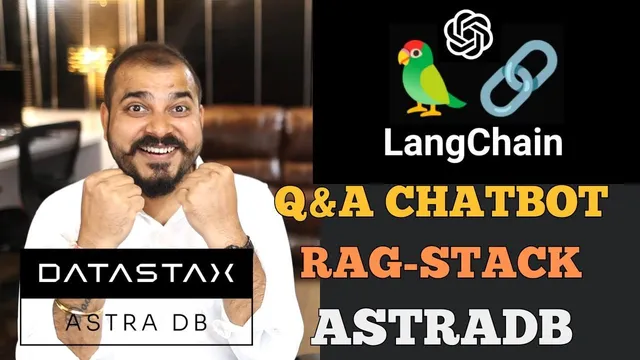
Advanced Q&A Chatbot Using Ragstack With vector-enabled Astra DB Serverless database And Huggingface
Based on Krish Naik's video on YouTube. If you like this content, support the original creators by watching, liking and subscribing to their content.
Create an Astra DB Serverless Vector database and capture the database ID plus an application token for authenticated access.
Briefing
A practical RAG (retrieval-augmented generation) chatbot setup ties together Ragstack, a vector-enabled Astra DB Serverless database, and Hugging Face/OpenAI embeddings to answer questions from a CSV-style dataset—while preserving author and tag metadata for more targeted responses. The core workflow is: convert each row’s quote into an embedded document, store those vectors in Astra DB, then retrieve the most relevant chunks at question time and feed them into an LLM with a prompt that instructs it to answer only from retrieved context (or say “don’t know”). This matters because it turns a simple dataset of quotes, authors, and tags into a queryable knowledge base with fast semantic search and controllable, metadata-aware outputs.
The build starts in DataStax Astra DB, where a serverless vector database is created and then configured with two critical credentials: the database ID (used to target the correct vector store) and an application token (used for authenticated access). The setup also requires an OpenAI API key for embeddings. After the Astra DB connection details are placed into environment variables, Ragstack AI is installed to provide the RAG building blocks—vector store integration, embedding pipelines, and retrieval utilities—so the pipeline can be assembled with minimal boilerplate.
Next comes the embedding and indexing step. The dataset is pulled from Hugging Face using the `datasets` library (the transcript references a philosopher quotes dataset with fields like `author`, `quote`, and `tags`). A Hugging Face token (HF token) is required to download the dataset. For each record, the quote becomes the document content, while `author` and parsed `tags` are attached as metadata. The transcript shows tags being split and stored so the retriever can later surface documents matching specific thematic labels (for example, tags such as “knowledge” or “truth”).
Those documents are then embedded using OpenAI embeddings and inserted into the Astra DB vector store under a chosen collection name (the transcript uses `test`). The indexing step results in hundreds of stored vectors (the transcript mentions 450 records) and can be verified by querying the collection and inspecting vector entries. Similarity search uses cosine similarity.
For the Q&A layer, the vector store is converted into a retriever interface that returns the top-k relevant documents (set to 3 in the transcript). A chat prompt template instructs the model to answer based on the supplied context and to respond with “don’t know” if the answer is missing from retrieved evidence. The chain is assembled using LangChain components (prompt template, chat model, and an output parser) and executed with `chain.invoke`.
Example questions demonstrate that the system can pull tag-linked information from the dataset—such as identifying philosophers’ concerns with knowledge and truth—and it can also respond to more open prompts while returning relevant tags. Finally, the workflow includes cleanup: deleting the Astra DB collection to remove the stored vectors and metadata.
Cornell Notes
The project builds a metadata-aware RAG chatbot by embedding a Hugging Face dataset of philosopher quotes into a vector-enabled Astra DB Serverless collection. Each dataset row becomes a LangChain document: the quote is stored as page content, while author and parsed tags are stored as metadata. OpenAI embeddings convert those documents into vectors that are inserted into Astra DB (collection name `test`), where cosine similarity powers retrieval. At question time, the Astra DB vector store is wrapped as a retriever that returns the top 3 relevant documents, which are then fed into a chat prompt template and an LLM to generate answers grounded in retrieved context (or “don’t know”). This approach turns a CSV-like dataset into a fast, queryable knowledge base with controllable evidence sourcing.
What credentials and endpoints are required to connect Astra DB Serverless Vector to the RAG pipeline?
How does the pipeline transform dataset rows into retrievable knowledge?
What role do embeddings play, and where do the resulting vectors live?
How does retrieval work during Q&A?
What prevents the model from answering without evidence from the dataset?
Why are Hugging Face and OpenAI tokens both needed in this workflow?
Review Questions
- How are author and tags represented so they can influence retrieval results later?
- What is the sequence of steps from dataset download to vector insertion to question answering?
- Where does the system enforce “answer only from context,” and how is the retriever configured (e.g., top-k)?
Key Points
- 1
Create an Astra DB Serverless Vector database and capture the database ID plus an application token for authenticated access.
- 2
Install Ragstack AI to streamline RAG components like vector store integration, embedding pipelines, and retrieval.
- 3
Download the dataset from Hugging Face using a Hugging Face token, then convert each row into a document with quote content and metadata (author, tags).
- 4
Embed documents with OpenAI embeddings and insert the resulting vectors into Astra DB under a chosen collection name (the transcript uses `test`).
- 5
Use cosine similarity in Astra DB for semantic retrieval and verify indexing by inspecting stored vector entries.
- 6
Wrap the Astra DB vector store as a retriever (top-k set to 3) and feed retrieved context into a chat prompt template that requires evidence or “don’t know.”
- 7
Clean up by deleting the Astra DB collection when finished to remove stored vectors and metadata.