After 27 years, I finally beat productivity! (Simplest ADHD System)
Based on Ali Alqaraghuli, PhD's video on YouTube. If you like this content, support the original creators by watching, liking and subscribing to their content.
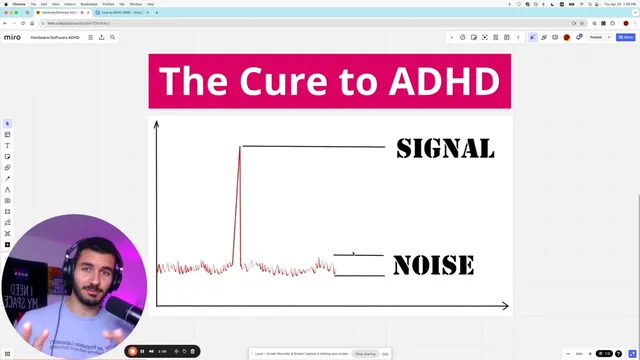
Treat productivity and ADHD management as a signal-to-noise problem: increase signal actions and reduce noise distractions.
Briefing
Productivity—and ADHD management—boils down to a simple signal-to-noise tradeoff: increase the “signal” that moves someone toward a goal, and reduce the “noise” that distracts from it. The practical payoff is that people don’t need elaborate productivity stacks or template libraries; they need a clear, daily view of what actions count as progress and what behaviors pull attention away.
The framework starts with defining a concrete goal. Using a personal example, the systems engineer and NASA Jet Propulsion Laboratory post-doctoral fellow frames a business target: grow “Next Level systems” to 10 users per day. From there, “signal” becomes the specific activities most likely to drive that outcome—obsessively making paid ads work, optimizing the product, meeting with the team to ensure clients are happy and the system improves, and coordinating with the software team to keep innovation moving. “Noise,” by contrast, is anything that consumes attention without advancing the goal: late-night Instagram scrolling, arguing on Facebook, having too many browser tabs open, turning on too many notifications, and getting pulled into toxic relationships—patterns the speaker links to ADHD traits like curiosity-driven distraction and dopamine-related vulnerability.
To make the distinction stick, the method emphasizes writing the signal and noise lists down and attaching them to daily life. The goal is not just insight but accountability: placing the page somewhere visible turns abstract intentions into immediate self-checks. When someone reaches for Instagram or starts a Facebook argument, the reminder forces an honest comparison—this behavior is noise, and it’s competing with the signal actions that align with the life they want. The approach is especially aimed at people higher on the ADHD spectrum, where memory and motivation for long-term goals can be weaker; a visible prompt helps compensate for forgetting why the goal matters.
The speaker also adds a “why” layer to strengthen motivation. Beyond the surface goal, the exercise asks why the goal matters—helping more people live better lives, feeling better through using knowledge, earning side income to hire talent or travel—so the signal actions connect to emotion and meaning. The final step is acknowledging that awareness alone isn’t enough: once noise is identified and reduced, execution still requires a system for sitting down and doing the signal work. The transcript ends by pointing to a separate resource for that execution system, but the core message remains consistent: productivity improves when attention is managed like a communications problem—boost the useful signal, cut the interference, and keep the plan in front of you.
Cornell Notes
Productivity and ADHD management are framed as a signal-to-noise problem. First, define a specific goal (for example, growing a business to a target number of users per day). Then list “signal” actions that directly increase the odds of reaching the goal (like improving the product and running paid ads) and “noise” behaviors that steal attention without moving progress (like late-night social scrolling, online arguments, too many notifications, and toxic interactions). To make the distinction actionable—especially for people who struggle with remembering long-term goals—the lists should be written and kept in view daily. The method also stresses adding a “why” behind the goal to strengthen motivation, and then using an execution system to actually carry out the signal work.
How does the signal-to-noise framework translate into everyday productivity decisions?
What does the exercise require before labeling anything as signal or noise?
Why does keeping the signal/noise list visible matter for ADHD?
What are concrete examples of signal and noise in the transcript’s business scenario?
How does the transcript strengthen motivation beyond goal-setting?
Review Questions
- What specific steps would you take to create your own signal and noise lists for one goal this week?
- How would you design a daily reminder system so the signal/noise distinction stays visible when distractions hit?
- After identifying noise, what additional capability does the transcript say is still required to execute signal work?
Key Points
- 1
Treat productivity and ADHD management as a signal-to-noise problem: increase signal actions and reduce noise distractions.
- 2
Start by defining a concrete goal, then label behaviors as signal (goal-advancing) or noise (goal-derailing).
- 3
Write the signal/noise lists down and keep them in a highly visible place to create daily accountability.
- 4
Add a “why” behind the goal to make signal actions emotionally motivating, not just logically correct.
- 5
Use the framework to counter ADHD-specific tendencies like forgetting long-term goals and chasing instant gratification.
- 6
Recognize that awareness and noise reduction are only part of the solution; execution still needs a practical system for sitting down and doing the signal work.