AI Artist is Becoming a VIABLE Career Path!
Based on MattVidPro's video on YouTube. If you like this content, support the original creators by watching, liking and subscribing to their content.
Fiverr’s AI services marketplace is positioned as a practical entry point for earning money from AI video creation.
Briefing
AI video freelancing is emerging as a practical career path, and a custom Fiverr job shows how quickly “AI artist” work can move from hobby to paid, portfolio-ready production. The core takeaway is that buyers aren’t just paying for prompts—they’re paying for end-to-end creative execution: consistent characters, coherent scenes, natural voice, and the technical stitching needed to turn image generation into a finished motion piece.
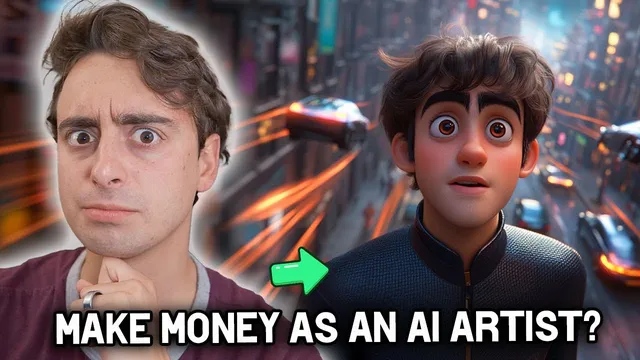
To test that, MattVidPro used Fiverr’s AI services marketplace to commission an AI creator, Jonas Ai, specifically because the listing claimed use of cutting-edge tools for AI movies. The resulting short scene set in a neon, VR-like future city features a consistent central character (the commissioner himself) moving through a fully stylized metropolis. The character consistency was achieved through Midjourney character reference: photos were used to get close to an accurate likeness, then the creator pushed it further into a Pixar-style cartoon look—an artistic choice that also helped solve a key limitation. When the same character was tested in a more realistic style, the AI struggled to keep the depiction stable across scenarios; the more stylized “cartoon” approach fit the generator’s strengths better.
Voice work also played a major role in making the piece feel complete. The creator selected a text-to-speech voice that sounded natural and matched the tone of the futuristic narration, using 11 Labs for the voiceover. The project relied on multiple image-to-video and motion tools, with the creator reporting 20 hours of work to produce the final result.
The production wasn’t flawless. Glitches and imperfect motion appeared in some transitions and walking sequences—typical issues for current image-to-video systems. Still, the imperfections were treated as part of the workflow: the creator used prompts designed to reduce errors, generated clips in segments, and then stitched them together into a coherent final timeline.
Beyond the finished clip, the broader career argument is straightforward: AI lowers the cost and time barrier for creative output, but it doesn’t remove the need for talent, creativity, and technical know-how. The commissioner emphasizes that meaningful work gets harder as requirements become more specific—especially when consistency, character replication, and multi-tool pipelines are involved.
Fiverr is positioned as a gateway for enthusiasts to earn early income, with an AI services tab and a growing ecosystem of freelancers. The transcript also contrasts Jonas Ai’s more affordable pricing with higher-end sellers like the Door Brothers, who charge thousands per video and have reached mainstream visibility (including work with Snoop Dogg). The message: professional-grade results are possible on today’s tools, but the market rewards people who can combine the right software, manage limitations, and deliver a polished product—not just generate a single image.
Cornell Notes
AI video freelancing is presented as a viable career path, with a Fiverr commission used to demonstrate what paid, end-to-end production looks like. Jonas Ai was hired to create a futuristic VR-style city scene featuring a consistent character likeness, achieved through Midjourney character reference and then stylized into a Pixar-like cartoon to improve stability. The project also used 11 Labs for natural-sounding voiceover and relied on a multi-tool pipeline (including image generation, image-to-video, and motion tools) with about 20 hours of work. Despite glitches and imperfect motion typical of current image-to-video systems, the work shows how stitching, prompting, and creative direction turn AI outputs into coherent deliverables. The takeaway: AI makes creation cheaper and faster, but talent and technical skill still determine quality.
What made the character look consistent across multiple scenes, and why did the style choice matter?
How did the project turn generated images into a finished video instead of a set of separate clips?
Which tools were named for different parts of the pipeline, and what roles did they play?
What limitations showed up in the final AI video, and how were they handled?
Why does the transcript treat Fiverr as a career on-ramp rather than just a place to buy one-off outputs?
How does the pricing and success gap between Jonas Ai and the Door Brothers support the career claim?
Review Questions
- What specific technique was used to keep the character recognizable across scenes, and what stylization change improved stability?
- Which named tools were used for voiceover versus image generation versus video/motion, and how did the workflow require stitching multiple outputs?
- What kinds of errors still appear in current AI image-to-video results, and what does that imply about the skills needed to deliver polished work?
Key Points
- 1
Fiverr’s AI services marketplace is positioned as a practical entry point for earning money from AI video creation.
- 2
Character consistency can be engineered using Midjourney character reference, but stylization may be necessary to reduce instability in motion.
- 3
Natural-sounding narration is a major quality lever; 11 Labs was used for the voiceover.
- 4
Current image-to-video tools still produce glitches and imperfect motion, so prompting and editing are essential.
- 5
High-quality results come from multi-tool pipelines and time-intensive iteration, not from a single generation step.
- 6
AI lowers the barrier to making creative work, but talent, creativity, and technical know-how still determine whether output looks professional.
- 7
Premium pricing in the market (e.g., the Door Brothers) suggests buyers value reliability and end-to-end production, not just raw generation.