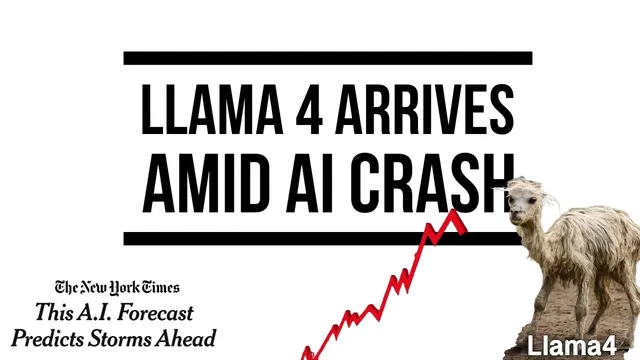
AI CEO: ‘Stock Crash Could Stop AI Progress’, Llama 4 Anti-climax + ‘Superintelligence in 2027’ ...
Based on AI Explained's video on YouTube. If you like this content, support the original creators by watching, liking and subscribing to their content.
A stock-market crash could slow AI progress by reducing investor confidence, lowering valuations, and shrinking compute budgets for frontier training runs.
Briefing
AI progress could be derailed less by technical limits than by real-world shocks to funding and compute—especially if a stock-market crash undermines investor confidence in companies building frontier models. Anthropic CEO Dario Amodei previously flagged risks like war in Taiwan and a potential “data wall,” but a newer concern centers on capitalization: major labs need continuous fundraising to pay for massive training runs and data-center compute. If investors pull back due to recession or geopolitical disruption, valuations fall, less money flows in, compute budgets shrink, and AI development slows—creating a self-fulfilling loop where financial stress becomes technical constraint.
Against that backdrop, the release of Meta’s Llama 4 family is portrayed as a mixed bag rather than a clean leap forward. The smallest model claims an “industry-leading” 10 million token context window, but the transcript stresses that context length alone doesn’t guarantee real-world usefulness. A key comparison is FictionBench for long-context comprehension, where Llama 4’s medium and small variants perform poorly and degrade as context length grows—contrasting with stronger results from Gemini 2.5 Pro. Even the release timing raises eyebrows: Llama 4 reportedly launched on a Saturday, with a knowledge cutoff of August 2024, while Gemini 2.5 Pro’s cutoff is January 2025—suggesting Meta may have been racing to catch up after competing model releases.
The most favorable read is reserved for Llama 4 Maverick, the medium-sized model. It’s described as comparable to DeepSeek V3 despite having about half the active parameters, and it performs well on certain hard benchmarks like GPQA Diamond. Yet the transcript also highlights a sharp drop outside its comfort zone: in coding-focused evaluations (including ADA’s Polyglot benchmark), Llama 4 Maverick scores far below Gemini 2.5 Pro and even below non-thinking models like Claude 3.7 Sonnet. That mismatch complicates hype about rapid automation of skilled work, including claims attributed to Mark Zuckerberg that AI could replace mid-level engineers soon.
Additional scrutiny targets how Meta frames comparisons for its unreleased “Behemoth” model, including footnotes implying internal best-of runs and selective benchmark choices. There are also practical and policy concerns: terms of use reportedly restrict EU users’ ability to build on the model, and Meta positions Llama 4 as addressing political bias. Still, the transcript concludes Meta remains competitive at the “base model” layer—an important foundation for future reasoning systems.
The second major thread challenges a widely circulated prediction of “superintelligence in 2027” from a former OpenAI researcher and superforecasters. The core premise is that AI will become a superhuman coder, then a machine-learning researcher, accelerating progress. The transcript pushes back on the timeline by arguing that benchmarks may not show consistent exponential gains, that real-world constraints (proprietary code, access permissions, simulation-to-reality gaps) complicate autonomous self-improvement, and that the scenario requires near-flawless execution of high-risk cyber actions. The critic’s own counter-prediction: reliable, fully autonomous hacking-and-replication at scale won’t be possible until at least 2030.
Overall, the transcript lands on a more cautious view: AI capabilities may advance quickly, but the biggest uncertainties are funding shocks, compute constraints, and whether real-world autonomy can outperform messy, benchmark-driven expectations—meaning timelines could stretch from “years” to “decades,” even if the long-term trajectory remains dramatic.
Cornell Notes
The transcript argues that AI’s pace depends heavily on real-world constraints—especially funding and compute—so a stock-market crash could slow progress even if models improve. It then evaluates Meta’s Llama 4 family as uneven: a claimed 10M-token context window doesn’t translate into strong long-context comprehension results, while Llama 4 Maverick shows solid benchmark performance but drops sharply on coding tasks. A separate section challenges predictions of “superintelligence in 2027,” saying the scenario over-relies on weight theft and assumes autonomous agents can reliably execute complex, high-risk plans that benchmarks may not capture. The takeaway is that timelines are likely less certain and possibly longer than hype suggests, because autonomy and scaling face messy real-world bottlenecks.
Why does a stock-market crash matter for AI progress, according to the transcript?
What’s the key critique of Llama 4’s “10 million token” context window claim?
Where does Llama 4 Maverick look strongest, and where does it struggle?
What concerns does the transcript raise about Meta’s comparisons for Llama 4 Behemoth?
Why does the transcript doubt “superintelligence in 2027” predictions?
What counter-prediction does the transcript offer against autonomous hacking-and-replication by 2027?
Review Questions
- Which real-world bottleneck—funding, data availability, compute, or autonomy—does the transcript treat as most likely to slow AI progress, and why?
- How do the transcript’s long-context benchmark results challenge the practical value of Llama 4’s 10 million token context window?
- What specific assumptions in the “superintelligence in 2027” scenario does the transcript say are most vulnerable to failure?
Key Points
- 1
A stock-market crash could slow AI progress by reducing investor confidence, lowering valuations, and shrinking compute budgets for frontier training runs.
- 2
Llama 4’s 10 million token context window is not automatically a breakthrough if long-context comprehension benchmarks show weak performance as context length grows.
- 3
Llama 4 Maverick looks competitive on some hard knowledge benchmarks but performs dramatically worse on coding benchmarks like ADA’s Polyglot.
- 4
Selective benchmarking and internal “best run” framing can make model comparisons harder to interpret, especially for unreleased systems like Llama 4 Behemoth.
- 5
EU restrictions in Llama 4 terms of use may limit downstream users’ ability to build on the model even if end users can still use it.
- 6
Predictions of “superintelligence in 2027” are challenged on realism grounds: autonomy requires permissions, access, and reliable execution that benchmarks may not reflect.
- 7
The transcript argues that real-world messiness—proprietary data, simulation gaps, and operational constraints—likely stretches timelines from “years” to “decades.”