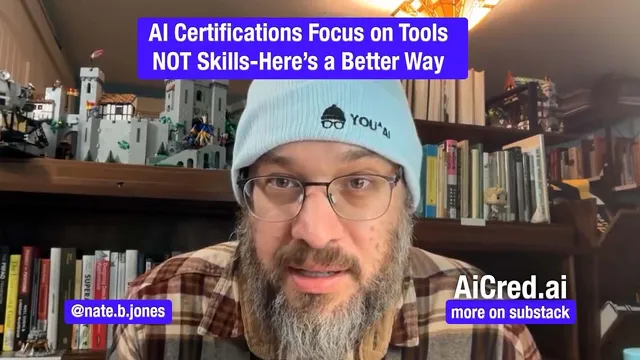
AI Certifications Focus on Tools NOT Skills—Here's a Better Way
Based on AI News & Strategy Daily | Nate B Jones's video on YouTube. If you like this content, support the original creators by watching, liking and subscribing to their content.
AI fluency is multi-dimensional; tool certification alone doesn’t indicate transferable competence across models.
Briefing
AI certifications often reward tool familiarity instead of real AI fluency, and that mismatch matters because today’s work depends on adapting across a fast-changing, multi-model landscape. With new models arriving frequently, “knowing the tool” no longer translates into “knowing how to use AI well.” The core message is that AI competence is multi-dimensional: people need a broader set of skills that sit above any single platform, so they can evaluate outputs, integrate AI into workflows, and make ethical product decisions as models evolve.
Rather than treating AI as one competency, the framework breaks it into five foundational skills that apply across job families. First is AI strategy—using AI as a team member requires knowing where it fits in product and workflow decisions, not just for executives but for anyone deploying AI in engineering, video, product, or other functions. Second is prompting as an evolving practice: effective prompting changes depending on the model and the task format (for example, prompting for a deck versus a doc), so the skill is tool-agnostic. Third is workflow integration, emphasizing that AI becomes “useful” only when it’s embedded into how work actually runs rather than bolted on. Fourth is critical evaluation—judging quality and taste across outputs, including narrative generation and business documents, with confidence rather than blind acceptance. Fifth is ethics, reframed as product design and trust-building: guardrails, security policies, and user trust are treated as part of building systems that resist misuse and remain reliable under model changes.
A key claim follows: most AI-fluent users over-index on one or two areas and neglect the rest, which distorts how they reason through ambiguity. That’s why a measurement approach matters. The transcript introduces AI Cred, a self-assessment tool built to score across the full multi-dimensional set—strategy, prompting, integration, critical evaluation, and ethics—so learners can identify specific gaps instead of following one-size-fits-all training. The assessment includes a leaderboard and sectional breakdown, and it’s designed to be retaken as skills improve. The tool also generates a personalized training plan with hands-on exercises, quizzes, and progress checks, then regenerates new modules after reassessment—aiming to move AI fluency from “a paper badge” into repeatable practice.
In the second half, the builder, Jonathan, describes how the product emerged from a shared belief that fluency matters regardless of which model people use. The dashboard scores users in six sections (including technical fundamentals and practical application), provides competitive context against peers, and then produces free, tailored modules based on the user’s results. The build story also highlights practical engineering choices: using multiple AI tools for different tasks (for example, using Codex for code review and Claude for execution), iterating with prototypes, and planning ongoing updates through community feedback. The result is an assessment-and-learning loop intended to keep pace with the evolving AI tool ecosystem—so people can adapt their skills as models change, not just learn one interface.
Cornell Notes
The transcript argues that AI certifications often measure tool usage rather than true AI fluency, which is increasingly necessary in a multi-model world where new models appear constantly. It proposes five foundational, tool-agnostic skill areas: AI strategy, prompting as an evolving practice, integrating AI into workflows, critical evaluation of outputs, and ethics reframed as trust-building product design. Because people typically strengthen only one or two pillars, a single score or a tool-only credential can misrepresent capability. AI Cred is introduced as a multi-section assessment and retakeable training system that scores across these dimensions, provides a leaderboard and gap-based recommendations, and generates free, hands-on modules that evolve after progress checks.
Why does tool certification fall short of “AI competency” in today’s model landscape?
What are the five foundational AI skills that apply regardless of job family?
How does the transcript define “prompting” as a skill above the tool?
What does critical evaluation look like in practice?
Why is ethics framed as product design and trust-building?
How does AI Cred turn these ideas into an assessment and learning loop?
Review Questions
- Which of the five foundational skills would be hardest for you to practice consistently, and why?
- How would you redesign a workflow so AI is “integrated” rather than used as a separate step?
- What signals would you use to decide whether an AI-generated output is trustworthy enough to act on?
Key Points
- 1
AI fluency is multi-dimensional; tool certification alone doesn’t indicate transferable competence across models.
- 2
AI strategy is a team-level skill because AI changes how products and workflows should be deployed.
- 3
Prompting should be treated as an evolving practice that adapts to model differences and output formats.
- 4
AI becomes valuable when it’s integrated into workflows (“AI-native”), not when it sits off to the side.
- 5
Critical evaluation requires taste and judgment—comparing outputs and selecting quality, not accepting the first response.
- 6
Ethics is best understood as product design for trust, including guardrails and security policies that anticipate model capability shifts.
- 7
AI Cred is positioned as a retakeable, gap-based assessment and training system that measures multiple skill pillars and generates customized learning modules.