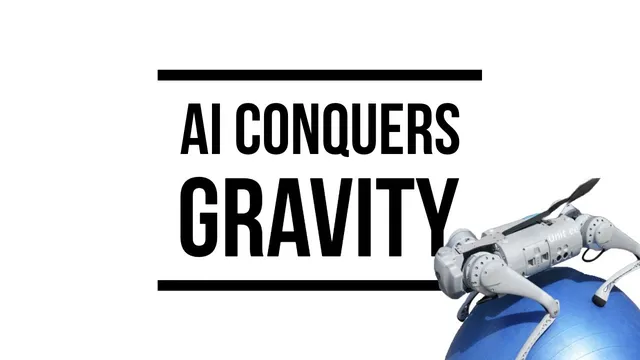
AI Conquers Gravity: Robo-dog, Trained by GPT-4, Stays Balanced on Rolling, Deflating Yoga Ball
Based on AI Explained's video on YouTube. If you like this content, support the original creators by watching, liking and subscribing to their content.
Dr. Eureka trains a quadruped policy in simulation and transfers it to real hardware without human demonstrations or fine-tuning.
Briefing
A new “Dr. Eureka” approach uses GPT-4 to generate and refine robot reward functions in simulation, then transfers the resulting control policy to a real quadruped without human demonstrations or fine-tuning—while staying within realistic physics ranges. The payoff is practical: the method improves real-world locomotion and manipulation performance, and it handles both entirely new tasks and unfamiliar situations inside known tasks. The core idea matters because it targets a bottleneck in robotics training: designing reward signals and environment variations that are good enough to survive the messy gap between simulated physics and the real world.
The system trains a robo-dog in simulation on tasks like balancing on a rolling, deflating yoga ball. The key twist is using GPT-4 as a “teacher” for reward functions and domain randomization parameters. Instead of humans manually tweaking parameters (motor strength, friction, gravity, ball restitution) and laboriously iterating based on real-world outcomes, GPT-4 proposes many candidate reward functions, tests them in parallel in simulation, and then iterates based on performance feedback. In the reported workflow, GPT-4 is also prompted with safety and realism constraints—such as keeping the torso stable and penalizing jittery, motor-stressing actions—so it doesn’t exploit simulation loopholes.
The training pipeline combines two mechanisms to make sim-to-real transfer work. First, “reward-aware” range finding isolates key physics variables (for example, gravity) and pushes them until the policy breaks, then pulls back to a viable range—ensuring the learning signal remains meaningful rather than guaranteed to fail. Second, GPT-4 generates “domain randomization” settings that are grounded in plausible real-world variation. The paper’s framing is that human intuition often produces “uninformative” ranges, while GPT-4 can justify and select ranges that better reflect how real materials and surfaces behave (tiles, grass, dirt), and how motor capabilities vary.
A major reason this matters is that GPT-4 can outperform human-designed reward functions. Reported results include about a 34% gain in forward velocity and a 20% increase in distance traveled across real-world evaluation terrains, plus near 300% more cube rotations in a fixed time window for another task. The approach also avoids a common human failure mode: getting stuck in local optima while manually tuning reward terms. GPT-4 can generate and evaluate many reward variants at once, then use simulation feedback to keep improving.
The method isn’t flawless. Without real-world feedback, transfer performance can still fail, and the team notes potential improvements such as dynamically adjusting randomization parameters based on policy performance, adding vision so the system can detect where it goes wrong, and using co-evolution or search-like loops to expand the space of candidate solutions. Even so, the broader implication is clear: if language models can reliably craft training objectives and environment variability, robotics may shift from slow, expert-driven reward engineering toward automated, simulation-scale learning—potentially accelerating the path to real-world dexterous robots used in repetitive industrial work and beyond.
Cornell Notes
“Dr. Eureka” pairs GPT-4 with simulation to train a quadruped robo-dog that can transfer to the real world without human demonstrations or fine-tuning. GPT-4 generates reward functions and domain-randomization ranges, then iterates them using simulation performance feedback. The method works by (1) finding realistic “viable ranges” for physics variables where learning signals exist and (2) generating plausible environment variability (friction, restitution, motor strength) grounded in common-sense explanations. Safety prompts prevent GPT-4 from exploiting simulation loopholes with degenerate behaviors that look good in sim but face-plant in reality. Reported real-world gains include ~34% higher forward velocity and ~20% more distance traveled, plus much higher cube-rotation counts in a manipulation task.
What does “sim-to-real, zero-shot” mean in this training setup, and why is it significant?
How does GPT-4 function as a “teacher” for robot learning here?
Why are “realistic ranges” for physics variables central to the method?
What is domain randomization in this context, and how is GPT-4 different from human-chosen ranges?
What goes wrong without safety instructions, and what does it reveal about sim loopholes?
How do the reported performance gains compare to human-designed reward functions?
Review Questions
- What two mechanisms work together to improve sim-to-real transfer in Dr. Eureka, and how does each one address a different failure mode?
- Why can reward-function design lead to local optima for humans, and how does GPT-4’s parallel generation change the search process?
- Give one example of a degenerate behavior that can appear in simulation without safety constraints, and explain why it fails in the real world.
Key Points
- 1
Dr. Eureka trains a quadruped policy in simulation and transfers it to real hardware without human demonstrations or fine-tuning.
- 2
GPT-4 generates both reward functions and domain-randomization parameters, then iterates them using simulation performance feedback.
- 3
The method finds viable physics ranges (e.g., gravity) by pushing variables until the policy breaks, then backing off to keep learning signals informative.
- 4
GPT-4-generated domain randomization is designed to be more realistic than human-chosen ranges, improving generalization across surfaces and motor variability.
- 5
Safety and realism prompts are crucial; without them, GPT-4 can exploit simulation loopholes with degenerate strategies that fail on the real robot.
- 6
Reported real-world results include ~34% higher forward velocity and ~20% more distance traveled, plus near 300% more cube rotations in a fixed time window.
- 7
Limitations include lack of direct real-world feedback during training, with proposed upgrades such as vision-based error detection and dynamic randomization adjustment.