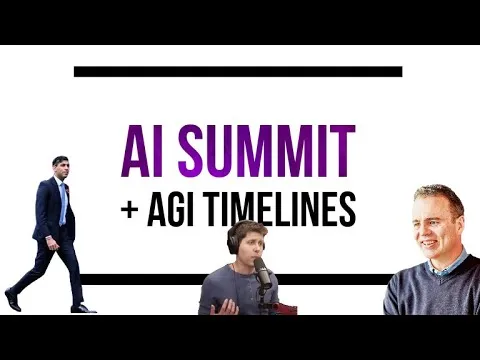
AI Declarations and AGI Timelines – Looking More Optimistic?
Based on AI Explained's video on YouTube. If you like this content, support the original creators by watching, liking and subscribing to their content.
AGI timeline forecasts are increasingly expressed as probability ranges, with some leaders pointing to late-2020s windows rather than distant decades.
Briefing
Predictions about when “human-level” AI arrives are getting more specific—and the policy response is getting more concrete—at the same time that safety researchers push for measurable, testable constraints on frontier systems. Several prominent AI leaders put timelines on the table with wide uncertainty, but a shared theme runs through the discussion: near-term progress is likely to come from model maturation (better multimodality, more up-to-date knowledge, and improved reasoning/tool use), while long-term risk management is increasingly tied to regulation, red-teaming, and scaling “stop rules.”
Shane Legg, co-founder of Google DeepMind and its chief AGI scientist, revisited an older forecast that human-level AI could arrive around 2025, framing it as a trend-based estimate rather than a certainty. He then offered a probability-style view: a roughly 50% chance of reaching human-level capability by 2028–2029, arguing that remaining limitations of large language models may be solvable within a relatively short research window. The practical implication is that today’s systems may not be “stuck,” but they will likely become less error-prone and more capable as they mature—especially as they become multimodal and more factual, rather than relying on purely text-based behavior.
OpenAI’s leadership also entered the timeline debate, with former alignment head Paul Christiano putting an aggressive stake in the ground: a 15% chance of an AI system capable of building a Dyson Sphere by 2030, rising to 40% by 2040. A Dyson Sphere is used as a proxy for extremely large-scale energy capture—far beyond what current systems can do—yet the probability framing highlights how some researchers think capability growth could accelerate. Bill Gates, discussing GPT progress, suggested there may be a plateau risk, but the discussion pushed back: improvements like better-curated data, video-in/video-out, reasoning modules, and longer context windows could still deliver meaningful gains. Even if the next step is more “practical update” than “civilization transforming,” the consensus is that 2025–2030 will bring more capability and more oversight.
That oversight is now formalizing around compute thresholds. A White House executive order introduces reporting requirements tied to raw compute: models trained above 10^26 flops (or above 10^23 flops when primarily using biological sequence data) must be reported for weight security and safety. Critics worry that regulating by compute can miss the real danger—Jim Fan of Nvidia argued for regulating outcomes or actions rather than the training process. The concern is that relatively small models could be repurposed for harmful automation, such as mounting targeting systems on robotic platforms.
At the AI Safety Summit in Bletchley, companies were asked for “responsible capability scaling” policies—essentially, conditions under which they would pause or stop scaling. Responses varied: OpenAI emphasized risk-informed development and argued that capability can rise without proportional scaling, while Anthropic pledged not to deploy models that produce cyber, bioterror, or nuclear risk information, even under expert red-teaming. Other firms described iterative approaches, continuous monitoring, and tool-using agents—capabilities that also raise the stakes for biosecurity and cyber misuse. The discussion also highlighted a growing push for better evidence: representation engineering research suggests that steering internal activations can shift model behavior (including truthfulness and harmfulness), and a proposed UK AI safety institute aims to generate hard data rather than speculation.
Overall, the tone is cautiously optimistic: despite sharp differences in timelines and risk philosophies, summit participants and governments appear to converge on the need for reliable measurement, coordination, and safety policies grounded in testing rather than rhetoric.
Cornell Notes
The discussion ties together three threads: uncertain AGI timelines, tightening government oversight, and evolving safety practices. Shane Legg and others offer probability-based forecasts for human-level AI in the late 2020s, while Paul Christiano frames extremely high-end capability (Dyson Sphere construction) with 15% by 2030 and 40% by 2040. Policy is moving toward measurable triggers—especially compute thresholds tied to reporting requirements for model weight security and safety. At the Bletchley AI Safety Summit, companies present different “stop scaling” or risk-management approaches, ranging from Anthropic’s pledge not to deploy models that generate certain high-risk information to OpenAI’s risk-informed development stance. The emphasis increasingly shifts from speculation to experiments and monitoring, including work on representation engineering and plans for new safety research institutions.
Why do some AI leaders think AGI timelines could be closer than many expect?
How do Dyson Sphere probabilities function as a proxy for AI risk?
What is the core controversy in regulating AI by compute?
What does “responsible capability scaling” mean in practice at the summit?
How does representation engineering relate to safety and behavior control?
Why is monitoring during training emphasized as a safety measure?
Review Questions
- How do probability-based forecasts (e.g., 50% by 2028–2029) differ from deterministic timelines, and what assumptions must hold for them to be meaningful?
- What are the strengths and weaknesses of compute-threshold regulation compared with outcome-based regulation?
- Which summit commitments are designed to prevent deployment, and which focus on iterative mitigation and monitoring?
Key Points
- 1
AGI timeline forecasts are increasingly expressed as probability ranges, with some leaders pointing to late-2020s windows rather than distant decades.
- 2
Model progress expected in the near term emphasizes maturation—especially multimodality, improved factuality, and better reasoning/tool use—rather than a sudden “plateau” stop.
- 3
Government oversight is moving toward measurable triggers, including reporting requirements tied to flops thresholds for weight security and safety.
- 4
Compute-based regulation is contested because harmful capability may be achievable through smaller models repurposed for real-world actions.
- 5
AI Safety Summit discussions centered on “stop scaling” or risk-informed development policies, with commitments ranging from deployment bans for certain risk outputs to iterative adaptation.
- 6
Safety research is shifting toward experiments and mechanisms (e.g., representation engineering) and toward institutions meant to generate hard data rather than rely on speculation.
- 7
Biosecurity and cyber risk concerns increasingly involve tool-using agents and autonomous lab workflows, raising the need for stronger liability, monitoring, and coordination.