AI News! HUGE Chatbot Research, Viral AI Songs, Text to Video & More!
Based on MattVidPro's video on YouTube. If you like this content, support the original creators by watching, liking and subscribing to their content.
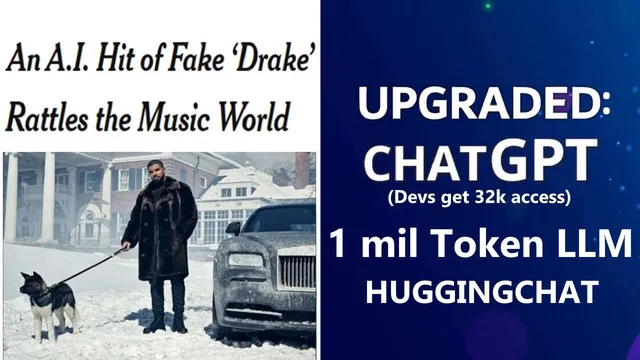
Long-context GPT-4 access (32,000 tokens) enables AI to summarize entire papers, answer questions over long documents without embeddings, and work with full codebases plus documentation.
Briefing
GPT-4’s 32,000-token “long context” access is emerging as a practical unlock for developer workflows: it can ingest far more text and code at once—enough to summarize entire research papers, answer questions without embeddings, and even take a full codebase plus documentation and make improvements. That shift matters because it moves AI from “chatting with snippets” toward acting on large, real-world artifacts: multi-page specs, long logs, whole repositories, and dense technical writing. With more tokens available, developers can feed dozens of articles for personalized news summaries across viewpoints, or ask for large-scale refactors and efficiency changes across existing systems.
The transcript also highlights a separate research push toward even longer memory. A viral paper on scaling transformer language models to 1 million tokens and beyond uses “recurrent memory” to store task-specific information across many segments during inference. In the described setup, memory is carried across seven 512-token segments and can be effectively used across thousands of segments—reaching a total length on the order of 2 million tokens. The key claim is that this dramatically exceeds prior transformer input limits (with earlier records cited around 64,000 tokens and 32,000 tokens) while keeping the base model’s memory footprint manageable in their experiment. The tradeoff is accuracy: longer contexts can increase error rates, so the practical challenge becomes balancing context length with factual reliability.
AI’s momentum is showing up beyond text. In music, AI-generated tracks that mimic famous artists—especially an “AI Drake” scenario—spread rapidly on YouTube, drawing tens of millions of views in days. Universal Music Group responded by invoking copyright law to remove the songs from major platforms. The transcript frames the legal uncertainty as a moving target: the technology is new, and courts haven’t settled how likeness-based generation should be treated. At the same time, the ease of producing convincing clones is portrayed as making enforcement difficult at scale.
One proposed path forward comes from Grimes, who publicly offered a consent-based model: she says she would split 50% royalties on successful AI-generated songs using her voice, treating it like a collaboration. The idea is to replace blanket bans with licensing-like agreements and clearer disclosure, acknowledging that AI music is likely to keep proliferating.
Safety and governance concerns run through the rest of the roundup. The transcript references calls to pause advanced AI development beyond GPT-4 capabilities, then pivots to concrete mitigations. Nvidia’s “Nemo guardrails” is presented as an open-source approach to keep LLM-powered apps topical, accurate, and secure—using topical, safety, and security guardrails layered on top of LangChain and deployable with only a few lines of code. The discussion also notes the likely arms race: guardrails can be reverse-engineered and jailbroken.
Finally, the roundup tracks product momentum: Hugging Face’s open alternative to ChatGPT via Open Assistant, Microsoft’s teased “memory” for Bing Chat in a restricted form, and RunwayML’s Gen 1 mobile app for generating and styling videos. The throughline is clear—AI capability is accelerating, but the industry is simultaneously trying to build guardrails, licensing norms, and longer-term memory into mainstream tools.
Cornell Notes
Long-context GPT-4 access (32,000 tokens) is pushing AI from small prompt snippets toward working with entire papers, large codebases, and multi-article inputs—enabling more powerful developer tools and personalized information workflows. A separate research direction uses “recurrent memory” to scale transformer models toward million-token contexts, carrying task-specific information across many segments during inference, though longer contexts can raise error rates. AI music is surging with voice-mimic tracks that can sound indistinguishable from real artists, triggering copyright takedowns by Universal Music Group and sparking debate over consent and licensing. Safety efforts are also moving from calls to pause to practical guardrails, including Nvidia’s Nemo guardrails for topical control, accuracy constraints, and security restrictions. Meanwhile, open-source chat alternatives and product features like memory in Bing Chat and mobile video generation in RunwayML show rapid mainstream adoption.
What changes when GPT-4 can accept 32,000 tokens instead of much smaller inputs?
How does the “recurrent memory” approach aim to reach million-token scale?
Why did AI-generated Drake-like songs trigger a legal response, and what uncertainty remains?
What alternative to bans is proposed for AI music using an artist’s voice?
What does Nvidia’s Nemo guardrails try to do for LLM-powered apps?
What product directions show up outside text—especially memory and video?
Review Questions
- How do long-context models change what developers can realistically delegate to AI compared with earlier token limits?
- What are the main tradeoffs mentioned for scaling to extremely long contexts (e.g., million-token approaches)?
- In the AI music debate, how do consent/royalty proposals differ from copyright takedowns, and what practical enforcement issue is raised?
Key Points
- 1
Long-context GPT-4 access (32,000 tokens) enables AI to summarize entire papers, answer questions over long documents without embeddings, and work with full codebases plus documentation.
- 2
Scaling transformer models toward million-token contexts uses recurrent memory to carry task-specific information across many segments during inference, but longer contexts can increase error rates.
- 3
AI-generated voice-mimic music can spread extremely fast and sound indistinguishable from real artists, prompting copyright takedowns such as those described from Universal Music Group.
- 4
Legal outcomes for likeness-based AI generation remain uncertain because there’s no settled court framework yet for this technology.
- 5
Grimes’ proposed 50/50 royalty split model represents a consent-based alternative to bans, aiming to treat AI voice use like a collaboration.
- 6
Nvidia’s Nemo guardrails targets topical control, accuracy/safety constraints, and security restrictions, but the transcript warns guardrails may be jailbreakable over time.
- 7
Mainstream AI products are moving toward memory features (Bing Chat) and mobile creative generation (RunwayML Gen 1).