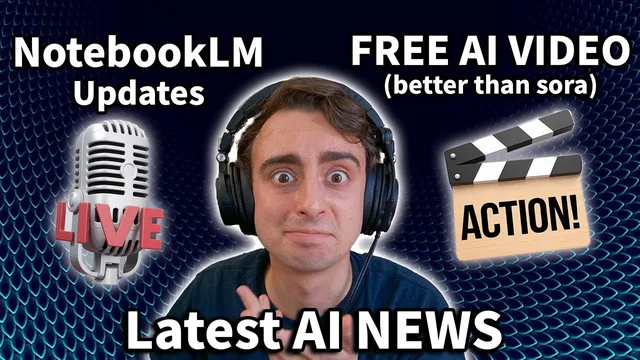
AI News Just Landed! - Free AI Video, NotebookLM Update, & Open AI Singularity
Based on MattVidPro's video on YouTube. If you like this content, support the original creators by watching, liking and subscribing to their content.
Sam Altman’s “near the singularity” tweet reignites debate over whether “singularity” implies self-improving AI beyond today’s AGI framing.
Briefing
Sam Altman’s “six-word story” tweet—“near the singularity”—sparks fresh debate over what “singularity” actually means in AI terms, and whether it implies a self-improving feedback loop that could outpace human capability. The transcript frames the uncertainty directly: is the industry approaching a true “singularity/AGI” moment, or is the phrasing mainly hype after a promising breakthrough? Either way, the central question lands on whether today’s systems are merely getting better at tasks, or are moving toward autonomous improvement that compounds rapidly.
The most concrete product update comes from Google, where NotebookLM gains Gemini 2.0 experimental support and a new “podcast” style interface that lets users join the discussion with AI hosts. The workflow described is practical: paste a chapter or upload a PDF, have NotebookLM generate an audio-style explanation, then dynamically ask follow-up questions and request elaborations. A three-panel layout—sources, chat, and a “studio” for deeper note-taking—aims to make study feel like a live tutoring session rather than a static summary. A demo centers on a research paper about “generative emergent communication,” portraying AI agents that start without language and develop shared communication while building internal world models through interaction.
On the free-and-fast front, the transcript highlights Halu AI (haluai ffree.com) as an ad-supported site for generating short videos without login, with reported generation times around five minutes and outputs around five seconds. The creator contrasts this with OpenAI’s Sora pricing model, arguing that ad-funded “free” generation could pressure paid video services—especially since Sora is described as expensive and limited for unlimited generation.
Audio generation gets a speed benchmark via Dreaming to Lupa (Dreaming Tupa in the transcript), a text-to-audio model aimed at sound effects and jingles. Reported performance is striking: up to 30 seconds of 44.1 kHz audio generated in about 3.7 seconds on a single A40 GPU, enabling near-instant iteration. Examples range from whistling and bird-song harmonization to game-like coin sounds and environmental effects, with quality varying by prompt but responsiveness consistently emphasized.
The transcript then shifts to open-source and multimodal customization. An open-source “Juaonan video” model on Hugging Face is presented as state-of-the-art and modifiable, with emerging “LoRA” training for video—where motion (walking, style-specific movement) makes fine-tuning different from image LoRAs. Finally, Roden gen 1.5 is showcased as an image-to-3D tool producing meshes with “clean topology” and PBR textures, with the creator emphasizing how quickly it can infer detailed geometry (like eyelashes and eyebrows) from one or multiple images.
Across all these updates, the throughline is acceleration across modalities—text-to-audio, text/image-to-video, and image-to-3D—raising the bigger question of whether digital outputs can soon become physical objects through 3D printing workflows.
Cornell Notes
The transcript ties together a wave of AI progress and product updates, with the biggest theme being rapid capability gains across multiple modalities. It starts with renewed “singularity vs. AGI” speculation after Sam Altman’s “near the singularity” tweet, then moves to tangible tools: NotebookLM’s Gemini 2.0 experimental integration and a discussion-style interface for studying PDFs and asking follow-up questions. It highlights ad-supported free video generation via Halu AI, fast text-to-audio sound effects using Dreaming Tupa, and open-source video models where LoRA fine-tuning can target motion and style. It also showcases Roden gen 1.5 for turning images into textured 3D meshes, emphasizing speed and detail from single-image inputs.
What does “near the singularity” imply, and how does it relate to AGI in the discussion?
How does NotebookLM’s Gemini 2.0 experimental update change studying compared with static summaries?
What is “generative emergent communication,” and why is it used in the NotebookLM demo?
Why does the transcript argue that free, ad-supported video generation could pressure paid services like Sora?
What performance claim is made for Dreaming Tupa’s audio model, and what does it enable?
How do LoRAs for video differ from LoRAs for images, according to the transcript?
What does Roden gen 1.5 claim to do, and what detail does the transcript highlight from its outputs?
Review Questions
- Which part of the transcript most directly connects “singularity” to a technical mechanism (not just a buzzword), and what mechanism is suggested?
- How does the NotebookLM interface design (sources/chat/studio) support the kind of learning workflow demonstrated?
- What makes video LoRA fine-tuning harder than image LoRA fine-tuning, based on the transcript’s explanation?
Key Points
- 1
Sam Altman’s “near the singularity” tweet reignites debate over whether “singularity” implies self-improving AI beyond today’s AGI framing.
- 2
NotebookLM’s Gemini 2.0 experimental mode adds a discussion-style interface that supports interactive Q&A while studying uploaded PDFs.
- 3
A three-panel NotebookLM layout—sources, chat, and studio—aims to turn research review into a more tutor-like, iterative process.
- 4
Halu AI is positioned as an ad-supported, login-free way to generate short videos, potentially undercutting subscription-based video tools.
- 5
Dreaming Tupa’s audio model is reported to generate up to 30 seconds of 44.1 kHz audio in about 3.7 seconds on a single A40, enabling fast sound-effect iteration.
- 6
Open-source video models on Hugging Face are enabling LoRA-based customization, with video-specific fine-tuning focused on motion and style consistency.
- 7
Roden gen 1.5 is presented as an image-to-3D system that outputs textured meshes quickly, including detailed geometry inferred from single images.