AI note taking | Take better notes using AI
Based on Reflect Notes's video on YouTube. If you like this content, support the original creators by watching, liking and subscribing to their content.
Reflect’s AI editor can turn long text into either a single-paragraph summary or key-takeaway bullets, and it supports cloning prompts for custom summary styles.
Briefing
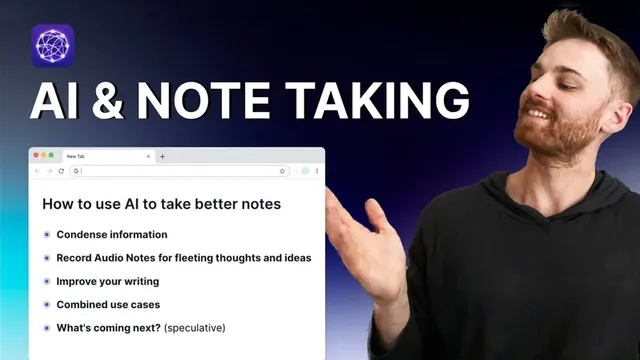
AI note-taking is moving beyond “summarize my text” into a full workflow upgrade: capture ideas faster, convert rough thoughts into structured notes, and turn drafts into cleaner writing—without leaving the notes app. The practical payoff is speed and output quality, with AI handling the tedious parts of organizing, editing, outlining, and generating follow-ups so people can spend more time thinking and producing.
A central example is summarization inside Reflect. After selecting a long excerpt from a blog post, an AI editor can condense multiple paragraphs into a single tight paragraph, or switch to a key-takeaways format that produces quick bullet points for later reference. The interface also exposes the underlying prompt, letting users clone and customize it—so the summary style can match how they actually read and review.
Voice notes are treated as the biggest friction reducer. Reflect’s Whisper AI integration transcribes recorded audio with near-human accuracy. But the more valuable step is what happens after transcription: a GPT-4-powered assistant can reorganize rambling audio into actionable outputs like step-by-step action items. That matters for real-life scenarios—recording an idea late at night so the next morning starts with a clear to-do list, or capturing thoughts while walking without turning them into a wall of text that’s hard to use.
Writing improvements follow a similar pattern: AI acts like a copy editor and a planning assistant. Users can select text and run an “act as a copy editor” prompt to fix spelling, correct grammar, and add punctuation for readability while keeping the writing fundamentally theirs. For longer-form work, voice notes can become article outlines. A recorded brainstorm can be transformed into a structured outline with numbered sections and subpoints, which the user then rearranges and edits—turning the slowest part of writing (planning) into a quick starting draft.
When drafts still feel off, the workflow shifts to rephrasing and tone control. A custom prompt can rewrite text in a specific author-like voice (the example uses “Matt Levine”), preserving meaning while changing phrasing. The same mechanism can translate notes into another language (example: German) with more natural writing than typical literal translation tools.
Beyond writing, AI is positioned as a research and decision-support layer. Custom prompts can generate historical examples to strengthen an argument, produce counterarguments to a hot take, and answer practical questions for tasks like planning a trip to Granada (including a reasoning-style response about the best time to visit).
The broader vision ties these capabilities together into an “AI second brain.” Meeting notes can be generated into key takeaways and action items without producing a full transcript. Brainstorm sessions can be summarized into what was decided and what comes next. Looking ahead, the next wave includes web browsing inside notes for scheduling, booking, and online research; semantic search that finds insights even when keywords don’t match; auto-backlinking to build an interconnected idea map without manual linking; and chatbots that can answer using personal notes—raising privacy and security questions, but promising a more tailored assistant that understands an individual’s knowledge and preferences.
Cornell Notes
AI note-taking in Reflect is presented as a workflow tool, not just a summarizer. Voice memos are transcribed with Whisper AI, then GPT-4 can convert rambling recordings into structured action items and outlines. Writing gets faster through copy-editing prompts, outline generation for articles, and rephrasing in a chosen tone (including translation into German). The approach extends to research-style prompts that generate historical examples, counterarguments, and practical travel guidance. The next step envisioned is a true “second brain” with web browsing, semantic search, auto-backlinking, and chat assistants grounded in personal notes—balanced against privacy concerns.
How does summarization work in Reflect, and why does prompt customization matter?
What’s the practical advantage of using voice notes beyond transcription accuracy?
How can AI speed up long-form writing without replacing the writer’s judgment?
What does “rephrase writing” enable that basic editing doesn’t?
How does the “research assistant” use case support argument building and preparedness?
What future capabilities would turn notes into an autonomous second brain?
Review Questions
- Which parts of the workflow are automated (summaries, action items, outlines, copy edits), and which parts still require user judgment (editing outlines, selecting rewritten sentences)?
- How do voice notes plus GPT-4 organization differ from simply transcribing audio into a transcript?
- What are the key differences between keyword search and semantic search as described in the notes-based second-brain vision?
Key Points
- 1
Reflect’s AI editor can turn long text into either a single-paragraph summary or key-takeaway bullets, and it supports cloning prompts for custom summary styles.
- 2
Whisper AI transcribes voice memos with near-human accuracy, but GPT-4’s organization of that transcript into action items is the bigger productivity gain.
- 3
Copy-editing prompts can fix spelling, grammar, and punctuation while preserving the user’s original intent and authorship.
- 4
Voice-note brainstorms can be converted into structured article outlines, cutting the slow planning stage and enabling faster drafting.
- 5
Tone-controlled rephrasing can rewrite selected text in a chosen author-like voice and can translate notes into languages like German with more natural phrasing.
- 6
Research-style prompts can generate historical examples, counterarguments, and practical guidance (e.g., travel timing) to support writing and decision-making.
- 7
The next wave includes web browsing inside notes, semantic search, auto-backlinking for idea maps, and chat assistants grounded in personal notes—raising privacy and security tradeoffs.