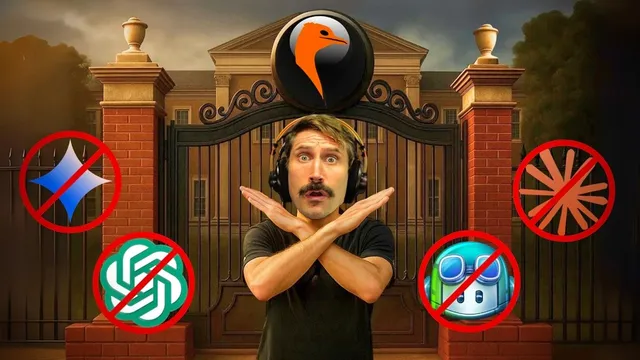
AI Outlawed ☠️ in Open Source Project
Based on The PrimeTime's video on YouTube. If you like this content, support the original creators by watching, liking and subscribing to their content.
The project’s GPL v2 copyleft licensing makes licensing uncertainty from AI-generated code a higher-stakes risk than in permissive-license projects.
Briefing
A GPL-licensed open-source project is tightening its contribution rules by refusing patches that use AI code generators, citing unresolved—and potentially incompatible—copyright and licensing questions around AI-generated code. The move matters because the project’s GNU GPL v2 “copyleft” terms can require downstream recipients to adopt the same license, so uncertainty about whether AI outputs carry or reproduce material from differently licensed sources becomes a direct compliance risk.
The policy centers on the idea that, for AI-assisted code, the copyright and license status of the output is “ill-defined” and lacks a settled legal foundation. Even when training data is known to include open-source material, the training mix may include code under restrictive terms that aren’t compatible with the project’s licensing requirements. That uncertainty collides with the project’s contribution mechanism: contributors must certify compliance through a DCO (Developer Certificate of Origin) process, which requires submitters to understand the copyright and license status of what they contribute. If contributors can’t credibly determine whether AI-generated code meets those licensing obligations, the certification becomes hard to justify.
The project’s stance is framed as risk management rather than a blanket anti-AI position. It draws a boundary around what counts as “AI code generators” in the contribution itself, while allowing other AI uses—such as researching APIs or algorithms, static analysis, and debugging—so long as the resulting output is not included in the submitted patch. Tools explicitly named as impacted include GitHub Copilot, along with other AI code generators and agent-style systems built on similar tooling.
The policy also reflects the project’s “viral” licensing reality. With GPL v2, incorporating or distributing derivative works can trigger license obligations for the broader product or distribution. That makes the project less tolerant of ambiguity than permissively licensed projects, because a licensing mismatch could force legal or compliance fallout for anyone who ships the resulting code.
In the surrounding discussion, commenters argue over enforceability and detectability. Several contend that it’s often impossible to tell whether a specific patch was produced with an LLM, making the rule difficult to police in practice. Others respond that the policy is still meaningful as a contributor standard: even if verification is imperfect, the project can refuse contributions where AI usage is known or suspected, and it can rely on the DCO certification as the accountability lever.
The debate spills into broader frustrations about open-source governance and internet culture, but the core issue stays technical and legal: until courts and regulators provide clearer guidance on how training data licenses apply to AI outputs, GPL-based projects may treat AI-generated contributions as too uncertain to certify. The policy is positioned as strict for now, with an explicit openness to revision as legal interpretations mature.
Cornell Notes
A GPL v2 open-source project adopted a strict contribution policy: it will not accept patches when AI code generators are known or suspected to have been used. The rationale is that GPL’s copyleft obligations make licensing uncertainty especially risky, and AI-generated output has an “ill-defined” copyright/license status with no settled legal framework. Because the project relies on DCO certification—contributors must understand and attest to the provenance and licensing of submitted code—AI outputs are treated as incompatible with credible compliance. The policy targets AI-generated code in contributions, while allowing AI for tasks like API research, static analysis, and debugging as long as the AI’s output is not included in the patch. The surrounding debate highlights enforcement challenges and the difficulty of proving whether AI was used, but the project’s accountability mechanism is the contributor certification standard.
Why does GPL v2 make AI-generated code a bigger compliance problem than it might be under permissive licenses?
How does the DCO requirement interact with the policy’s view of AI outputs?
What kinds of AI uses are allowed under the policy, and what’s disallowed?
Why do critics say the policy is hard to enforce?
Which tools are explicitly mentioned as impacted by the policy?
Review Questions
- What specific legal/compliance mechanism (license type and certification process) drives the project’s decision to restrict AI-generated code contributions?
- How does the policy draw a line between using AI for development assistance versus including AI-generated output in a submitted patch?
- What enforcement and verification arguments appear in the discussion, and how do they challenge or support the policy’s practical impact?
Key Points
- 1
The project’s GPL v2 copyleft licensing makes licensing uncertainty from AI-generated code a higher-stakes risk than in permissive-license projects.
- 2
AI code generator outputs are treated as having “ill-defined” copyright/license status due to lack of settled legal guidance.
- 3
The policy is tied to DCO certification: contributors must attest they understand the provenance and licensing of what they submit.
- 4
The restriction targets AI-generated code included in patches, while allowing AI for tasks like API research, static analysis, and debugging if AI output is not incorporated.
- 5
Tools explicitly named as impacted include GitHub Copilot and other LLM-based code generators and agent-style systems built on similar tooling.
- 6
The policy is framed as strict for now with openness to revision as legal interpretations mature.
- 7
Commentary disputes enforcement feasibility, arguing that it’s often difficult to prove whether AI was used to produce a given patch.