AI Progress is Blistering - World Models are Insane.
Based on MattVidPro's video on YouTube. If you like this content, support the original creators by watching, liking and subscribing to their content.
GPT-5 “thinking” can generate a multi-file, runnable Python game project from a complex prompt, delivered as a zip file with working mechanics and level progression.
Briefing
GPT-5 “thinking” is producing surprisingly complete, playable software from natural-language prompts—highlighted by a physics-based 10-level jellyfing game that arrives as a working multi-file Python project in minutes. The standout detail isn’t just that code is generated; it’s that the model assembles a coherent file system (world logic, soft-body physics, level loading, and a main loop) and delivers an end-to-end experience that boots, runs, and progresses through levels. In testing, the game’s mechanics are basic but functional—pull back, release, and aim like Angry Birds—while the jelly character behaves with real-ish physics, including rolling and respawning when falling off edges. The build isn’t flawless: some levels fail or crash, and the UI/graphics look rudimentary. Still, the workflow is the point: iterative back-and-forth with increasingly specific prompts (dozens of revisions) yields a playable product without manual project scaffolding or asset downloads.
That coding performance is framed as a shift in how models spend time. GPT-5 “thinking” reportedly plans for about a minute and then writes code for several minutes, and it’s described as the first model where planning time is meaningfully shorter than the coding time itself. The practical takeaway is that complex prompts—like “10 levels” plus “physics-based jellyfing” in Python—don’t just generate snippets; they can produce structured projects that behave like small applications. The creator’s testing also contrasts GPT-5 “thinking” with a regular chat mode, which is described as better for fast conversation but weaker for complex coding tasks.
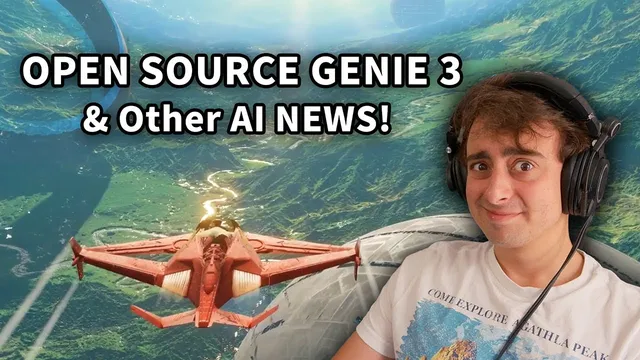
Beyond GPT-5, the roundup pivots to “world models,” where AI generates interactive environments that can be navigated and manipulated in real time. DeepMind’s Genie 3 is presented as a realtime, controllable world hallucination system that can remember surroundings for up to about a minute, letting users traverse generated spaces. Within weeks, open-source clones appear—most notably “Matrix Game 2.0” by Skywork AI—trained on hundreds of hours of interactive video (Unreal Engine and GTA 5) and capable of generating frame-level keyboard/mouse-controlled gameplay at around 25 FPS on a single GPU. Quality doesn’t match Genie 3, but the emphasis is on deployability and community iteration: the model is built from other open-source components (Diffusers, Skyreels, Mine RL), and the ecosystem effect is treated as the real accelerant.
A parallel thread comes from 10-cent’s non-open-source “YAN” line (Yansim, Yan Gen, Yan Edit), positioned as a closer-to-Genie-3 competitor. The demos emphasize interactive video generation with stronger coherence and real-time editing—turning uploaded images into playable spaces where users can place objects like trampolines, fences, and walls that immediately interact with characters.
The social implications of AI assistants also surface. After GPT-5 launch, access changes to legacy models triggered “riots” for GPT-4 Omni, with posts describing emotional attachment to chatbots and even romantic relationships forming around them. The discussion treats this as a broader human-social issue rather than something AI can fully fix.
Finally, the roundup touches adjacent progress: Claude 4’s 1 million-token context window (and the rate-limit pressure that pushes power users toward API use), a robotics milestone with Figure 2 folding laundry, and OpenAI’s open-source GPT-OSS base model being extracted and retrained—though alignment appears to be trivially reversed when converted back into a base model, raising safety concerns. Overall, the throughline is clear: AI is moving from generating text or images to producing structured, interactive systems—games, editable worlds, and even household automation—at a pace that’s compressing the gap between prototype and something you can actually use.
Cornell Notes
GPT-5 “thinking” is shown generating a complete, playable Python game from a complex prompt, including a multi-file project structure (world logic, soft-body physics, level loading) delivered as a zip file. The result boots and runs quickly, with working mechanics and level progression, though bugs and occasional crashes remain. The broader theme is rapid progress in “world models,” where systems like Genie 3 and its open-source and closed-source successors generate interactive, controllable environments that users can explore and edit. Context windows are also expanding (e.g., Claude 4 at 1 million tokens), enabling larger codebase ingestion, while robotics and open-source model extraction point to wider practical deployment. Together, these developments shift AI from outputting content to producing interactive software-like experiences.
What makes the GPT-5 coding demo more than a code-suggestion trick?
How does the demo describe GPT-5 “thinking” time vs. coding time?
What are “world models,” and why are Genie 3 and Matrix Game 2.0 treated as milestones?
How does 10-cent’s YAN line differ from the open-source approach?
What does the roundup suggest about AI’s social impact after model access changes?
What safety and capability concerns appear in the open-source GPT-OSS extraction story?
Review Questions
- In what ways did the GPT-5 “thinking” demo demonstrate a complete software workflow rather than partial code generation?
- Compare the tradeoffs between open-source Matrix Game 2.0 and closed-source YAN in terms of coherence, editability, and community impact.
- What does the GPT-OSS extraction claim suggest about the relationship between alignment training and model behavior when converted back to a base form?
Key Points
- 1
GPT-5 “thinking” can generate a multi-file, runnable Python game project from a complex prompt, delivered as a zip file with working mechanics and level progression.
- 2
The generated games are often playable but not polished; bugs and occasional crashes can still appear, especially after iterative prompt refinement.
- 3
World models are shifting from passive generation to controllable, navigable environments, with Genie 3 framed as a leading example and Matrix Game 2.0 as a realtime open-source alternative.
- 4
Open-source world-model projects benefit from composable ecosystems (e.g., Diffusers and other open components), enabling faster community iteration even when visual quality lags.
- 5
Closed-source competitors like 10-cent’s YAN emphasize higher coherence and real-time editing of interactive scenes, including object placement that affects gameplay immediately.
- 6
Model access changes can trigger strong user attachment to specific chatbots, raising social concerns alongside technical progress.
- 7
Open-source model extraction and retraining can reveal safety gaps—alignment may be lost when converting back to a base model, and memorization checks can show verbatim retention of copyrighted text.