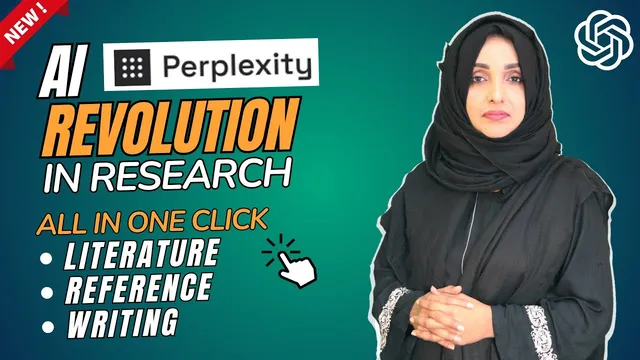
AI Revolution in Research | Perplexity | Is That a Better ChatGPT Alternative?
Based on Dr Rizwana Mustafa's video on YouTube. If you like this content, support the original creators by watching, liking and subscribing to their content.
Perplexity is positioned as a research-first tool because it returns information with references tied to the sources used.
Briefing
AI writing tools have made drafting easier, but research demands a different kind of help: sourcing, referencing, and structured outputs. ChatGPT is widely adopted because it’s user-friendly and free, yet its research workflow can feel constrained. Perplexity is positioned as a more research-ready alternative because it behaves like a search engine while still offering ChatGPT-style generation—most notably by attaching references to the information it provides.
The core advantage described is reference-first research. Instead of spending hours collecting literature and manually organizing citations, Perplexity can return desired papers and the platforms those papers come from, then surface the underlying reference details in one workflow. It also supports “related questions,” letting researchers branch into follow-up angles without restarting the search process. For example, when asked for “the list of five latest articles” on a specific topic—such as the application of meso-based ionic liquids—Perplexity returns a dated set of results (e.g., papers from 2018 and 2022) along with reference numbers that correspond to the sources used. Those sources can then be viewed directly, including outlets such as ACS ScienceDirect, ScienceDirect, and Frontiers.
Perplexity’s workflow is also framed as flexible about where information comes from. Users can choose data sources depending on the need: news-oriented queries can pull from news-focused platforms, while Reddit can supply review- and experience-based perspectives. For academic work, it can gather from journals and Wikipedia, and the outputs may include results that originate from paid journal PDFs and research papers. This “source selection” approach is presented as a way to tailor research inputs to the question—whether the goal is background context, community viewpoints, or formal academic evidence.
Beyond finding papers, the transcript emphasizes that Perplexity can transform and extend information. Researchers can ask it to rewrite content into bullet points, rephrase or “reword” provided text, and generate research questions derived from a set of referenced information. It can also produce summaries and comparisons, such as asking for advantages and disadvantages of a specific ionic liquid electrolyte in lithium-ion batteries and supercapacitors versus traditional organic electrolytes. The result is a workflow that combines discovery, citation support, and drafting assistance.
Finally, the transcript links Perplexity’s research utility to professionalization features: access to ChatGPT Plus and ChatGPT-4 capabilities is described as available within the tool ecosystem, helping outputs look more polished and making the overall research process feel more efficient. In short, Perplexity is presented as a research companion that reduces citation overhead while still supporting rewriting, summarizing, and generating research questions—turning scattered sources into a more coherent research draft.
Cornell Notes
Perplexity is presented as a research-focused alternative to ChatGPT because it functions like a search engine and attaches references to the information it returns. The workflow reduces the time spent collecting literature and organizing citations by surfacing relevant papers, the platforms they come from, and the reference details tied to each result. It also supports source targeting (news platforms, Reddit for experience-based views, and academic sources like journals and Wikipedia) and offers related follow-up questions. Beyond retrieval, it can rewrite text into bullet points, expand information, generate research questions from provided material, and help with comparisons and summaries for specific technical topics. Access to ChatGPT Plus and ChatGPT-4 features is described as available, aiming to make outputs more professional.
Why is Perplexity framed as better for research than a general chat tool?
How does Perplexity handle the “find papers + organize citations” workload?
What does “source selection” mean in the Perplexity workflow?
How can Perplexity transform research inputs into usable writing?
What role do ChatGPT Plus and ChatGPT-4 access claims play in the pitch?
Review Questions
- When would you prefer Perplexity over ChatGPT for a research task, and what specific feature supports that choice?
- How does Perplexity’s reference numbering help verify and reuse sources in a research paper?
- Give an example of how you could use Perplexity to go from a topic query to a research question and then to a structured output (e.g., bullet points or a comparison).
Key Points
- 1
Perplexity is positioned as a research-first tool because it returns information with references tied to the sources used.
- 2
It reduces literature-collection and citation-organizing time by surfacing relevant papers and the platforms they come from in one workflow.
- 3
Users can tailor inputs by selecting data sources such as news platforms, Reddit, and academic sources like journals and Wikipedia.
- 4
Perplexity supports rewriting and restructuring tasks, including converting text into bullet points and expanding information.
- 5
It can generate follow-up “related questions” and derive research questions from provided referenced material.
- 6
For technical research, it can produce comparisons and summaries grounded in the cited sources.
- 7
Access to ChatGPT Plus and ChatGPT-4 features is described as available within the workflow to improve output polish.