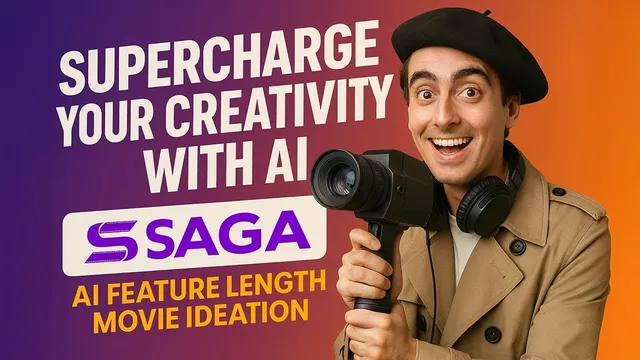
AI SUPERCHARGER for Aspiring Film Makers! Harness Your Inner Creativity!
Based on MattVidPro's video on YouTube. If you like this content, support the original creators by watching, liking and subscribing to their content.
Saga is positioned as an AI storytelling workspace that helps screenplay writers generate theme, archetype-based structure, characters, acts, beats, and screenplay-formatted scenes.
Briefing
AI is being positioned as a practical “creativity bootstrap” for aspiring filmmakers—turning early sparks of story ideas into structured, cinematic material faster than traditional writing workflows, while still requiring human taste to steer the results. The core pitch is that Saga, an AI storytelling tool aimed at screenplay writers and filmmakers, can help generate plot structure, characters, dialogue, and even storyboard visuals by using established storytelling archetypes and maintaining consistency across a screenplay’s context.
The workflow starts with a raw concept, then layers it into a screenplay-ready framework. Users pick archetypes and storytelling patterns (for example, combining a road story with a superhero-like arc), choose genres and tone, and then let the AI propose supporting elements such as subplots and thematic framing. Saga’s character module is presented as especially useful: it can generate character wants, needs, lies, and backstory details while trying to keep them aligned with the overall narrative—an area the creator worries other AI tools sometimes struggle with when projects get large.
To test the platform, a full example story is built: “Gold Runner,” set in ancient Mesopotamia. The creator supplies a log line about a gold miner rebelling against masters under principles of freedom, then selects a central theme focused on whether defying authority is justifiable even at the cost of destabilizing the world. Archetypes and tone are set to dark, thought-provoking adventure with PG-13 intensity. The character build becomes detailed: Davos (the gold miner) is given a disillusion arc, a physical condition (missing right arm), a resilient personality, and a moral framework centered on personal freedom. The AI helps generate external goals (recovering an artifact of freedom), internal lessons (freedom requires responsibility), and a “ghost” unresolved past tied to gods as antagonists.
Plot development proceeds through act generation and beat-level expansion. Saga autogenerates act segments (including obstacles like sandstorms, divine punishment in a village, and villain ambushes), then the creator selectively edits—especially when the autogenerated direction feels too stereotypical or misaligned with the intended emotional vision. For the final act, the creator abandons AI suggestions and writes a new direction: the artifact is seized to slaughter gods, gods respond with a flood, and Davos ultimately confronts the main villain god—while the epilogue reveals rebuilding and Davos’s survival.
Scriptwriting and visualization are treated as the “real test.” Saga generates an opening scene with screenplay formatting and dialogue, then rewrites it to better match the creator’s worldbuilding constraints (keeping early characters unaware of rebellion against gods). Storyboard tools produce shot descriptions and AI imagery/video, though integration and character consistency in generated visuals are described as less refined than the story-structuring features.
The verdict is that Saga can meaningfully accelerate screenplay development—especially for structure, character logic, and writer’s block—while still depending on human judgment for pacing, tone, and originality. Pricing is framed as accessible: a three-day trial with a credit card, limited free usage, and $20/month after the trial (with a creator-provided coupon reducing the first month to $10). The comparison lands on Saga as a film-focused alternative to novel-oriented tools like pseudo write, with storyboarding included and positioned as a useful early-stage capability.
Cornell Notes
Saga is presented as an AI-powered storytelling workspace for screenplay writers and filmmakers, designed to turn early story “sparks” into structured acts, characters, beats, and even storyboard visuals. The workflow begins with archetypes, genres, tone, and a log line, then expands into theme selection and character frameworks (wants, needs, lies, backstory). A full example—“Gold Runner,” set in ancient Mesopotamia—shows how AI can draft acts and scenes, while the creator frequently edits to preserve emotional intent and avoid clichés. The strongest value highlighted is consistency across story elements and faster progress past blank-page problems. Storyboard generation is useful but less tightly integrated and sometimes less accurate than the writing tools.
How does Saga move from a rough story idea to screenplay-ready structure?
What does the character-building system add beyond basic plot summaries?
Where does human editing matter most in the Saga workflow?
How does Saga handle consistency across large story elements—and what concern remains?
What are the strengths and weaknesses of Saga’s script-to-visual features?
What pricing and trial details are given for evaluating Saga?
Review Questions
- In the “Gold Runner” example, which specific character elements (wants/needs/lies/ghost) most directly shape the plot’s moral dilemmas?
- Identify one point where the creator rejected or rewrote AI-generated act content. What mismatch was being corrected?
- How do the storyboard and video-generation tools differ in reliability compared with the story/character generation tools?
Key Points
- 1
Saga is positioned as an AI storytelling workspace that helps screenplay writers generate theme, archetype-based structure, characters, acts, beats, and screenplay-formatted scenes.
- 2
Character development is built around wants, needs, lies, and backstory “ghosts,” aiming to keep internal logic aligned with the overall narrative.
- 3
The “Gold Runner” example demonstrates both acceptance of AI-generated plot beats and selective human edits to avoid clichés and preserve emotional intent.
- 4
Saga’s act and beat generation can accelerate drafting, but the creator still uses writer judgment to rewrite sections that feel misaligned.
- 5
Storyboard and AI video generation are treated as helpful but less consistent and less tightly integrated than the writing tools.
- 6
The creator describes Saga as film-focused compared with novel-oriented tools like pseudo write, and highlights that storyboarding is included.
- 7
Pricing is framed around a three-day trial and $20/month afterward, with a coupon reducing the first month to $10.