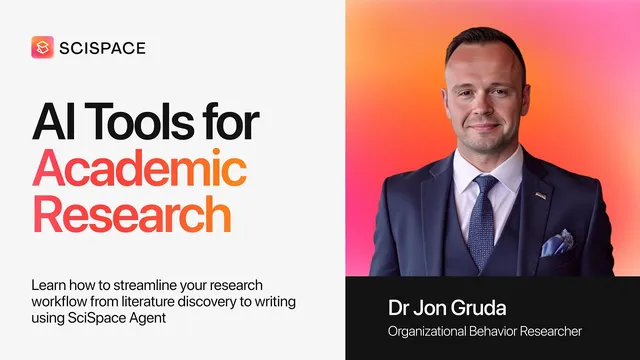
AI Tools for Academic Research | Step-by-Step Guide with Dr. Jon Gruda
Based on SciSpace's video on YouTube. If you like this content, support the original creators by watching, liking and subscribing to their content.
Use a hybrid workflow: researchers keep responsibility for the research question, critical judgment, and final manuscript landing.
Briefing
Academic research is moving toward a hybrid workflow: researchers keep control of the idea, judgment, and final argument, while AI tools handle multi-step discovery and synthesis with traceable sources. SciSpace’s core pitch is that this division of labor matters because “autopilot” can accelerate the flight, but the pilot still decides the route, avoids hazards, and lands safely—especially when the output must be accurate, citable, and publishable.
A major emphasis is on maintaining academic voice and originality. Tools can draft sections and organize evidence, but they shouldn’t replace critical thinking or creativity. If everyone relies on the same AI-driven drafting pipeline, papers risk sounding similar in tone and structure; what will still differentiate strong science is the novelty of the research question, design, and how the argument is built. That’s why the workflow described centers on researchers directing the process and verifying claims, rather than treating AI text as a finished product.
The transcript contrasts generalist chatbots (ChatGPT, Gemini, Claude) with specialized research tools like SciSpace. Generalist models can be useful for broad summarization or rewriting, but they’re not designed to plan a literature search, filter results to what’s most relevant, and ground every claim in scholarly sources. SciSpace is positioned as “grounded in scholarly databases,” with traceability built in: claims come with citations that can be opened and checked. The platform’s goal is to reduce hallucinations and fake citations by ensuring that outputs are tied to real papers.
SciSpace’s most important feature is the SciSpace Agent, described as recently launched (around July, about two months prior to the session). The agent consolidates multiple functions—literature review workspace, chat with PDF, and a citation generator—into one end-to-end workflow. Instead of producing an answer immediately, it runs a goal-driven process: it asks clarifying questions, creates a plan, searches, filters, and then produces deliverables such as an overview, identified mediators and moderators, and a structured literature review. In a demonstration, a broad prompt about organizational resilience and employee wellbeing using the PRISMA framework triggered a multi-step workflow that narrowed from hundreds of records to a smaller set of relevant papers, then generated an organized synthesis and outputs that could be expanded.
Beyond discovery, the transcript highlights three practical workflow upgrades. First, the agent generates structured tables (replacing manual Excel matrices) that summarize frameworks, variables, and study details, and can surface commonalities. Second, the chat with PDF tool lets users upload papers to interrogate them—summarize, extract results and contributions, and locate where specific contributions appear inside the document—while keeping uploaded files in the user’s space rather than using them to train models. Third, the platform supports a hybrid writing pipeline: SciSpace can draft introductions and theory backgrounds with citations, then generalist AI tools can polish language and transitions, while researchers verify references and ensure the final manuscript meets journal requirements.
The transcript closes with cautions: avoid overreliance, verify key claims, disclose AI use when required, and don’t let AI-generated synthesis become a “summary graveyard.” The researcher remains responsible for the final contribution, the argument’s coherence, and the ethical and editorial standards of publication.
Cornell Notes
SciSpace is presented as a specialized research platform that automates multi-step literature discovery and synthesis while keeping outputs grounded in scholarly sources. The SciSpace Agent consolidates tasks like literature review, chat with PDF, and citation generation into one workflow that plans, searches, filters, and produces structured deliverables with traceable citations. The transcript stresses that researchers must remain the “pilot”: they direct the goal, maintain their own academic voice, and verify references and key claims before writing or submitting. The practical payoff is time savings—moving from manual paper searching and Excel-style evidence mapping to generated outlines, tables, and cited drafts that can then be refined and polished.
Why does the workflow emphasize a “hybrid” model instead of letting AI write the whole paper?
How does SciSpace differ from generalist tools like ChatGPT, Gemini, and Claude for literature review work?
What does the SciSpace Agent do beyond generating text from a prompt?
What are the practical outputs of a literature review run, and how do they help writing?
How does “chat with PDF” fit into the workflow, and what’s the privacy claim?
What are the main pitfalls to avoid when using AI for academic research?
Review Questions
- When would it make sense to start with a broad literature review prompt rather than a highly specific one, and how does the transcript justify that approach?
- What mechanisms in SciSpace are meant to improve traceability and reduce fake citations, and how should a researcher still verify outputs?
- How does the workflow recommend combining SciSpace with generalist AI tools during the writing stage?
Key Points
- 1
Use a hybrid workflow: researchers keep responsibility for the research question, critical judgment, and final manuscript landing.
- 2
Prefer specialized research tools for literature discovery because they can plan, search, filter, and attach traceable citations to claims.
- 3
Maintain academic voice by using AI for synthesis and drafting, then rewriting so the argument reflects the researcher’s original contribution.
- 4
Treat AI output as a draft: verify key claims, check references, and ensure the work meets journal-specific AI disclosure requirements.
- 5
Leverage SciSpace Agent for end-to-end tasks—literature review, chat with PDF, and citation finding—so evidence gathering and outlining happen in one place.
- 6
Use generated tables and structured outputs to replace manual Excel-style evidence mapping, then integrate findings into a coherent argument rather than stacking summaries.
- 7
Avoid overreliance on any single tool; combine strengths (SciSpace for grounded evidence, generalist tools for polishing language and transitions).