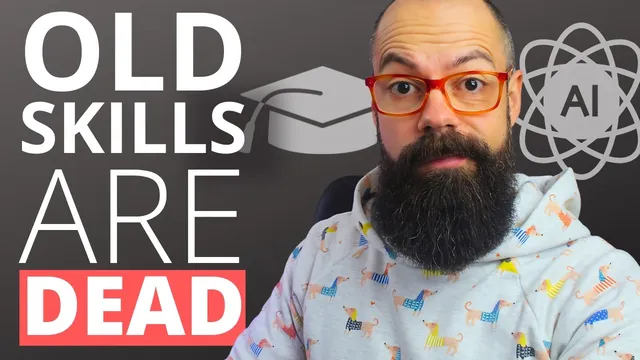
AI Won’t Replace You - But Academics Who Use AI Will
Based on Andy Stapleton's video on YouTube. If you like this content, support the original creators by watching, liking and subscribing to their content.
AI is increasingly automating literature searching, synthesis, and first-draft writing, shifting academic effort toward verification and interpretation.
Briefing
AI literacy is becoming a decisive advantage in research, and institutions that restrict or ban AI are likely to fall behind. The central shift is away from labor-heavy drafting tasks—like searching, summarizing, and producing first drafts—and toward higher-value work such as experimental design, data analysis, interpretation, and the human judgment required to validate claims. In that framing, AI doesn’t eliminate academic skills; it changes what those skills are used for, pushing researchers to spend more time on what makes findings credible rather than on producing text from scratch.
A recurring concern is “skill loss,” especially around literature reviews and early paper drafting. The argument here is that many of those steps are increasingly automated: AI can generate first drafts and synthesize sources quickly. That doesn’t mean researchers stop thinking. Instead, the skill focus shifts toward critical evaluation—breaking down AI-generated drafts, checking logic, interrogating evidence, and ensuring accuracy rather than accepting outputs at face value. The emphasis is on training researchers to scrutinize AI-produced text, not to treat it as an authority. The result is a different kind of academic work: less time “writing the perfect draft,” more time deciding what research questions matter, how to analyze data, and how to craft a defensible research narrative.
The transcript also targets a cultural obsession with suffering in academia. Traditional PhD pathways involved extensive manual effort—finding papers, reading them, and drafting documents. As those processes become easier with AI, the “suffering” changes form. The claim is that insisting on old hardship rituals harms progress, because it preserves outdated training and assessment norms rather than adapting to new tools. Researchers will still face challenges, but the pain will move toward verification: ensuring correctness, consistency, and truth in AI-assisted outputs.
That leads to a direct warning for universities and publishers: redefine success and assessment. If institutions keep measuring achievement by the volume of written output, AI will make that metric meaningless. Instead, evaluation should focus on learning outcomes that AI can’t replicate—robust academic conversation, the ability to interrogate literature, and performance in presentations and discussions. Institutions that cling to guardrails—allowing only narrow AI uses and trying to police “cheating”—risk slowing adoption of more capable “agentic AI” workflows that could expand what studies and analyses are possible.
The transcript’s forward-looking message is blunt: AI-literate researchers will thrive, and the gap between adopters and resisters will widen as AI capabilities grow. The long-term risk is that institutions that tie researchers’ hands now will struggle to catch up later, especially if they prevent full exploration of AI tools for research writing, fact-checking, and downstream steps beyond first drafts. The call is to stop banning AI and instead ask researchers how they want to use it—then update policies and assessment to match what learning and rigor should look like in an AI-augmented academic world.
Cornell Notes
AI is shifting academic work from manual drafting to higher-stakes judgment. Literature reviews and first drafts are increasingly automated, so “skill loss” becomes “skill refocus” toward critical analysis, verification, and stronger research design. The transcript argues that universities and publishers should stop treating writing volume as success and instead assess learning through academic conversation, interrogation of sources, and presentation performance—areas AI can’t replace. Institutions that restrict AI to narrow, heavily policed uses risk falling behind as agentic AI expands what researchers can do. Over time, AI-literate researchers are expected to thrive, widening the gap with those who resist change.
What changes in academic skills when AI can generate first drafts and synthesize sources?
Why does the transcript treat “suffering” in academia as a problem rather than a requirement?
How should institutions redefine “success” for PhD students and researchers?
What’s the risk of banning or tightly restricting AI use in research and publishing?
What does “AI-literate researchers will thrive” mean in practical terms?
Review Questions
- How does the transcript distinguish “skill loss” from “skill shift,” and what new competencies does it prioritize?
- Which assessment criteria does the transcript argue should replace measuring success by writing volume?
- What long-term consequences does it predict for institutions that restrict AI use rather than update policies and evaluation methods?
Key Points
- 1
AI is increasingly automating literature searching, synthesis, and first-draft writing, shifting academic effort toward verification and interpretation.
- 2
“Skill loss” is framed as a “skill refocus”: researchers must learn to critically analyze and validate AI-generated outputs.
- 3
Academic suffering should change form rather than be preserved as an outdated requirement; verification and correctness become the new challenge.
- 4
Universities and publishers should redefine success away from word count and toward learning outcomes like academic conversation, interrogation of sources, and presentation performance.
- 5
Tight AI guardrails can slow research progress by preventing full use of more capable tools, including agentic AI workflows.
- 6
Institutions that resist AI adoption risk widening a long-term gap between AI-literate researchers and those who remain resistant.