AI Won't Be AGI, Until It Can At Least Do This (plus 6 key ways LLMs are being upgraded)
Based on AI Explained's video on YouTube. If you like this content, support the original creators by watching, liking and subscribing to their content.
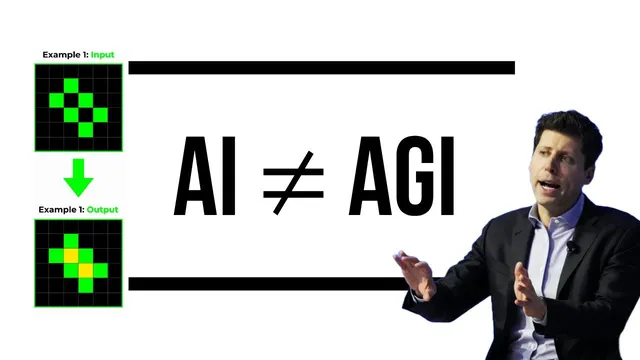
ARC-style abstract reasoning failures are framed as evidence that current LLMs don’t reliably generalize to unseen task structures.
Briefing
Current AI systems fall short of AGI largely because they struggle with genuinely novel abstract reasoning: when a task pattern hasn’t appeared in training, models often can’t generalize, even if they can sometimes recall familiar “reasoning procedures” from prior examples. That gap matters because it reframes today’s breakthroughs as impressive pattern-matching and partial program retrieval—not reliable, on-the-fly problem solving across unfamiliar situations.
A concrete example centers on an abstract reasoning challenge tied to the ARC-style test. The model behavior described is stark: it can’t reliably notice and interpret a grid transformation when the specific configuration wasn’t in its training set. The failure isn’t treated as a minor glitch; it’s presented as evidence that current large language models (LLMs) aren’t “generally intelligent” in the human sense. Instead, they often succeed by retrieving reasoning chains or programs they have effectively seen before. When the needed procedure is missing, the system may produce plausible-sounding but wrong outputs—an issue that shows up not only in benchmark reasoning but also in real-world claims.
From there, the discussion widens into a broader critique of the AI landscape: overpromising and underdelivering, persistent hallucinations, and marketing that outpaces measurable capability. Examples include rolled-back features after error-prone performance, and admissions that even consumer-facing systems can hallucinate. Privacy risks also enter the picture, with concerns about systems that continuously analyze user data such as desktop screenshots. Another major worry is “AI slop”: tools that imitate writing styles can flood platforms with low-quality, high-volume content, making it harder to trust what people read, hear, or share—especially as bots and deepfakes scale.
Yet the narrative refuses a binary “AI is hype” versus “AGI is imminent” framing. The core counterpoint is that the reasoning limitations aren’t necessarily a dead end. Multiple research directions aim to make LLMs more capable at the kind of generalization ARC demands, without relying on naive scaling alone.
Six pathways are highlighted. First is compositional generalization—training models to combine learned reasoning blocks into new structures, with evidence from small transformer models that can mimic aspects of systematic generalization. Second is better program discovery using verifiers and search: approaches that train reward models to flag faulty reasoning steps, or use external simulators to evaluate many candidate solutions. Third is active inference via test-time fine-tuning, where models adapt during evaluation using a small set of examples plus synthetic data to learn the task’s structure on the fly. Fourth is hybrid planning that pairs LLMs with symbolic systems, letting the language model generate candidate plans while a symbolic checker validates and refines them. Fifth is algorithmic grounding through specialized neural components (e.g., graph neural networks) whose learned algorithms are then made usable by language models through embeddings. Sixth is “tacit data” transfer—capturing the unprinted, conversational, and failure-driven knowledge that humans accumulate, especially in mathematics.
The takeaway is pragmatic: AGI isn’t shown as imminent, but progress toward more general reasoning is portrayed as achievable through combinations of training strategies, external verification, adaptive inference, and tighter coupling between language models and tools that can check or execute plans. The most realistic near-term path, the discussion suggests, is not a single leap but a convergence of methods that reduce the reliance on memorized procedures and increase the ability to synthesize new ones when the situation is unfamiliar.
Cornell Notes
The central claim is that today’s LLMs aren’t AGI because they often fail on genuinely novel abstract reasoning tasks—especially when the exact pattern or procedure wasn’t present in training. Their partial strength comes from recalling reasoning chains they’ve effectively seen before, not from reliably synthesizing new solutions on the fly. The discussion then argues against “all hype” and “all doom” by pointing to six research directions that could close the gap: compositional generalization, verifier/search-based program selection, test-time fine-tuning (active inference), hybrid neural-symbolic planning, algorithm embeddings from specialized networks, and learning from tacit human knowledge. The practical implication is that progress likely comes from combining methods that add adaptation and external checking rather than simply scaling parameters and data.
Why does an ARC-style abstract reasoning failure count as evidence against AGI?
What’s the difference between “recalling reasoning procedures” and “doing fresh reasoning,” and why does it matter?
How do verifiers and Monte Carlo tree search reduce reasoning errors?
What is “active inference” in this context, and why is test-time fine-tuning emphasized?
Why might hybrid neural-symbolic planning outperform LLM-only planning?
What does “tacit data” mean, and how could it change AI progress expectations?
Review Questions
- What specific capability gap between memorized procedures and synthesized reasoning is used to explain ARC-style failures?
- Which two approaches rely on external evaluation (verifiers/simulators or symbolic checkers), and how do they change the model’s failure modes?
- Why does the transcript argue that naive scaling (more parameters/data) is insufficient for generalization to novel tasks?
Key Points
- 1
ARC-style abstract reasoning failures are framed as evidence that current LLMs don’t reliably generalize to unseen task structures.
- 2
LLM “reasoning” is often treated as retrieval of familiar reasoning chains rather than synthesis of new procedures when the pattern is novel.
- 3
Hallucinations and overhyped marketing are presented as symptoms of systems optimized for fluent output rather than guaranteed correctness.
- 4
The “AI slop” problem is described as a trust and information-quality crisis amplified by bots and style-mimicking tools.
- 5
Research progress toward more general intelligence is organized around six directions: compositional generalization, verifier/search methods, active inference via test-time fine-tuning, neural-symbolic planning, algorithm embeddings, and learning from tacit human knowledge.
- 6
External checking—through simulators, reward models, or symbolic systems—is repeatedly emphasized as a practical way to reduce wrong reasoning.
- 7
Near-term improvement is portrayed as achievable through combinations of methods rather than a single leap to AGI.