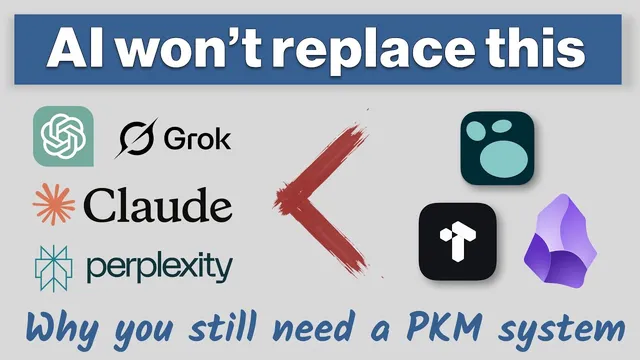
AI won't replace THIS: Why you still need a PKM system
Based on CombiningMinds's video on YouTube. If you like this content, support the original creators by watching, liking and subscribing to their content.
Treat PKM as a connection system, not just a fast retrieval tool, because serendipitous links often generate the best insights.
Briefing
AI can answer questions instantly, but that speed comes with a cost: it reduces the randomness, friction, and personal context that make knowledge stick and ideas grow. The core case for a Personal Knowledge Management (PKM) system is that outsourcing “second brain” work to large language models risks turning learning into consumption—fast retrieval without the grounding, synthesis, and emotional/creative work that produces real understanding.
A central theme is the “beauty of unoptimized search.” PKM isn’t just about finding information quickly; it’s about connecting dots across notes, projects, and memories. AI-style precision tends to eliminate serendipity—unexpected results that can trigger new lines of thought. The transcript describes how wandering through old nodes can produce “mind sparks,” including seemingly odd connections (e.g., a note about Tibetan Buddhism’s “rainbow bodies” surfacing while reading unrelated material). These detours matter because solutions often come as discontinuous stepping stones rather than a straight path. In that framing, PKM creates conditions for generative exploration: you don’t merely retrieve answers; you stumble into new questions.
Grounding the abstract is another pillar. Writing is presented as a thinking tool—like doing calculations by hand—because externalizing ideas onto a page forces clarification, exposes logical gaps, and enables revision over time. The transcript also links writing to emotional grounding: journaling in a private space helps convert a “swirling mass” of thoughts into manageable, taggable items that can be revisited without clinging to them. Just as important is engaging past versions of yourself. Notes act like time capsules, showing how thinking and interests evolved, revealing patterns that repeat, and offering perspective during difficult periods.
From there, personalization becomes the differentiator. A PKM system should reflect an individual’s priorities, context, and workflow—not a generalized “everyone’s second brain.” The transcript gives a practical example: when researching cloud hosting alternatives, prior notes can surface specific tools and even relevant conversations, enabling context-rich problem solving that a generic AI query is unlikely to replicate.
The argument then turns to friction as a feature. AI can provide streams of information, but comprehension happens at the point of wrestling—summarizing, refactoring notes, writing in one’s own words, and building scratch pads. That resistance embeds concepts into memory and creates cognitive conditions for connections. The goal isn’t speed; it’s a process that makes knowledge uniquely yours.
Finally, the transcript stresses humanity, privacy, and wise use of AI. Human thought and lived experience—especially in writing and poetry—are treated as irreplaceable. PKM is framed as a protected space that supports organic reflection and helps resist overreliance. AI is positioned as additive: editing, transcription/OCR, routine fact-finding, and surfacing connection candidates (with the actual linking done by the human). The takeaway is a pro-PKM, pro-AI-augmentation stance: build a system that preserves cognitive autonomy, then use AI to handle the grunt work so deeper understanding can still be earned.
Cornell Notes
The case for a Personal Knowledge Management (PKM) system is that instant AI retrieval can’t replace the human work that turns information into understanding. PKM preserves serendipity, grounding, and personalization—especially through writing, journaling, and revisiting past notes that act like time capsules. The transcript argues that friction (summarizing, refactoring, and expressing ideas in one’s own words) is what makes knowledge stick and enables genuine connections. AI should be used as an additive tool—editing, transcription/OCR, quick searches, and connection suggestions—while the user maintains responsibility for synthesis. In short: AI can accelerate tasks, but PKM protects cognitive autonomy and keeps learning uniquely “yours.”
Why does “unoptimized search” matter if AI can retrieve exactly what you ask for?
How does writing function as more than documentation in a PKM system?
What does “engaging past versions of yourself” add to learning?
Why is personalization a key PKM advantage over generalized AI help?
What role does friction play, and why isn’t speed the main objective?
How should AI be used alongside PKM rather than instead of it?
Review Questions
- What specific kinds of “serendipity” does PKM protect that AI precision can remove, and how does that affect creativity?
- Which stages of understanding in the transcript depend on friction (e.g., summarization, refactoring, writing), and why are those stages necessary?
- How does personalization change the quality of problem-solving compared with asking an AI a generic question?
Key Points
- 1
Treat PKM as a connection system, not just a fast retrieval tool, because serendipitous links often generate the best insights.
- 2
Use writing to ground abstract ideas: externalizing thoughts exposes gaps, enables revision, and improves clarity over time.
- 3
Journal and tag emotional and cognitive states to convert vague mental noise into manageable, revisit-able artifacts.
- 4
Build a system that reflects personal context and workflow, since generalized “second brains” can’t carry the same lived references.
- 5
Protect learning by embracing friction—summarizing, refactoring, and expressing ideas in your own words are what make knowledge stick.
- 6
Use AI as an additive layer for routine tasks (editing, transcription/OCR, quick searches) and for suggesting connection candidates, while keeping synthesis and meaning-making human.
- 7
Maintain privacy and cognitive autonomy by keeping some material local and preserving time for reflection without AI dependence.