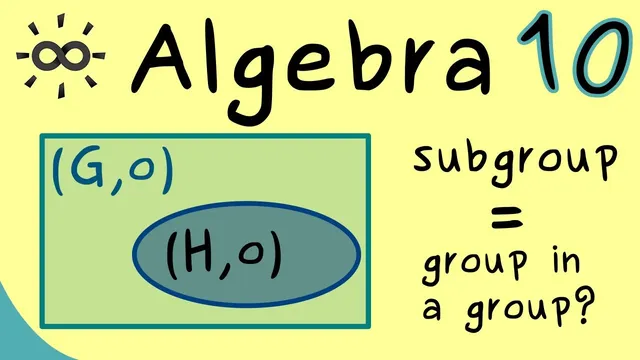
Algebra 10 | Subgroups
Based on The Bright Side of Mathematics's video on YouTube. If you like this content, support the original creators by watching, liking and subscribing to their content.
A subgroup H of a group G is a nonempty subset that becomes a group when the operation is restricted to H.
Briefing
A subgroup is a smaller group hiding inside a bigger group: pick a nonempty subset H of a group G, keep the same binary operation, and require that H itself becomes a group. The payoff is practical—once the subgroup conditions are met, there’s no need to re-check every group axiom from scratch, because associativity and the operation structure already come from G.
The video starts with the intuition of “embedding” one algebraic structure into another. A concrete example anchors the idea: the real numbers R under addition contain the integers Z under addition, and Z forms a subgroup of R. This sets up the central question for the lesson: how to recognize when a subset of a group is actually a subgroup, and what properties must hold.
Formally, a group G consists of a set with an associative binary operation, an identity element e, and inverses for every element. A subset H ⊆ G (with H ≠ ∅) is called a subgroup when H, using the same binary operation restricted to elements of H, is itself a group. The key simplification is that associativity automatically holds on H because it already holds on G. That leaves only two essential checks: (1) closure under the operation and (2) closure under inverses.
That leads to the main criterion: H is a subgroup of G if and only if for all A, B in H, the product A ∘ B lies in H, and for every A in H, the inverse A⁻¹ also lies in H. The lesson justifies why these two conditions are enough. If H already forms a group, closure is immediate, and inverses stay inside H. Conversely, if closure under the operation and inverses holds, then associativity is inherited from G, and the identity element e must land in H: pick any a in H (possible because H is nonempty), then a⁻¹ is in H by the inverse-closure rule, and combining a with a⁻¹ stays in H by closure—yielding e. With identity and inverses in place, H becomes a group, hence a subgroup.
The video then frames subgroup examples in two extremes. Every group G has at least two “trivial” subgroups: {e} (the smallest possible subgroup) and G itself (the largest). For nontrivial groups, there are at least these two distinct subgroups.
Finally, it gives an infinite family of concrete subgroups in the integers. For any natural number m, the set mZ of multiples of m—written as {m·k : k ∈ Z}—forms a subgroup of Z under addition. This produces infinitely many subgroups of Z. The discussion also points ahead to a broader theme: once a subgroup H exists, it becomes possible to form new groups built from cosets, leading toward the quotient construction G/H, which will be treated next.
Cornell Notes
A subgroup is a nonempty subset H of a group G that becomes a group when the operation is restricted to H. Because associativity already holds in G, subgroup verification boils down to two closure properties: for any A, B in H, the product A ∘ B must stay in H, and for any A in H, the inverse A⁻¹ must also lie in H. If these two conditions hold (and H is not empty), the identity element e must belong to H as well, since picking a ∈ H gives a ∘ a⁻¹ = e. This is why the test is both necessary and sufficient. The lesson illustrates with Z inside R under addition and with mZ (multiples of m) as subgroups of Z.
Why does checking associativity not matter when testing whether H is a subgroup of G?
What two conditions are necessary and sufficient for H ⊆ G to be a subgroup?
How do closure properties guarantee that the identity element e is in H?
What are the trivial subgroups of any group G?
Why is mZ a subgroup of Z under addition for any natural number m?
Review Questions
- State the subgroup test for a nonempty subset H ⊆ G and explain why it is sufficient.
- Given a subset H of a group G, how would you prove the identity element e lies in H using only closure under inverses and closure under the operation?
- List the trivial subgroups of a group G and give an example of a nontrivial subgroup in Z.
Key Points
- 1
A subgroup H of a group G is a nonempty subset that becomes a group when the operation is restricted to H.
- 2
Associativity on H is automatic because it already holds on G; subgroup checks focus on identity and inverses only after closure is established.
- 3
H is a subgroup of G exactly when it is closed under the group operation and closed under taking inverses.
- 4
Nonemptiness matters: it allows selecting an element a ∈ H so that a ∘ a⁻¹ forces the identity e into H.
- 5
Every group has at least two trivial subgroups: {e} and G itself.
- 6
In (Z, +), the sets mZ of multiples of m form subgroups for every natural number m.
- 7
Subgroups enable building new group structures later via quotient constructions like G/H.