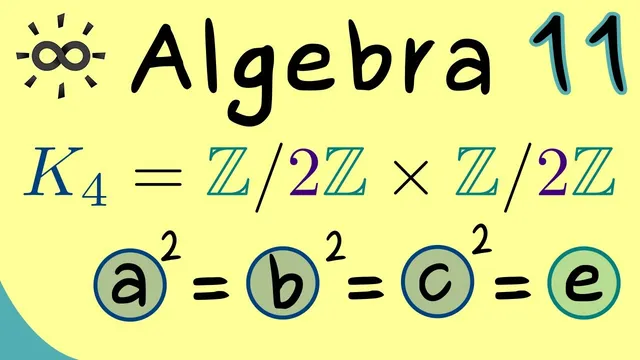
Algebra 11 | Klein Four-Group
Based on The Bright Side of Mathematics's video on YouTube. If you like this content, support the original creators by watching, liking and subscribing to their content.
Klein four-group K4 can be realized as the four symmetries of a non-square rectangle: identity e, 180° rotation a, and two reflections b and c.
Briefing
The Klein four-group (often written K4) is built from the symmetries of a non-square rectangle: doing nothing, rotating the rectangle 180°, and reflecting it across two perpendicular axes. Those four symmetry operations form a group because combining any two operations produces another operation from the same set, the operation is associative, and every element is its own inverse. In the transcript’s notation, the identity is e, the 180° rotation is a, one reflection is b, and the other reflection is c—yielding a group of order four.
To make the group structure explicit, the operations are organized into a multiplication table. The identity e leaves everything unchanged in both the first row and first column. The rotation a has the property a² = e, and each reflection also squares to the identity: b² = e and c² = e. The table also encodes how different symmetries combine: composing a with b produces c, and composing a with c produces b (with the remaining products determined similarly by the symmetry rules). With the full table in hand, associativity is verified by checking all cases, confirming that these four elements with the table-defined binary operation form a well-defined group.
The discussion then shifts from constructing K4 to analyzing its subgroups (called “subcubes” in the transcript’s terminology). A general criterion is recalled: for a non-empty subset H of a group G, H is a subgroup exactly when the binary operation stays within H (i.e., H is closed under the operation). For finite groups, this closure condition becomes especially efficient because it’s enough to guarantee that H is a subgroup—no separate inverse-check is needed.
Applying this to the Klein four-group, the transcript identifies all subgroups. There is always the trivial subgroup consisting only of the identity {e}. Next come the subgroups of size two: {e, a} is one, and closure forces the other two-element subgroups to be {e, b} and {e, c}. A three-element subgroup is ruled out because no subset of size three can remain closed under the group’s operation. That leaves only the full group K4 itself as the remaining subgroup.
In total, K4 has exactly five subgroups: the trivial subgroup, three distinct subgroups of order two, and the whole group. Even though the group is small, its subgroup pattern illustrates a broader strategy for understanding groups: studying subgroups can reveal structural information about the group itself, setting up the next step toward general characterizations of groups through their subgroups.
Cornell Notes
The Klein four-group K4 can be modeled using the symmetries of a non-square rectangle: identity e, a 180° rotation a, and two reflections b and c. These four operations form a group of order 4, with a² = b² = c² = e and combinations like a·b = c (and similarly for the other products). A subgroup test is used: for a finite group, a non-empty subset H is a subgroup as soon as it is closed under the group operation. Applying that to K4 shows there are exactly five subgroups: {e}, {e,a}, {e,b}, {e,c}, and K4 itself. No subgroup of size three exists because closure fails for any such choice.
Why do the four rectangle symmetries form a group, and what makes each element its own inverse?
How does the multiplication table encode relationships like a·b = c?
What subgroup criterion is used for finite groups, and why does it simplify the check?
Which subgroups of K4 exist, and how are the size-two ones determined?
Why can’t K4 have a subgroup with three elements?
Review Questions
- What are the four elements of K4 in the rectangle-symmetry model, and what are their defining properties (like a² = e)?
- State the finite-group subgroup test used here and apply it to decide whether a given subset of K4 is a subgroup.
- List all subgroups of K4 and explain why no subgroup of size three can exist.
Key Points
- 1
Klein four-group K4 can be realized as the four symmetries of a non-square rectangle: identity e, 180° rotation a, and two reflections b and c.
- 2
In K4, every element is its own inverse, with a² = e, b² = e, and c² = e.
- 3
A multiplication table for K4 encodes composition of symmetries, including relations such as a·b = c.
- 4
For finite groups, a non-empty subset H is a subgroup exactly when it is closed under the group operation.
- 5
K4 has exactly five subgroups: {e}, {e,a}, {e,b}, {e,c}, and K4 itself.
- 6
No subgroup of size three exists in K4 because any three-element subset fails closure under the operation.