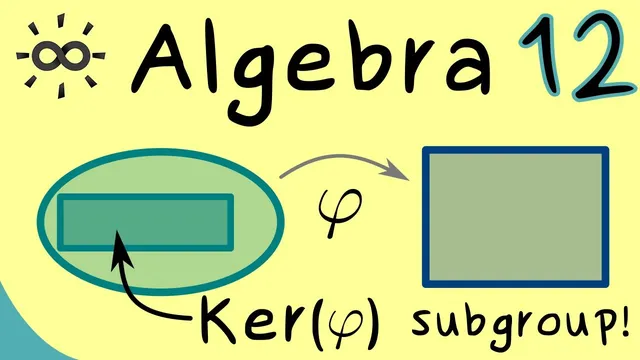
Algebra 12 | Subgroups under Homomorphisms
Based on The Bright Side of Mathematics's video on YouTube. If you like this content, support the original creators by watching, liking and subscribing to their content.
A homomorphism f: G → H preserves subgroup structure: f(U) is a subgroup of H whenever U is a subgroup of G.
Briefing
A group homomorphism doesn’t just carry elements from one group to another—it reliably carries subgroup structure with it. If U is a subgroup of a group G and f: G → H is a homomorphism, then the image f(U) is always a subgroup of H. Likewise, if V is a subgroup of H, then the pre-image f⁻¹(V) is always a subgroup of G. This “subgroups under homomorphisms” principle is the backbone for later results about kernels, ranges, and quotient-style constructions.
The key setup starts with two groups (G, ⋆) and (H, ⊕) and a homomorphism f that preserves the group operation: f(a ⋆ b) = f(a) ⊕ f(b). On the subgroup side, U ⊆ G is a subgroup when it’s closed under the operation and inverses (and contains the identity automatically once closure/inverses are established). The question then becomes whether f(U) ⊆ H inherits those subgroup properties. The answer is yes: take any two elements a, b in f(U). By definition of image, there exist x, y in U with f(x) = a and f(y) = b. Using homomorphism preservation, the product a ⊕ b equals f(x) ⊕ f(y) = f(x ⋆ y). Since U is a subgroup, x ⋆ y lies in U, so f(x ⋆ y) lies in f(U). The same closure logic applies to inverses: if a = f(x) is in f(U), then a⁻¹ = f(x)⁻¹ = f(x⁻¹), and x⁻¹ is in U because U is a subgroup. With closure under the operation and inverses, f(U) is a subgroup of H.
The reverse direction uses the pre-image. For a subgroup V ⊆ H, define f⁻¹(V) = {g in G : f(g) is in V}. To show it’s a subgroup, pick elements x, y in f⁻¹(V). Then f(x) and f(y) are in V. Because f(x ⋆ y) = f(x) ⊕ f(y), and V is closed under ⊕, the element f(x ⋆ y) lies in V—so x ⋆ y lies in f⁻¹(V). Inverses work similarly: if f(x) is in V, then f(x)⁻¹ is in V, and homomorphisms preserve inverses via f(x⁻¹) = f(x)⁻¹, so x⁻¹ also lies in f⁻¹(V). Together, these checks confirm that pre-images of subgroups under homomorphisms are subgroups.
Two especially important special cases follow immediately. First, the kernel of f is the pre-image of the identity element e in H: ker(f) = f⁻¹({e}). It consists of exactly those elements of G that map to e. Second, the range (or image) of f is the image of all of G: range(f) = f(G) (often written Im(f)). The lesson then lands on a concrete example: define a homomorphism f: (Z, +) → (Z₂, ⊕) by sending even integers to the identity element e and odd integers to the other element a. Under this map, the kernel is precisely the even integers, written 2Z, confirming that ker(f) forms a subgroup of Z.
Cornell Notes
Homomorphisms preserve subgroup structure in both directions. If U ≤ G and f: G → H is a group homomorphism, then the image f(U) is a subgroup of H because closure under the operation and inverses transfers through f. If V ≤ H, then the pre-image f⁻¹(V) = {g ∈ G : f(g) ∈ V} is a subgroup of G for the same reason: homomorphism preservation ensures products and inverses stay inside V. Two key subgroups arise from this: the kernel ker(f) = f⁻¹({e}) and the range Im(f) = f(G). In the example f: Z → Z₂ sending even numbers to e and odd numbers to a, the kernel is 2Z.
Why does the image f(U) of a subgroup U under a homomorphism always stay closed under the group operation?
How does closure under inverses work for f(U)?
What is the pre-image f⁻¹(V), and why is it a subgroup when V is a subgroup of H?
How do kernel and range fit into the general image/pre-image results?
In the example f: (Z, +) → (Z₂, ⊕) that sends even integers to e and odd integers to a, what is ker(f) and why?
Review Questions
- If U ≤ G, what two subgroup properties must be checked to prove f(U) ≤ H, and how does the homomorphism property help each check?
- Given V ≤ H, how do you show that for x, y ∈ f⁻¹(V), the element x ⋆ y is still in f⁻¹(V)?
- Why is ker(f) always a subgroup of G, and what elements does it contain in terms of f?
Key Points
- 1
A homomorphism f: G → H preserves subgroup structure: f(U) is a subgroup of H whenever U is a subgroup of G.
- 2
The image f(U) is closed under the operation because f(x ⋆ y) = f(x) ⊕ f(y) and U is closed under ⋆.
- 3
The image f(U) is closed under inverses because f(x⁻¹) = f(x)⁻¹ and U contains inverses of its elements.
- 4
For any subgroup V ≤ H, the pre-image f⁻¹(V) = {g ∈ G : f(g) ∈ V} is a subgroup of G.
- 5
The kernel ker(f) = f⁻¹({e}) is the subgroup of elements mapping to the identity in H.
- 6
The range (image) Im(f) = f(G) is the subgroup of H consisting of all values f takes.
- 7
In the parity homomorphism f: Z → Z₂ (even → e, odd → a), the kernel is exactly 2Z (the even integers).