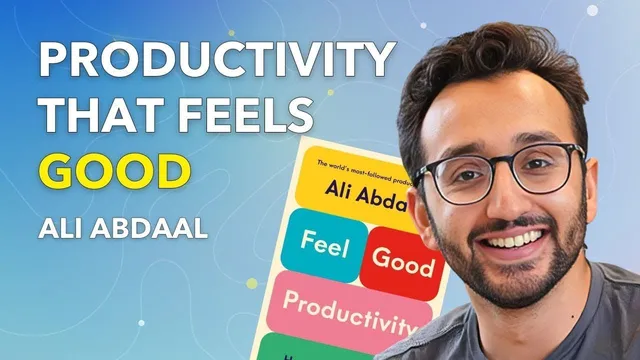
Ali Abdaal - The Keys to Joyful Work and Being Batman (or Professor X)
Based on Linking Your Thinking with Nick Milo's video on YouTube. If you like this content, support the original creators by watching, liking and subscribing to their content.
Ali Abdaal frames sustainable productivity as alignment: burnout often signals that work no longer matches what energizes the person, not just that effort is insufficient.
Briefing
Ali Abdaal’s central message is that sustainable productivity comes from alignment—choosing work that matches what actually energizes a person—and from designing the conditions that make effort feel good. He frames burnout and creative output not as a motivation problem but as a signal that either recovery is missing or the work has drifted away from personal meaning. The practical through-line is to keep experimenting, build environments that support action, and use reflective prompts to steer back toward a “north star” rather than chasing relentless consistency.
A major thread runs through how Abdaal built his career: long-term seeds planted years before execution. He wanted to start a YouTube channel as early as 2010, but perfectionism, gear anxiety, and imposter syndrome delayed his first uploads until 2017. When he finally began, his early videos were musical covers made with friends—low-stakes practice that helped him overcome the fear of being seen. He connects this to a broader pattern: skills and interests accumulate until they “connect the dots.” Web design and entrepreneurship experiments in his early teens, plus years of tutoring, later fed directly into content creation—teaching medical school hopefuls with production value, thumbnails, and a clear instructional style.
Abdaal also argues that experimentation is the engine of growth. Some series he labored over—like a science breakdown of Harry Potter—flopped, while other formats, such as his “book club” content, found traction and even influenced author book sales. The lesson is not to treat failure as a verdict, but as data: keep running trials, double down on what works, and accept that creative projects often need multiple attempts before they land.
On burnout, he distills it into three types: overexertion burnout (working too hard), depletion burnout (working too long without breaks), and misalignment burnout (doing something that may look successful from the outside but doesn’t match what lights the person up). Misalignment is the most dangerous for high achievers because it can persist despite external rewards. To counter it, he recommends reflective planning tools like the “Odyssey plan,” which asks people to imagine their lives 3–5 years ahead on both the current path and alternative paths—especially when money and other people’s opinions don’t matter.
He ties recovery to real-world constraints through a story from emergency medicine: a consultant forced him to take lunch and cited a hard rule—do not go more than four hours without a break for at least half an hour—because doctors who skip breaks risk patient safety and their own burnout. That story becomes a metaphor for “permission” to rest: productivity isn’t just pushing through; it’s scheduling recovery.
Abdaal’s “Batman effect” adds another layer: people can boost creativity and resilience by adopting an alter ego. For him, wearing glasses functions as a cue to embody a teacher-like identity—someone who learns and shares sincerely. He ends with a challenge prompt: ask, for the next task, “What would this look like if it were fun?”—then act on whatever answer appears, as long as basic needs are met. The combined message is pragmatic and psychological: build environments, take breaks, experiment without fear, and keep steering toward work that feels aligned.
Cornell Notes
Ali Abdaal links joyful, sustainable productivity to alignment and recovery rather than willpower alone. He describes burnout in three forms—overexertion, depletion, and misalignment—arguing that the last one is common among successful people who are pursuing the “right” outcomes with the “wrong” inner purpose. He recommends reflective tools like the Odyssey plan to compare future lives on the current path versus alternative paths when money and approval don’t matter. He also emphasizes experimentation (some series flop, others compound) and uses concrete recovery rules from emergency medicine to show that breaks are safety-critical. Finally, he uses identity cues (the “Batman effect”) and a simple prompt—“What would this look like if it were fun?”—to make work feel energizing.
How did Ali Abdaal’s early interests and skills eventually converge into his YouTube and teaching career?
What are the three types of burnout, and why does misalignment matter most?
What does “experimentation” look like in his content strategy?
How does he connect breaks to both safety and sustainability?
What is the “Batman effect,” and how does it function for him personally?
What is the practical prompt he gives for making work feel more doable?
Review Questions
- Which of the three burnout types best matches your current situation—overexertion, depletion, or misalignment—and what evidence supports that choice?
- How would you use the Odyssey plan to compare your current path with an alternative path if money and approval didn’t matter?
- Pick one recurring task you avoid. What would it look like if it were fun, and what is the smallest next step you could take within 24 hours?
Key Points
- 1
Ali Abdaal frames sustainable productivity as alignment: burnout often signals that work no longer matches what energizes the person, not just that effort is insufficient.
- 2
He distinguishes three burnout types—overexertion, depletion, and misalignment—and treats misalignment as the most common trap for high achievers.
- 3
Long-term success can come from delayed execution: early seeds (teaching, web skills, entrepreneurship experiments) can mature into a career years later.
- 4
Creative growth depends on experimentation: series can flop without being wasted effort, because each trial provides feedback for what to double down on.
- 5
Breaks are not optional for sustainability; in emergency medicine, a hard rule limits how long doctors can go without a recovery break to protect both safety and morale.
- 6
Identity cues can unlock creativity and resilience; the “Batman effect” describes how imagining an alter ego improves performance and emotional steadiness.
- 7
A simple reframing prompt—“What would this look like if it were fun?”—can turn avoided work into an actionable, more enjoyable next step.