Aliens: Are We Looking in the Wrong Place?
Based on minutephysics's video on YouTube. If you like this content, support the original creators by watching, liking and subscribing to their content.
Most individuals are statistically more likely to belong to larger groups than to smaller ones, so humans should expect to be part of a relatively high-population intelligent species.
Briefing
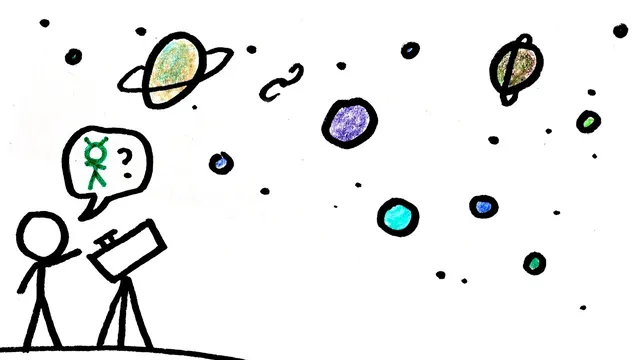
The hunt for intelligent extraterrestrials may be failing for a simple reason: it assumes aliens will resemble Earth. With so many planets in the observable universe, basic statistics and physics suggest intelligent life is more likely to be found in systems that are not Earth-like at all—smaller, dimmer, and hazier—because the “typical” intelligent species should be the one with a large population, and population size strongly shapes a species’ physical and environmental traits.
The argument starts from scale. The observable universe contains hundreds of billions of galaxies, each with billions or trillions of stars, and most stars host planets. That implies roughly a million billion billion planets. If even a small fraction of those planets support intelligent life, there should be many intelligent species—likely with a wide range of sizes and habitats.
The key statistical move is to distinguish between the properties of a typical individual and the properties of a typical group. When groups vary in size, most individuals belong to the larger groups. The transcript illustrates this with everyday examples: most humans live in very large countries, most people follow very large religions, and most Premier League fans support huge fanbases like Manchester United rather than small ones. Translating that logic to extraterrestrials means humans should expect to be members of a relatively large-population intelligent species—because we are individuals, and individuals are more likely to be found in big groups.
Once population size is treated as the anchor, physics supplies the constraints. Individual organisms require space and energy. Species with high population tend to occupy larger habitable worlds, while smaller organisms can pack more densely. That leads to a counterintuitive prediction: if humans belong to a high-population intelligent species, then Earth should be larger than most other habitable planets with intelligent life, and humans should be physically smaller than most other intelligent species.
Energy availability then links biology to stellar and atmospheric conditions. Maintaining large populations is easier with abundant energy, so intelligent species with smaller populations should typically orbit stars that are cooler, dimmer, and farther away than our Sun. Their planets should also receive light differently—implying atmospheres that are less transparent (more opaque or hazy) to their stars’ radiation.
With additional simplifying assumptions, the predictions become more specific. Researchers cited in the transcript estimate that the population of most intelligent alien species should fall below 20 million individuals, and that most habitable planets hosting intelligent life should have radii under about 80% of Earth’s. The typical intelligent alien individual should also be at least as massive as polar bears.
Taken together, the search strategy flips: instead of prioritizing nearby “Earth-like” worlds, the more promising targets may be habitable planets that are slightly smaller, darker, and hazier—because the universe’s intelligent species are expected to resemble the “big fanbase” end of the statistical distribution, making humans closer to the Manchester United of the cosmos than to a random, ordinary team.
Cornell Notes
The transcript argues that the search for intelligent aliens should not start with “Earth-like” planets. With an enormous number of planets, many intelligent species likely exist, and statistics says individuals are more likely to belong to large groups than to small ones. Since humans are individuals, humans should belong to an intelligent species with a relatively high population compared with most other intelligent species. Physics then ties population size to planetary and stellar conditions: high-population species should live on larger worlds, have smaller bodies, and benefit from more available energy. That implies most intelligent aliens would be larger than humans, live in smaller groups on smaller, dimmer, and hazier planets—so the best targets may be habitable worlds that are not Earth-like.
Why does the argument shift from “typical planet” to “typical individual” when predicting alien traits?
How does population size connect to planet size and organism size?
What stellar and atmospheric conditions follow from the idea that most intelligent species have smaller populations?
What quantitative predictions are given for alien species and their planets?
How does the conclusion change the practical search strategy for extraterrestrial intelligence?
Review Questions
- If individuals are more likely to belong to larger groups, what does that imply about the population size of the intelligent species humans belong to compared with most other species?
- Which physical factors (space, energy, organism size) are used to connect population size to planet size and to the likely properties of alien stars and atmospheres?
- How do the predictions about alien planet radii and stellar brightness change the criteria for selecting targets in the search for intelligent life?
Key Points
- 1
Most individuals are statistically more likely to belong to larger groups than to smaller ones, so humans should expect to be part of a relatively high-population intelligent species.
- 2
If a species has a high population, physics suggests it may require more habitable area, implying Earth could be larger than most other habitable worlds with intelligent life.
- 3
High-population species can also be consistent with smaller body sizes, since smaller organisms need less space and energy per individual.
- 4
Lower-energy environments should be common for most intelligent species, implying their stars are typically cooler, dimmer, and farther away than the Sun.
- 5
Atmospheric conditions should follow energy and light-transport needs, leading to planets that are more hazy or less transparent to their stars’ light.
- 6
Quantitative estimates cited include alien species populations typically below 20 million, habitable planet radii often under 80% of Earth’s, and individual masses at least comparable to polar bears.
- 7
The search strategy may work better by targeting habitable planets that are smaller, darker, and hazier rather than strictly Earth-like worlds.