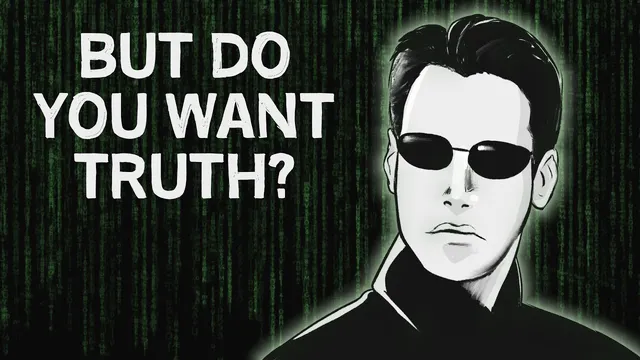
All I’m Offering is the Truth | The Philosophy of the Matrix
Based on Einzelgänger's video on YouTube. If you like this content, support the original creators by watching, liking and subscribing to their content.
Plato’s cave shows that truth can provoke ridicule because it destabilizes identity and social order, not just beliefs.
Briefing
“Do people actually want the truth?” The Matrix, read through Plato’s Allegory of the Cave, suggests the uncomfortable answer is: often, not in the way they claim. Truth can be liberating, but it also threatens identity, destroys comforting narratives, and can make life feel worse—so many people hide from it, soften it, or replace it with a more livable story.
In Plato’s cave, chained prisoners can only watch shadows cast on a wall, mistaking projections for reality. When one prisoner is freed, he struggles with the shock of sunlight and then realizes the world he trusted was an illusion. Yet when he returns to tell others, ridicule and resistance follow—because the truth demands a painful reorientation. The Matrix mirrors this structure: Neo, living inside a simulated world, discovers that his “reality” is a prison maintained by systems that keep people from seeing the underlying mechanism. Morpheus frames the choice as a red pill that leads “down the rabbit hole” into what’s real, but the shift is not portrayed as purely uplifting. Neo initially rejects what he learns, asking whether he can go back, and Morpheus counters with a sharper question: if escape were possible, would Neo even want it? The implication is that denial is a predictable human response when reality threatens the foundations of selfhood.
The contrast between Plato and The Matrix sharpens the argument. Plato’s liberated world is brighter, more beautiful, and offers freedom of movement—an ascent that feels like progress. The Matrix flips the emotional valence: the “real world” is bleak, sunless, and dominated by machines, while the simulated world provides pleasures, color, and a sense of normalcy. That makes the central moral tension harder: if truth comes with suffering, some people may prefer the cave even after seeing its walls. Cypher embodies that logic. He regrets taking the red pill, calls ignorance “bliss,” and chooses to re-enter the Matrix in exchange for wealth, influence, and the erasure of memories. His decision isn’t ignorance born of innocence—it’s a conscious trade of freedom for comfort.
Still, the story doesn’t reduce truth to a simple villain. Neo eventually embraces reality and takes on the role of the enlightened figure who bears responsibility for others, even when the truth is resisted. The Matrix also complicates the idea that knowing something is fake automatically kills enjoyment. Programs like the Oracle and characters such as the Merovingian appear to savor the simulated world—cookies, cigarettes, sunsets, romance—suggesting humans can practice “suspension of disbelief,” temporarily setting aside skepticism to enjoy what isn’t real.
Across both Plato and The Matrix, the takeaway is that people don’t just want facts; they want meaning, belonging, and a story that fits. Truth can uplift, depress, or destabilize depending on who receives it. Sometimes people defend a comforting illusion with their lives; sometimes they reject truth to preserve identity. The result is a conditional answer to the opening question: people want truth only when it supports the life they’re able—or willing—to live.
Cornell Notes
Plato’s Allegory of the Cave and The Matrix both treat “truth” as a destabilizing force. Liberation brings a shift from shadows to reality, but the freed person often meets resistance because the new knowledge threatens identity and comfort. The Matrix intensifies the dilemma by making the real world harsher than the simulated one, which helps explain Cypher’s choice to return to the Matrix for blissful ignorance. At the same time, characters like the Oracle suggest that people can still enjoy an illusion through “suspension of disbelief.” Overall, the desire for truth depends less on truth itself than on the person, the costs of knowing, and the stories that provide meaning and belonging.
How does Plato’s cave illustrate why truth can trigger resistance rather than gratitude?
Why does The Matrix complicate the “truth = better life” equation compared with Plato?
What role does denial play when someone confronts a reality-shattering truth?
How does Cypher’s arc answer the question “Do people want the truth?”
What is “suspension of disbelief,” and how does it explain enjoyment inside an illusion?
Why does the transcript end up arguing that people may want “a story” more than “the truth”?
Review Questions
- In what ways do Plato’s freed prisoner and Neo face different kinds of “costs” after learning the truth?
- What does Cypher’s decision reveal about the relationship between truth, freedom, and psychological comfort?
- How does suspension of disbelief challenge the idea that knowing something is fake automatically eliminates enjoyment?
Key Points
- 1
Plato’s cave shows that truth can provoke ridicule because it destabilizes identity and social order, not just beliefs.
- 2
The Matrix mirrors the cave structure but makes the “real world” harsher, raising the possibility that comfort can outweigh truth.
- 3
Neo’s initial refusal highlights denial as a predictable response when reality threatens core assumptions.
- 4
Cypher demonstrates a direct trade: he chooses blissful ignorance, wealth, and memory erasure over freedom and painful truth.
- 5
The transcript argues that people often enjoy illusions through “suspension of disbelief,” even when they know the illusion is artificial.
- 6
Across both stories, the desire for truth depends on the person and the costs of knowing, not only on whether the information is correct.
- 7
The strongest concluding claim is that humans may prefer a meaningful story—one that enables belonging—over “the truth” itself.