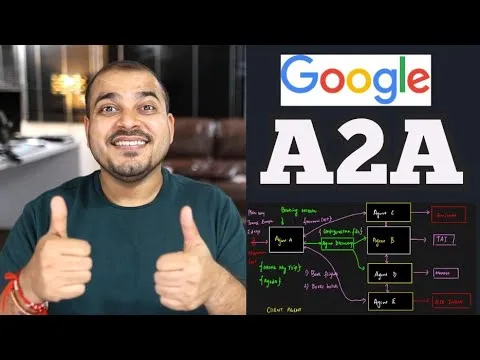
All You Need To Know About Google Agent2Agent Protocol- A2A Vs MCP
Based on Krish Naik's video on YouTube. If you like this content, support the original creators by watching, liking and subscribing to their content.
Google’s Agent2Agent (A2A) protocol standardizes secure communication between AI agents owned by different organizations.
Briefing
Google’s Agent2Agent (A2A) protocol is designed to let AI agents securely discover each other, exchange information, and coordinate actions across different enterprise platforms—so one agent can delegate parts of a task to specialized agents owned by other companies. The practical payoff is interoperability: if a travel site, a flight provider, or a hotel chain exposes its capabilities as agents, other agents can plug into those capabilities and assemble an end-to-end workflow such as “plan a trip with minimum cost.” Google positions A2A as an open protocol that complements Anthropic’s Model Context Protocol (MCP), aiming to solve the “agent-to-agent” communication gap rather than just tool/context access.
A2A’s core mechanics start with agent discovery and a shared configuration model. Each agent is registered through a well-known JSON configuration file (named wellknown agent.json in the demo), which acts like a directory of available agents and their capabilities. A client agent reads this configuration, learns which remote agents exist, and then negotiates secure collaboration to route requests. In the travel example, a client agent handling “plan my travel to Europe for 7 days with minimum cost” would identify flight-booking agents (e.g., Emirates and Air India) to compare prices, then identify hotel-booking agents (e.g., Taj Hotels and Marriott) to find affordable options. The same pattern extends to other domains: job portals can expose hiring workflows as agents that communicate with company-specific agents to match candidates to requirements.
From an architecture standpoint, A2A distinguishes between a client agent and remote agents. The client agent orchestrates task and state management, handles user experience negotiation, and performs capability discovery based on the configuration. Remote agents focus on executing their specialized functions, such as currency conversion or exchange-rate retrieval.
The transcript also draws a sharp contrast between A2A and MCP. MCP is framed as a “within-agent” protocol: an agent (or AI assistant) connects to external MCP servers to fetch context or use tools from service providers. A2A, by contrast, is “between agents”: agents communicate with other agents to complete work, without needing to know the internal MCP connections those remote agents may have. In other words, MCP can live inside an agent’s internal toolchain, while A2A governs how agents collaborate with each other.
A coding demo reinforces the discovery flow. The setup registers multiple agents—such as a LangGraph-based currency conversion agent—along with metadata like streaming and push notification support. A CLI client agent queries the well-known agent.json directory, then sends a request like “convert USD 100 to EUR.” The currency agent responds with exchange-rate output (e.g., “1 USD is equal to 0.88308 EUR”), illustrating how the client agent can route the request to the correct remote agent after discovery.
Looking ahead, the transcript emphasizes that both MCP and A2A are still evolving. The key adoption requirement is compatibility: service providers and companies must implement these protocols so their agents can participate in cross-company collaboration. Without adherence to the protocol, other agents can’t reliably discover or use those capabilities.
Cornell Notes
Google’s Agent2Agent (A2A) protocol enables AI agents to communicate with other agents securely by using open, interoperable standards. A2A relies on agent discovery via a shared configuration file (wellknown agent.json in the demo), letting a client agent learn which remote agents exist and what they can do. Once discovered, the client agent routes tasks to specialized remote agents—like flight-price or hotel-price agents in a travel workflow, or a currency-conversion agent in the coding demo. MCP is contrasted as a different layer: it connects an agent to external tools/context providers, while A2A connects agents to each other. The practical importance is cross-company orchestration of complex tasks through standardized agent-to-agent collaboration.
What problem A2A is meant to solve in agentic AI systems?
How does agent discovery work in the A2A flow described here?
In the travel example, what does A2A coordination look like step-by-step?
How is MCP different from A2A, according to the transcript?
What does the currency-conversion demo demonstrate about A2A in practice?
Review Questions
- How does agent discovery via wellknown agent.json enable a client agent to route tasks to the correct remote agents?
- Give a concrete example of how A2A coordination differs from MCP-based tool access within a single agent.
- What compatibility requirement must companies meet for their agents to participate in A2A-based collaboration?
Key Points
- 1
Google’s Agent2Agent (A2A) protocol standardizes secure communication between AI agents owned by different organizations.
- 2
A2A relies on agent discovery using a well-known JSON configuration file (wellknown agent.json) so client agents can find remote agents and their capabilities.
- 3
A client agent orchestrates task routing, secure collaboration, and capability discovery, while remote agents execute specialized functions.
- 4
A2A is positioned as complementary to MCP: MCP connects an agent to external tools/context providers, while A2A connects agents to other agents.
- 5
In the travel scenario, A2A enables a single planning workflow by querying flight agents for price comparisons and hotel agents for affordable options.
- 6
The coding demo shows A2A in action by discovering a currency-conversion agent and returning exchange-rate results after the client routes the request.