All You Need To Know About Model Context Protocol(MCP)
Based on Krish Naik's video on YouTube. If you like this content, support the original creators by watching, liking and subscribing to their content.
MCP is an open-source protocol that standardizes how AI applications provide context to LLMs, functioning like a “USB-C port” for AI tools.
Briefing
Model Context Protocol (MCP) is an open-source standard that standardizes how applications provide external context to large language models—effectively acting like a “USB-C port” for AI tools. Instead of building one-off integrations for every search engine, database, API, or internal service, MCP creates a common communication layer so tool providers can plug in by following the protocol. That matters because it removes the scaling bottleneck: as the number of tools grows from a handful to dozens or hundreds, custom glue code and ongoing maintenance typically explode.
The need for MCP becomes clear when comparing today’s tool-augmented LLM setups with what MCP replaces. In many agent frameworks, an LLM can call external tools (for example, research-paper retrieval, Wikipedia-style search, RAG over a database, or web search). But each tool usually requires custom integration code—wrappers, parameter handling, and library-specific wiring. When tool providers update their interfaces, developers often must update their integration layer too. MCP targets that pain directly by introducing a protocol that sits between the LLM application and tool/service providers.
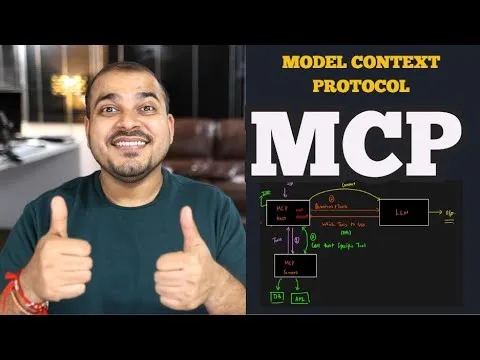
MCP’s architecture is built around three components. First is the MCP host, which can be an IDE like VS Code or Cursor, a cloud desktop environment, or an application built with frameworks such as FastAPI or Streamlit. The host runs the interaction logic and contains an MCP client. Second is the MCP client, created inside the host to communicate using MCP. Third is the MCP server, which connects to one or more tool providers or resources—such as code repositories, databases, or external APIs. Multiple MCP servers can exist, each exposing different capabilities through the same protocol.
Communication follows a loop driven by user input. The MCP host receives a prompt, queries MCP servers to learn what tools are available, and then sends the question plus tool information to the LLM. The LLM selects which tool to use. The host routes the request through the MCP server to the chosen tool, receives the tool’s response, feeds the resulting context back to the LLM, and finally returns the completed answer to the user.
A practical example demonstrates the concept: a custom “weather” MCP server (implemented via a Python SDK) is integrated into Cursor as the host. The server exposes tools like “get forecast” and “get alerts.” When a user asks for the weather in a location such as California, the system routes the request through MCP, calls the appropriate tool, and returns the forecast—showing how an MCP server can be added as a capability without rewriting the host-side integration for each tool change.
Overall, MCP’s core promise is maintainable interoperability: tool providers manage the backend details behind the MCP server, while AI application developers keep a stable calling mechanism through the protocol. That stability is the key lever for building assistants that can scale across many services without turning integration code into a permanent maintenance burden.
Cornell Notes
Model Context Protocol (MCP) is an open-source standard that standardizes how AI applications provide external context to LLMs. It addresses a scaling problem in tool-using agents: every new tool often requires custom integration code and ongoing updates when providers change. MCP introduces a common “USB-C-like” interface so tool providers expose capabilities through an MCP server, while AI apps connect through an MCP host and MCP client. The host discovers available tools, the LLM selects a tool, the host calls it via the MCP server, and the tool’s output becomes context for the final LLM response. This approach reduces integration churn and makes it easier to add many tools over time.
What problem does MCP target in tool-augmented LLM applications?
What are the three core MCP components and what does each do?
How does the MCP request/response flow work after a user submits a prompt?
Why does MCP reduce maintenance when tool providers change?
What does the weather example illustrate about MCP in practice?
Review Questions
- How do MCP host, MCP client, and MCP server responsibilities differ, and why is that separation important?
- Describe the step-by-step flow from user prompt to final LLM output in an MCP-based system.
- What maintenance burden in traditional tool integrations does MCP aim to eliminate, and how does the protocol design address it?
Key Points
- 1
MCP is an open-source protocol that standardizes how AI applications provide context to LLMs, functioning like a “USB-C port” for AI tools.
- 2
Traditional tool-using LLM systems often require custom integration code per tool, which becomes hard to maintain as tool counts and provider changes increase.
- 3
MCP architecture uses three components: MCP host (IDE/app), MCP client (inside the host), and MCP server (connected to tool providers/resources).
- 4
After a user prompt, the MCP host discovers available tools via MCP servers, sends tool info to the LLM, and routes the LLM’s chosen tool call back through MCP.
- 5
Tool providers manage backend details behind MCP servers, so host-side integration can stay stable even when providers update.
- 6
An MCP server can expose multiple tools (e.g., weather “get forecast” and “get alerts”) that the host can call through a consistent protocol.