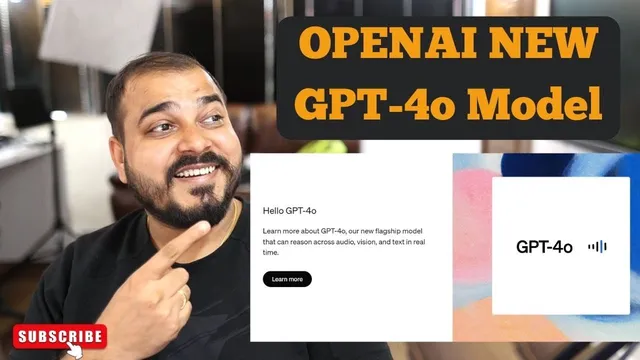
All You Need To Know About Open AI GPT-4o(Omni) Model With Live Demo
Based on Krish Naik's video on YouTube. If you like this content, support the original creators by watching, liking and subscribing to their content.
GPT-4o (“Omni”) is framed as a real-time multimodal flagship that reasons across audio, vision, and text.
Briefing
OpenAI’s GPT-4o (“Omni”) is positioned as a real-time, multimodal flagship model that can reason across audio, vision, and text—while responding with conversational speed. The headline capability is low-latency interaction: audio responses can arrive as quickly as 232 milliseconds (with an average around 320 milliseconds), which the demo frames as comparable to human back-and-forth. That speed matters because it turns multimodal understanding from a “wait for the answer” experience into something closer to live coaching, conversation, and hands-on guidance.
The model’s core input/output promise is broad: it accepts any combination of text, audio, and images, and can generate any combination of text, audio, and images in return. In practice, demos show the system interpreting what a camera sees and responding naturally through voice—without the interaction feeling edited or staged. One example has a user directing an AI that can see the environment while a second AI, unable to see, asks questions and steers the camera based on what it needs to know. The result is a workflow where vision understanding and dialogue coordination happen in real time.
Beyond the live interaction, GPT-4o is described as matching GPT-4 Turbo performance on text tasks in English and code, while also improving vision and audio understanding compared with existing models. Cost and deployment are also part of the pitch: the API is described as 50% cheaper than GPT-4. The transcript also emphasizes language reach, noting support for 20 languages and giving examples tied to token comparisons across different language formalities, including Gujarati, Telugu, Tamil, Marathi, and Hindi, alongside English, French, and Portuguese.
The transcript further links GPT-4o’s multimodal abilities to product possibilities—especially for consumer devices with cameras and microphones. A concrete scenario is offered: a user near a monument could ask what it is, and the system would identify the location and provide information automatically. That same “see-and-answer” framing extends to other use cases, from interactive tutoring to guided assistance.
Evaluation and safety are mentioned as well, including references to text evaluation, audio performance, audio translation performance, and zero-shot results, plus “U security”/security considerations. Still, the demo experience includes limitations: when asked to generate an animated image of a dog playing with a cat, the system reportedly couldn’t produce animation at that moment and instead returned a general description—suggesting image/video generation capabilities may be constrained or staged for later rollout.
Overall, GPT-4o is presented as a step toward more natural human-computer interaction: faster voice responses, unified multimodal inputs/outputs, strong text/code performance, improved audio/vision understanding, and a path to broader language support—available first through ChatGPT and later via API and additional interfaces like OpenAI Playground and a planned mobile app.
Cornell Notes
GPT-4o (“Omni”) is presented as OpenAI’s flagship multimodal model that can reason across audio, vision, and text with real-time responsiveness. It accepts mixed inputs (text, audio, images) and can generate mixed outputs (text, audio, images). The transcript highlights low latency—audio responses as fast as 232 ms and an average around 320 ms—aimed at conversational interaction. It also claims strong baseline performance on English text and code (matching GPT-4 Turbo), improved vision/audio understanding, and a 50% cheaper API versus GPT-4. Language support is described as spanning 20 languages, with examples including Gujarati, Telugu, Tamil, Marathi, Hindi, English, French, and Portuguese.
What makes GPT-4o different from earlier multimodal models in the transcript?
How do the live demos illustrate the model’s vision-and-audio interaction?
What performance and cost claims are made alongside the multimodal features?
Which languages does GPT-4o support, and what examples are mentioned?
What limitations show up in the transcript’s hands-on attempt?
How is GPT-4o’s capability connected to real-world product ideas?
Review Questions
- How do the transcript’s latency numbers (232 ms and ~320 ms) change the expected user experience compared with typical multimodal systems?
- What does “any combination of text, audio, images” input/output imply for how GPT-4o could be integrated into apps or devices?
- Which parts of the transcript suggest both strengths (vision/audio/text) and current constraints (e.g., animated image generation)?
Key Points
- 1
GPT-4o (“Omni”) is framed as a real-time multimodal flagship that reasons across audio, vision, and text.
- 2
It can accept mixed inputs (text/audio/images) and generate mixed outputs (text/audio/images).
- 3
Audio interaction is highlighted as low-latency, with responses as fast as 232 ms and an average around 320 ms.
- 4
The transcript claims GPT-4o matches GPT-4 Turbo performance on English text and code while improving vision and audio understanding.
- 5
The API is described as 50% cheaper than GPT-4, aiming to make deployment more accessible.
- 6
Language support is described as spanning 20 languages, including Gujarati, Telugu, Tamil, Marathi, Hindi, English, French, and Portuguese.
- 7
A hands-on attempt suggests some generation abilities (like animated images) may be limited or unavailable at the time of testing.