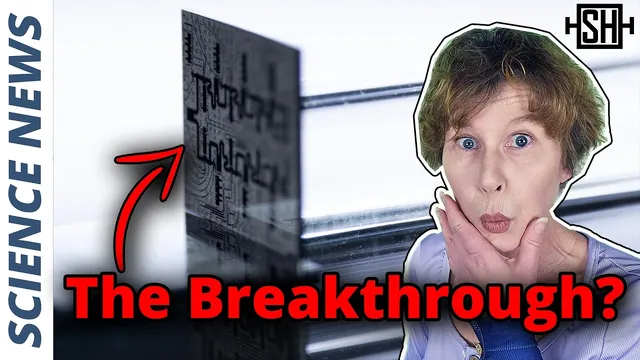
Amazon’s Quantum Breakthrough That Everyone Missed
Based on Sabine Hossenfelder's video on YouTube. If you like this content, support the original creators by watching, liking and subscribing to their content.
Quantum qubits are highly sensitive to noise, so reliable computation requires error correction.
Briefing
Amazon’s quantum chip debut—centered on a new approach to reducing error—stands out as a more concrete scaling breakthrough than the flashier, more speculative headlines around Microsoft. While quantum computing’s promise is widely known—using quantum physics to speed up certain problem types in areas like materials science, finance, and cryptography—the practical bottleneck remains scaling. Quantum bits (qubits) are extremely sensitive to noise, so even tiny disturbances can scramble their quantum state. That sensitivity forces error correction, which in turn demands large numbers of additional qubits. Estimates often put the requirement for commercially relevant machines around a million qubits, whereas today’s systems typically sit at only a few hundred—leaving “four zeros” to be filled before real-world utility.
Against that backdrop, the key news is Amazon’s first quantum computing chip, named Ocelot, built around “cat qubits.” The design combines five cat qubits into a single computational qubit, aiming to suppress a specific kind of error: a “flip” error. The mechanism is redundancy built into the physics of the encoding—if one component qubit flips unexpectedly, the coupled structure can automatically correct it. Amazon claims this architecture can reduce the overhead needed for error correction by up to 90%, a figure that would dramatically shrink the qubit-count gap. If that reduction holds in practice, the path to useful quantum computers could look less like a distant million-qubit cliff and more like a shorter climb.
The significance is sharpened by the broader industry context. Microsoft’s recent push has focused on topological states that are purportedly less vulnerable to noise, but critics have argued that those qubits are not truly topological and remain closer to hypothetical constructs. Amazon’s approach, by contrast, is framed as addressing the same scaling problem—error rates and error-correction cost—through a more direct engineering strategy using superconducting circuits, the same general platform pursued by companies such as Google and IBM.
Still, the chip announcement does not mean quantum computers arrive immediately. Cat qubits require extreme cooling to temperatures of a few millikelvin, and scaling still involves connecting many devices to fit into a cooling setup—an engineering constraint that favors architectures with smaller, more manageable qubits. The transcript also notes skepticism about claims of rapid production elsewhere, including an interview remark about mass-producing millions of chips for photonic quantum computing, where photon leakage and the inability to compute with missing photons remain major hurdles.
In short: Amazon’s Ocelot chip targets the central scaling pain point—error correction overhead—using a five-to-one cat-qubit encoding that could, if it performs as claimed, reduce the qubit burden by an order of magnitude. The remaining challenge is not just building more qubits, but making them reliable at scale under real-world hardware constraints.
Cornell Notes
Quantum computing is limited less by theory than by scaling: qubits are so noise-sensitive that error correction requires huge numbers of additional qubits. Estimates often place commercially relevant systems around a million qubits, while current machines have only a few hundred. Amazon’s new chip, Ocelot, uses “cat qubits” encoded so that five cat qubits form one computational qubit, suppressing flip errors and reducing error-correction overhead by up to 90%. That claim matters because it could shrink the gap between today’s qubit counts and what large, useful quantum computers would need. Even so, scaling still faces hardware constraints like millikelvin cooling and the complexity of connecting many devices.
Why does error correction force quantum computers to use so many qubits?
What is Amazon’s Ocelot chip, and what problem does it target?
How do “cat qubits” reduce flip errors in Amazon’s design?
How does this compare with Microsoft’s scaling strategy?
Why doesn’t a new chip announcement mean quantum computers are imminent?
Review Questions
- What are the two main reasons qubit counts must rise for quantum computing to become commercially useful?
- Explain how combining five cat qubits into one computational qubit helps with flip errors.
- What engineering constraints beyond error rates still limit scaling, even if error correction overhead drops significantly?
Key Points
- 1
Quantum qubits are highly sensitive to noise, so reliable computation requires error correction.
- 2
Error correction increases qubit counts because it relies on redundancy, with million-qubit estimates for commercial relevance.
- 3
Amazon’s Ocelot chip uses superconducting circuits and “cat qubits” to suppress flip errors.
- 4
Five cat qubits are combined into one computational qubit, and Amazon claims up to a 90% reduction in error-correction overhead.
- 5
Microsoft’s scaling approach has focused on topological states, but critics question how truly topological the qubits are.
- 6
Even with better error suppression, scaling still depends on extreme millikelvin cooling and the difficulty of connecting many devices into cooling systems.