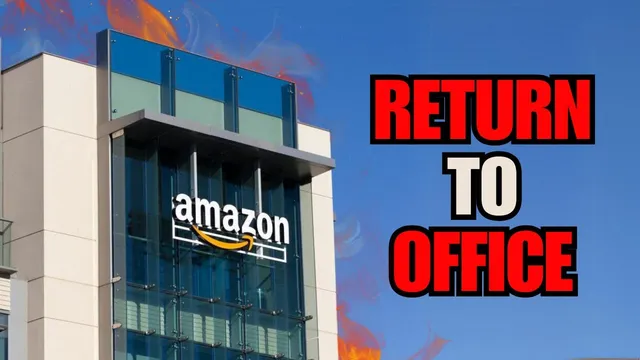
Amazon Says Return To Office Or Get Fired
Based on The PrimeTime's video on YouTube. If you like this content, support the original creators by watching, liking and subscribing to their content.
Amazon aims to speed execution by increasing the individual-contributor-to-manager ratio by at least 15% by the end of Q1 2025, citing too many layers and meeting gates.
Briefing
Amazon CEO Andy Jassy sent a companywide message promising to “strengthen” Amazon’s culture and speed up decision-making—while also tightening return-to-office expectations. The centerpiece is a push to flatten organizations by increasing the ratio of individual contributors to managers by at least 15% by the end of Q1 2025, paired with a stated goal of cutting “unnecessary and excessive process” that slows teams down. Jassy frames the changes as part of a broader effort to keep Amazon operating like “the world’s largest startup,” with more authority pushed toward front lines and fewer layers that create overhead.
The message also sets up a major operational shift: Amazon plans to return to in-office work “the way we were before the onset of covid,” with an expectation that employees be in the office consistently five days per week, except for approved remote work exceptions. Jassy argues that in-person work makes learning, practice, brainstorming, and collaboration “simpler and more effective,” and says the last 15 months of at least three days a week in office strengthened that conviction. The plan includes assigned desk arrangements in locations that previously used agile desk setups, and it calls for Global Real Estate and Facilities to develop a transition plan, with details to be communicated as finalized.
In the discussion around the CEO note, the strongest practical implication is that the culture-and-structure changes are likely to come with staffing consequences. The ratio target—plus the explicit critique of added management layers and pre-meetings—naturally points to manager reductions, and the conversation repeatedly characterizes the move as a form of “quiet firing” rather than a traditional layoff announcement. The concern is that requiring office attendance could pressure employees who prefer remote work to leave voluntarily, reducing headcount without the costs and optics of layoffs.
There’s also skepticism about how “startup-like” the incentives can be at Amazon’s scale. Jassy’s remarks emphasize ownership, speed, and reduced bureaucracy, but the conversation highlights the tension between that rhetoric and Amazon’s compensation mechanics—especially the vesting schedule referenced in the debate (5% in year one, then 15%, then 40% and 40% in later years). Critics argue that if Amazon wants startup behavior, it should match startup-style risk and reward more directly; supporters counter that culture and execution can still improve outcomes even without startup-level equity.
Beyond workplace policy, the transcript detours into broader themes about Amazon’s expansion—AWS, advertising, Prime Video, and new investment areas like “gen,” healthcare, and other initiatives—while raising concerns about using AI in high-stakes settings such as medical diagnosis. Still, the dominant throughline remains workplace governance: flatten management, cut process, strengthen culture from the top, and bring employees back into shared physical space. Whether the changes improve collaboration or mainly function as cost control is framed as something that will become clearer over the next year to 18 months, depending on whether Amazon later softens the remote-work stance.
Cornell Notes
Andy Jassy’s message to Amazon employees pairs two big moves: flattening management to speed decisions and tightening return-to-office expectations. Amazon aims to increase the individual-contributor-to-manager ratio by at least 15% by the end of Q1 2025, citing too many layers, pre-meetings, and review gates that slow execution. At the same time, employees are expected to be in the office consistently five days per week, with remote work allowed only via approved exceptions. The discussion around the note centers on likely staffing effects—especially manager reductions—and whether “startup-like” culture can be achieved without startup-style equity and incentives.
What specific organizational change does Amazon target to speed up execution?
How does the return-to-office plan work, and what exceptions are mentioned?
Why does the transcript connect office attendance to potential staffing outcomes?
What tension appears between “operate like a startup” and Amazon’s compensation/vesting approach?
What is the role of culture in the CEO message, and how is it described as being maintained?
Review Questions
- What does Amazon mean by increasing the individual-contributor-to-manager ratio, and why does it claim this will improve decision-making?
- How do return-to-office expectations and remote-work exceptions interact in the plan described here?
- What arguments are made for and against the idea that Amazon can “operate like a startup” without changing equity incentives more aggressively?
Key Points
- 1
Amazon aims to speed execution by increasing the individual-contributor-to-manager ratio by at least 15% by the end of Q1 2025, citing too many layers and meeting gates.
- 2
The company plans to return to five-days-per-week in-office expectations, with remote work limited to approved exceptions and extenuating circumstances.
- 3
A “bureaucracy mailbox” is proposed as a mechanism to identify and eliminate unnecessary process, with the stated goal of reducing overhead and waste.
- 4
The transcript repeatedly links the return-to-office policy to potential staffing outcomes, including the possibility of manager reductions and voluntary departures among remote-preferring employees.
- 5
The “operate like a startup” framing is paired with an ownership emphasis, but the vesting schedule discussed (5% year one, then 15%, then 40%/40%) becomes a focal point for skepticism.
- 6
The discussion suggests that whether the policy shift helps or harms will likely become clearer within roughly 12–18 months, depending on whether remote work is later softened.