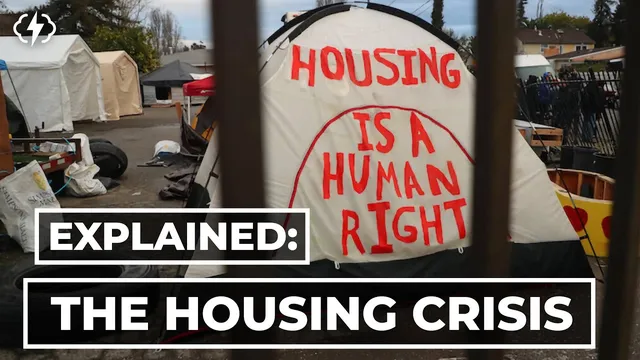
America's Looming Housing Crisis
Based on Second Thought's video on YouTube. If you like this content, support the original creators by watching, liking and subscribing to their content.
Housing affordability is portrayed as collapsing under a supply crunch: active listings are down about 30% year over year and the U.S. faces an estimated shortage of roughly 7 million homes as of 2021.
Briefing
America’s housing market is running short on supply while institutional investors and wealthy buyers intensify competition for the homes that do exist—pushing prices beyond reach for first-time buyers and making even renting unaffordable for many workers. The result is a “looming housing crisis” that could trigger broader economic fallout, especially if eviction protections weaken and more properties shift into corporate portfolios.
The pressure shows up in day-to-day market behavior: homes that hit the market tend to sell within days, often after dozens of bids, with winning offers commonly tens of thousands of dollars above asking price. The underlying driver is a supply crunch. Housing production has slowed sharply, leaving the U.S. facing an estimated shortage of roughly 7 million homes as of 2021. Inventory is also thin—active listings are down about 30% from a year earlier—so buyers have fewer options and must compete harder for what’s available.
But the crisis isn’t only about home prices. Affordable rental housing is also scarce. So-called “Class C” apartments are reported as 96% occupied nationally, limiting vacancy and increasing leverage for landlords. Meanwhile, the transcript argues that wages and unemployment make affordability worse: there are zero counties where a worker earning the federal minimum wage can afford a one-bedroom apartment, and a “true unemployment rate” using a living-wage job-search definition is given as 23.7%. Even if more units existed, the ability to pay remains constrained for a large share of Americans.
A major theme is that institutional capital is amplifying demand and reshaping housing into an investment asset. The transcript highlights wealthy actors and investment firms buying large numbers of homes, including properties owned by people displaced during the pandemic. Charles Koch is used as an example: the transcript claims he invested heavily in real estate, including $200 million into Amherst Holdings in April 2020, and points to lobbying efforts to eliminate COVID-era eviction protections. It also cites the role of landlord-tech company Smart Rent and argues that corporate ownership helps drive rents upward and increases the likelihood of eviction.
The narrative extends into a critique of media framing. It argues that outlets such as Vox and the Wall Street Journal promote the idea that young people prefer renting, and that Bloomberg suggests a renter-based future is acceptable. The transcript counters that the preference story masks affordability constraints—mortgages are often lower than rents, but buyers are priced out of ownership and, increasingly, out of renting too. It also claims that investors have bought up many properties that might otherwise expand supply, including through short-term rental platforms like Airbnb.
As for what happens next, the transcript draws a parallel to the subprime mortgage era: when housing stress peaks, investors can profit by acquiring distressed properties. The proposed near-term path is cautious—expect some kind of correction, with prices potentially easing if construction materials and supply recover and the bidding frenzy cools. The longer-term prescription centers on political and collective action: push back against eviction policy rollbacks, demand rent increases tied to inflation, organize tenants and unions, fight evictions, and support higher wages. The closing message frames housing as a class struggle issue, arguing that organizing is the key lever to change outcomes for working people.
Cornell Notes
The transcript links a worsening housing crisis to two forces: a sharp shortage of homes for sale and aggressive competition from wealthy investors and institutional buyers. Limited inventory and fast sales with bids above asking price reflect supply constraints, while high occupancy in lower-cost apartments and rising rents make renting increasingly difficult. It also argues that eviction protections are a pressure point—weakening them would allow more displaced households to lose homes to corporate portfolios. The stakes extend beyond housing costs, with the possibility of broader economic instability and a repeat of past cycles where the ruling class gains while working people absorb losses. The proposed response emphasizes tenant organizing, eviction resistance, rent protections, and wage gains.
What market signals show the housing shortage is already affecting everyday buyers?
Why does the transcript treat housing as a supply-and-demand problem rather than just a “preference” story?
How does institutional investment factor into the crisis narrative?
What role do eviction protections and “Class C” occupancy play in the transcript’s outlook?
What does the transcript predict could happen if the crisis deepens?
What solutions does the transcript prioritize, and why?
Review Questions
- Which supply-side facts (inventory changes, production slowdown, shortage estimate) does the transcript use to justify calling the situation a crisis?
- How does the transcript connect eviction protections to investor acquisition and long-run affordability?
- What specific forms of organizing and policy demands does the transcript argue for, and how do they relate to wage and rent affordability?
Key Points
- 1
Housing affordability is portrayed as collapsing under a supply crunch: active listings are down about 30% year over year and the U.S. faces an estimated shortage of roughly 7 million homes as of 2021.
- 2
Fast sales and bidding wars—often tens of thousands above asking—are presented as symptoms of limited inventory and slowed housing production.
- 3
Rental pressure is described as severe, with “Class C” apartments reported at 96% occupancy nationally and no counties where federal minimum-wage workers can afford a one-bedroom apartment.
- 4
The transcript argues that institutional investors and wealthy buyers increase competition for homes and keep single-family housing out of reach for owner-occupiers.
- 5
Eviction protections are treated as a critical policy lever; ending them would likely increase displacement and expand the pool of properties investors can acquire.
- 6
Media narratives about “generational preferences” for renting are challenged as masking affordability constraints and wage/job realities.
- 7
The proposed response centers on tenant organizing, eviction resistance, rent protections tied to inflation, and broader wage gains to reduce vulnerability.