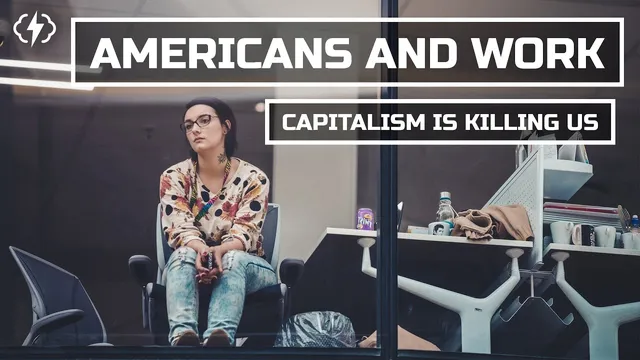
America's Overwork Obsession
Based on Second Thought's video on YouTube. If you like this content, support the original creators by watching, liking and subscribing to their content.
The American dream is portrayed as shifting from a promise of upward mobility to a narrow definition of success tied to capital accumulation.
Briefing
America’s “success” story is being paid for with time, health, and family life—and the United States’ overwork culture is increasingly incompatible with human flourishing. The core claim is that the American dream’s promise of prosperity through individual effort has narrowed into a relentless drive to accumulate capital, even as the real-world rewards of hard work have eroded. The result is a society where people work longer, get fewer benefits, and still face declining living standards, worsening well-being metrics, and reduced life expectancy.
Marx’s 1844 framing of capitalism—where workers are granted only enough to keep them wanting to live, while their passions and activity are replaced by money—serves as the lens for why the pursuit of wealth can become “alienated life.” In the U.S., that dynamic is intensified by a national ethos that treats success as universally attainable through bootstraps self-reliance. The transcript argues that this belief is both historically and practically distorted: the frontier mindset of always imagining a better place elsewhere mirrors a work-and-save cycle that never satisfies. Over time, the dream evolves from “work hard so your kids do better” into a system where the benefits once associated with hard work—stable jobs, pensions, retirement security, and generous leave—have largely disappeared.
A key section lays out the mismatch between rising productivity and falling worker outcomes. Productivity has increased dramatically since 1950, yet workers are not receiving comparable gains in leisure or compensation. Instead, the transcript points to longer workweeks and weaker protections: the U.S. lacks federal mandates for paid sick leave and paid annual leave, and it does not require paid parental leave—leaving it as the only industrialized country in a 41-nation comparison without a mandatory paid parental leave option. The argument extends to vacation and caregiving time, emphasizing that paid leave is not just a perk but a structural difference in how societies value workers’ time.
The transcript also connects overwork to labor market changes and household economics. With more families relying on dual incomes—70% of American children living in households where both parents work—many workers can’t afford to reduce hours even when they want to. Meanwhile, gig work and precarious employment often shift costs like health insurance and benefits onto individuals. The result is a workforce that is stretched thin, with low rankings in happiness and job satisfaction.
Beyond policy and economics, the transcript targets “hustle culture” and class-based self-mythology. It criticizes the idea that working all day will eventually unlock security, arguing that gig workers and overworked employees are treated as equipment rather than people with advancement prospects. It also warns that divisions between “working” and “middle” class, or between wage earners and those aspiring to billionaire status, weaken collective power—because people who feel superior to other workers are less likely to organize against the structures producing their conditions.
The closing message reframes American exceptionalism: the U.S. is exceptional, but in the wrong direction—most overworked, declining in life expectancy and living standards, and unable to protect itself during crises because constant work has become a default expectation. The proposed remedy is dismantling the structures that normalize overwork and restoring space for relationships, creativity, rest, and genuinely human goals.
Cornell Notes
The transcript argues that the American dream has narrowed into an obsession with accumulating capital, pushing workers into longer hours and weaker protections while productivity rises. It links this to capitalism’s tendency to replace human activity and passions with money, leaving people with only enough to keep working. A major evidence thread contrasts the U.S. with other countries: the U.S. lacks federal mandates for paid parental leave, paid sick days, and paid annual leave, and it ranks poorly on vacation and parental leave. The result is declining life expectancy, low happiness and job satisfaction, and a workforce increasingly unable to match the stability enjoyed by earlier generations. The message is that “success” defined as overwork is not exceptional in a good way—it’s exceptional in harming human flourishing.
How does the transcript connect capitalism to overwork and “alienated life”?
What does the transcript claim has happened to the rewards of hard work over time?
Which policy gaps are highlighted as evidence that the U.S. under-protects workers’ time?
How does the transcript use international comparisons to strengthen its case?
Why does “hustle culture” get criticized, and what alternative does the transcript imply?
What does the transcript say about class divisions and organizing power?
Review Questions
- What specific legal or federal protections does the transcript say the U.S. lacks, and how are those absences linked to overwork?
- How does the transcript reconcile rising productivity with declining worker outcomes?
- Why does the transcript argue that hustle culture and class-status comparisons undermine collective action?
Key Points
- 1
The American dream is portrayed as shifting from a promise of upward mobility to a narrow definition of success tied to capital accumulation.
- 2
Overwork is framed as a structural outcome of capitalism, not merely a personal failing or individual choice.
- 3
Productivity gains since 1950 are contrasted with longer hours and weaker benefits, suggesting workers aren’t receiving the value they produce.
- 4
The transcript highlights major policy gaps: no federal mandate for paid parental leave, no federal requirement for paid sick days, and no federal mandate for paid annual leave.
- 5
International comparisons are used to argue the U.S. ranks worst among industrialized countries on paid parental leave and offers no mandatory option.
- 6
The transcript links household economics and labor market precarity (including gig work) to why many workers can’t reduce hours even when they want to.
- 7
It argues that hustle culture and class-based self-comparison fracture worker solidarity and reduce the likelihood of organizing against the systems driving overwork.