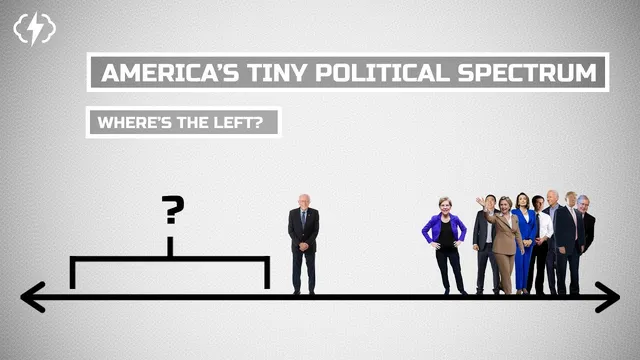
America's Stunted Political Spectrum
Based on Second Thought's video on YouTube. If you like this content, support the original creators by watching, liking and subscribing to their content.
The political compass framework separates economics (collective vs market) from social stance (authority vs personal freedom), and authoritarianism can exist on either side of the economic axis.
Briefing
America’s political debate is far narrower than the shouting suggests: when candidates and major political figures are plotted on a two-axis “political compass,” most of the U.S. falls into a single quadrant, leaving only a small slice of the spectrum considered thinkable. The central claim is that the country’s mainstream argument runs from “moderate” to “slightly less moderate,” with even Bernie Sanders barely crossing the compass’s center line—despite how many people label him a communist. That mismatch between rhetoric and placement matters because it explains why elections can feel like existential conflict while policy differences remain clustered around a limited range of acceptable ideas.
The compass frames politics with two dimensions: economics (from collective, cooperative control on the left to market competition on the right) and social attitudes (from strict obedience to authority at one extreme to maximized personal freedom at the other). A key point is that authoritarianism can appear anywhere on the left-right economic axis; the real dividing line is not simply “left equals authoritarian.” The transcript illustrates this by listing figures across quadrants—such as Mao, Stalin, and Mugabe on the authoritarian left; Hitler, Viktor Orban, Hillary Clinton, and Donald Trump on the authoritarian right; and libertarian examples like Milton Friedman and Hayek on the libertarian right, alongside Gandhi, Thomas Paine, Bernie Sanders, and Nelson Mandela on the libertarian left.
So why does American discourse stop so close to the center? The explanation centers on Cold War legacy. During the Red Scare, anyone critical of the prevailing American model was treated as communist or sympathetic to the Soviet enemy, triggering crackdowns and political “witch hunts.” After the Soviet Union collapsed and Eastern Bloc countries adopted both democracy and free markets, the two compass axes became tangled in public thinking—leading many to equate free-market capitalism with democracy, and to treat left-leaning politics as inherently authoritarian.
The transcript argues that this confusion still shapes how people talk. It points to a recurring pattern in which “blank equals communism” becomes a catch-all label for policies people dislike, including examples framed as absurdly broad—such as closing Baskin-Robbins “so people don’t die from a deadly virus.” It also credits Ronald Reagan’s era—deregulation, tax cuts, increased military spending, and union-busting—with helping lock in the decline of American left politics, leaving today’s landscape dominated by “consensus politicians” who may sincerely see each other as opposites while still operating within the same narrow quadrant.
The discussion then tackles a common right-wing claim that Adolf Hitler was a leftist. The response: the Nazis’ “National Socialist” branding was a propaganda tactic, not evidence of Marxian socialism—similar to how autocrats adopt popular terms to gain legitimacy. From there, the transcript pivots to define socialism in plain terms as a broad label for left-leaning goals: greater economic egalitarianism, ending wars driven by powerful interests, expanding healthcare so people aren’t bankrupted by illness, protecting small businesses from multinational dominance, and—crucially—pushing for worker control or meaningful worker involvement in enterprises. The takeaway is that government action is not automatically communism or socialism, and that understanding political labels requires learning what they actually mean.
Overall, the transcript urges viewers to use tools like the political compass as a starting point, then deepen understanding beyond the “stunted” U.S. version of the spectrum—so political fear-mongering loses its grip and disagreement becomes more informed rather than purely tribal.
Cornell Notes
The transcript argues that U.S. politics is “stunted” because most mainstream positions cluster in one quadrant of a two-axis political compass. The compass separates economics (collective vs market) from social stance (authority vs personal freedom), and it warns that authoritarianism can exist on either side of the left-right economic divide. Cold War dynamics—especially the Red Scare—helped fuse “capitalism” with “democracy” and “left politics” with “authoritarianism,” narrowing what Americans treat as acceptable. The discussion also rejects the claim that Hitler was a leftist, framing “National Socialist” as branding rather than Marxian socialism. Finally, it defines socialism as a broad left-leaning agenda focused on egalitarian outcomes, humane policies, and worker involvement in enterprises.
How does the political compass used here define the left-right and authoritarian-libertarian dimensions?
Why does the transcript claim American politics clusters near the center of the compass?
What examples are used to challenge the idea that “left” automatically means authoritarian?
How does the transcript respond to claims that Hitler was a leftist?
What does the transcript say socialism actually means in practice?
What distinction does the transcript make between government action and socialism/communism?
Review Questions
- What two axes does the political compass use here, and why does the transcript say authoritarianism can’t be mapped to only one side of the left-right spectrum?
- How does the Cold War legacy (Red Scare, post-Soviet shifts) explain the transcript’s claim that U.S. politics stays within one compass quadrant?
- What criteria does the transcript use to distinguish socialism from other forms of government intervention?
Key Points
- 1
The political compass framework separates economics (collective vs market) from social stance (authority vs personal freedom), and authoritarianism can exist on either side of the economic axis.
- 2
Mainstream U.S. politics is portrayed as clustered in a single compass quadrant, making only a narrow range of ideas seem acceptable.
- 3
Cold War Red Scare dynamics helped fuse “capitalism” with “democracy” and “left politics” with “authoritarianism,” narrowing public debate.
- 4
The transcript rejects claims that Hitler was a leftist by arguing that “National Socialist” was branding rather than Marxian socialism.
- 5
Socialism is defined as a broad left-leaning agenda focused on egalitarian outcomes, humane policies (including healthcare), and worker involvement or control in enterprises.
- 6
Government action (such as safety nets or quarantines) is not automatically socialism or communism; the transcript emphasizes how enterprise power is structured.
- 7
Using ideology quizzes and reading beyond the “stunted” U.S. spectrum is presented as a way to improve political understanding.