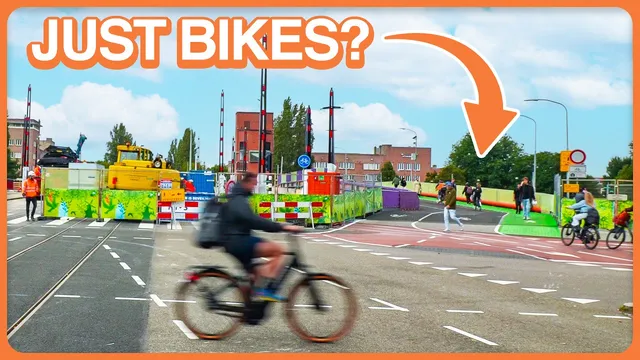
Amsterdam Closed This Bridge to Cars (but not bikes ofc)
Based on Not Just Bikes's video on YouTube. If you like this content, support the original creators by watching, liking and subscribing to their content.
Baraka Bridge was closed to cars for about four months because it no longer met safety standards, and partial operation would have extended the renovation timeline.
Briefing
Amsterdam closed the Baraka Bridge to cars for roughly four months to meet safety standards on a nearly 90-year-old historic monument—then kept the city moving by building a temporary crossing for walking and cycling. The bridge’s renovation mattered because it wasn’t just aging infrastructure: it had become a dangerous six-lane road for cyclists by the 1970s, and the city needed a full safety-and-capacity overhaul rather than a partial, longer repair.
Baraka Bridge (80 meters long and 24 meters wide) was originally built in 1932, taking about three years to complete because river traffic had to continue throughout construction. When it opened, it drew huge crowds, and it remains tied to major Dutch and Canadian history: the Canadian Army entered Amsterdam via the bridge on May 8, 1945 to liberate the city from Nazi occupation, an event later reenacted by Canadian veterans. The bridge is named after its designer, Hendrik Patri Beraka, and the surrounding area reflects the planning vision of the 1920s and 1930s—neighborhoods that still function well today, even as later car-focused changes reshaped streets and junctions.
The car closure triggered a carefully managed detour. Cars were rerouted, while a temporary bridge—narrower than the original—served only pedestrians and cyclists. Public transit faced disruption too: tram services across the bridge were paused, including tram line 12 and multiple bus routes, which were diverted. Mopeds were largely banned from cycling paths, so riders had to walk their vehicles across the temporary bridge or risk a steep fine enforced via license-plate cameras. Emergency vehicles could use the temporary crossing if needed.
Cycling access became the central design test during and after construction. The renovation replaced the dangerous car-heavy configuration with protected bicycle infrastructure and reworked key intersections to reduce bottlenecks and conflict points. On the west side, the junction improvements created more space for cyclists and introduced a banana-and-freak-cone style queueing geometry that helps riders negotiate right-of-way more smoothly at green lights. On the east side, upgrades were less visible because some work had already been done, but new transit stops, bus/transit improvements, and additional bicycle parking were added.
Inside the bridge, the overhaul was extensive: the interior structure was fully replaced to modern safety standards, and the movable deck and its counterweight system were renewed. New curb-and-curve separations further reduce conflict between modes. Still, a compromise remains—public transit lanes sit beside the bridge, but the bridge deck includes a shared lane that can let a left-turning car block a transit vehicle. The city mitigates this with intelligent signal timing, but the arrangement underscores the tradeoffs of retrofitting.
Finally, the bridge’s bascule design (a lift for marine traffic) creates specialized engineering details, including a tram-rail production mistake that left missing electrification infrastructure across the moving section. Until the Fram rails are installed, trams are replaced by extra buses, including a temporary extension of bus route 40 beyond Amstel Station. For residents who rely on trams, the improvements can’t fully offset the temporary loss of rail service—yet the overall message is clear: Amsterdam treated a historic bridge repair as a chance to prioritize safe cycling and transit access, not just restore old concrete.
Cornell Notes
Baraka Bridge’s four-month closure to cars was driven by safety requirements on a historic, nearly 90-year-old structure. The city kept mobility running by routing cars away and building a temporary bridge for pedestrians and cyclists, while trams and some buses were diverted. Renovation work included major structural replacement inside the bridge and a renewed movable deck, plus intersection redesigns that reduced cycling bottlenecks—using protected paths and junction geometry such as banana/freak-cone queueing. The result improves safety and cycling flow, but a remaining compromise lets left-turning cars sometimes interfere with transit, and a tram electrification issue means buses temporarily replace trams until new rails are installed.
Why did Baraka Bridge need a full closure rather than a partial one?
How did Amsterdam maintain access for cyclists and pedestrians during construction?
What changed for cycling after the renovation, especially at intersections?
What major engineering work happened beyond what riders could see?
Why were trams missing during the construction period, and what’s the longer-term issue?
Review Questions
- What safety and historic-status factors pushed the decision toward a full car closure of Baraka Bridge?
- Describe how the temporary bridge and moped rules affected daily mobility for cyclists and pedestrians.
- Which intersection design elements were used to improve cycling throughput, and how do they change rider behavior at green lights?
Key Points
- 1
Baraka Bridge was closed to cars for about four months because it no longer met safety standards, and partial operation would have extended the renovation timeline.
- 2
The city built a temporary bridge for pedestrians and cyclists during construction, while cars were detoured and tram service across the bridge was suspended.
- 3
Mopeds were largely prohibited from cycling paths during the works; riders had to walk their mopeds across the temporary bridge or face fines enforced by license-plate cameras.
- 4
Renovation included major structural replacement inside the bridge and a renewed movable deck, not just surface-level repairs.
- 5
Cycling improvements focused on both protected path design and junction redesign, including banana/freak-cone queueing geometry to reduce bottlenecks.
- 6
A remaining compromise is a shared lane on the bridge deck that can allow left-turning cars to block transit vehicles, partially mitigated by intelligent signal timing.
- 7
Trams were temporarily replaced by buses due to tram-rail/electrification issues across the bascule section, with plans to install Fram rails soon.