An Argument The Moon is a PLANET!
Based on minutephysics's video on YouTube. If you like this content, support the original creators by watching, liking and subscribing to their content.
The Moon can be argued to satisfy the IAU’s three main planet criteria: solar-orbit participation, near-round shape from self-gravity, and dominance of its orbital neighborhood.
Briefing
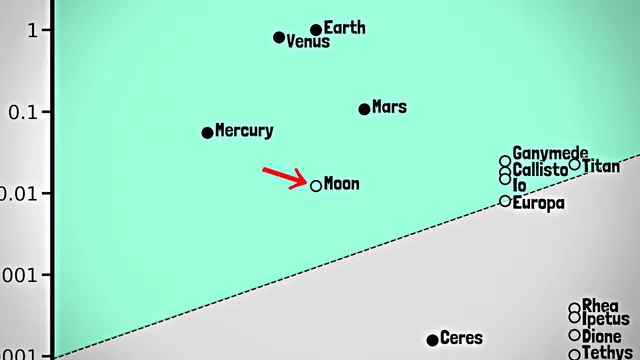
The Moon can be made to fit the International Astronomical Union’s (IAU) own planet criteria—until the definition’s built-in exclusions and the IAU’s fixed “eight planets” list kick in. Using the IAU’s three main requirements for planethood—solar orbit, near-round shape from self-gravity, and dominance of its orbital neighborhood—the Moon checks every box. From the Sun’s perspective, the Earth–Moon system orbits the Sun while the bodies tug on each other, so the Moon’s path is part of a solar-centered orbital motion. On shape, the Moon is round because its gravity is strong enough to overcome rigid-body forces, putting it in the same “gravitationally rounded” category as Earth and excluding smaller irregular bodies like many asteroids and comets. On orbital clearing, the Moon’s mass relative to its orbital radius is sufficient to dominate nearby material; the transcript contrasts this with Pluto, which—because it sits farther out—does not have enough mass to clear its region and is instead gravitationally dominated by Neptune.
That leaves the question: if the Moon satisfies all three criteria, why isn’t it classified as a planet? The answer lies in the IAU definition’s wording and footnotes. The criteria apply to “planets and other bodies, except satellites,” meaning an object must not be a satellite of another body—so the Moon is disqualified simply because it is a moon. Then a second constraint appears in the IAU’s own presentation: a footnote lists only eight planets—Mercury through Neptune—leaving no room for additional bodies like the Moon. The transcript argues this reveals a prescriptive, list-first approach: publish a predetermined roster of “planets,” then craft scientific-sounding criteria to justify it after the fact. In that framing, “planet” becomes a human label tied to culture and history rather than a purely natural category derived from physics.
The discussion broadens beyond the Moon to challenge the IAU’s logic. If the definition is taken literally, a captured small red dwarf star passing through the solar system and settling into orbit around the Sun could also qualify as a “planet,” even though it is clearly a star. That mismatch mirrors why exoplanet definitions often require objects to be substellar. The transcript’s bottom line is that modern planetary science uses different reasoning—one that would classify many large round moons (including those of Jupiter, Saturn, Uranus, and Neptune) as planets, along with Pluto and Ceres—suggesting the IAU’s list is scientifically out of step. The Moon, under the IAU’s own three tests, is a planet; it only fails because the definition carves out satellites and then hard-codes an eight-object roster.
Cornell Notes
The IAU’s planet definition includes three main tests: orbiting the Sun, being nearly round due to self-gravity, and clearing the neighborhood around its orbit. The Moon can be argued to satisfy all three: it participates in the Earth–Moon system’s solar orbit, it is round because its gravity overcomes rigid-body forces, and its mass relative to its orbital radius is enough to dominate nearby material. The classification breaks down not on those three physics criteria, but on extra wording: the definition excludes satellites, and the IAU’s footnote lists only eight planets. The transcript uses this to argue the IAU approach is prescriptive—list-first—rather than purely descriptive of natural categories. It also notes a broader problem: literal application could label a captured star as a planet, which is why exoplanet definitions often require substellar objects.
How does the Moon meet the IAU’s “orbiting the Sun” criterion if it’s commonly described as orbiting Earth?
Why does the Moon qualify for the IAU’s “nearly round” requirement?
What does “clearing the neighborhood” mean, and how does the Moon compare to Pluto?
What hidden exclusion prevents the Moon from being a planet under the IAU definition?
How does the IAU footnote listing only eight planets affect the argument?
Why does the transcript say the IAU definition could misclassify a captured star as a planet?
Review Questions
- If the Moon satisfies orbit, roundness, and orbital clearing, which specific parts of the IAU wording still block its classification—and why?
- How does changing the reference perspective (Earth-centered vs Sun-centered) alter the interpretation of “orbiting the Sun”?
- What does “clearing the neighborhood” imply about the relationship between orbital radius and an object’s ability to dominate nearby bodies?
Key Points
- 1
The Moon can be argued to satisfy the IAU’s three main planet criteria: solar-orbit participation, near-round shape from self-gravity, and dominance of its orbital neighborhood.
- 2
The IAU definition’s satellite exclusion (“except satellites”) is the direct reason the Moon fails planethood under that framework.
- 3
A footnote listing only eight planets reinforces a list-first, prescriptive approach rather than a purely descriptive scientific classification.
- 4
The transcript uses Pluto as a contrast case: Pluto’s distance makes it unable to clear its orbital region and leaves it dominated by Neptune.
- 5
A literal reading of the IAU criteria could label a captured star (e.g., a small red dwarf) as a planet, motivating why exoplanet definitions often require substellar objects.
- 6
Modern planetary-science reasoning, as described here, would extend “planet” status to large round moons and bodies like Ceres and Pluto, not just the eight IAU planets.