Anne-Laure Le Cunff - How to Design Tiny Experiments Like a Scientist @neuranne
Based on Linking Your Thinking with Nick Milo's video on YouTube. If you like this content, support the original creators by watching, liking and subscribing to their content.
Define a tiny experiment with two parts: a specific action and a pre-set duration (number of trials).
Briefing
Success doesn’t have to mean reaching a predefined destination. Anne-Laure Le Cunff’s core pitch is to treat life and work like science: define a small action, set a clear duration, collect data, and count learning—not outcomes—as the win. That shift matters because it replaces the familiar cycle of “try, miss the goal, blame yourself” with a repeatable method for building momentum and reducing fear of failure.
Le Cunff’s path to this mindset started after leaving Google, when a failed startup and a lack of direction left her “completely lost.” Instead of chasing a new plan, she returned to curiosity—specifically, her long-standing fascination with how the brain works. She went back to school for neuroscience, then began writing online to translate what she was learning into something usable for others. Her earliest article, “The Generation Effect,” captured a key learning mechanism: writing in one’s own words improves understanding and recall. That insight became the seed for her newsletter, where each week she turns a university topic into her own creation.
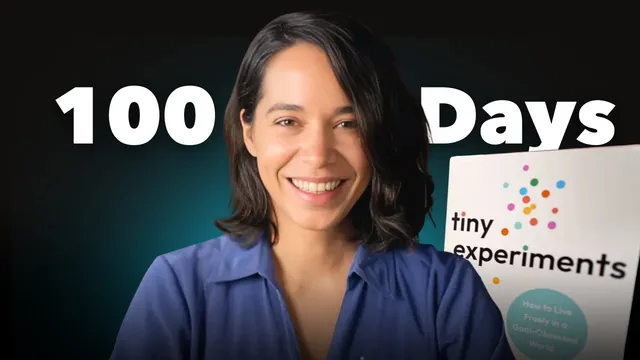
To make the learning process measurable, Le Cunff designed “tiny experiments” modeled on how scientists run studies. The method is simple but strict: choose the action and specify the number of trials (duration). She describes doing “100 articles in 100 weekdays,” taking weekends off. By pre-committing to the timeframe, she avoided the temptation to quit when early results looked unimpressive or didn’t match expectations—an approach meant to curb confirmation bias. The experiment produced more than output; it generated data about what she liked, what formats worked, and what topics resonated.
That experimental mindset also reframes success. In her view, the common definition—reaching a desired outcome—creates failure whenever the target isn’t hit. The scientific alternative is learning something new as long as new data is collected. Even when an experiment doesn’t go as hoped, the “failure” is really information. She links this to a broader psychological benefit: tiny experiments restore agency. Even when outcomes are uncertain, people can steer the process through the next iteration—tweaking the action, changing the duration, or switching formats—without white-knuckling every result.
Curiosity, she adds, isn’t just a personality trait; it can be crowded out by linear productivity goals. She describes reconnecting with curiosity by removing objectives entirely—an unsettling move for someone used to clear corporate success metrics. She also treats reading as a signal: if she’s stuck in too much non-fiction, she’ll deliberately insert fiction (often science fiction) to avoid becoming overly optimization-driven.
Le Cunff extends these ideas into creative practice and knowledge work. She contrasts “digital gardening,” where published work can be updated based on feedback, with the permanence anxiety of writing a book. Her solution was to treat the book as another experimental cycle—capturing metacognition (thinking about thinking) and planning future iterations rather than aiming for a single flawless artifact. She also discusses applying “architects and gardeners” thinking—structuring when needed, letting ideas emerge when helpful—then switching modes as the project evolves.
Ultimately, tiny experiments are presented as a practical antidote to information overload and perfectionism: pick an action, set a duration, publish or share if possible, and let learning accumulate over time. The episode ends with a concrete example tailored to curious communities: connect two ideas each day and publish the result for a week, month, or longer—turning curiosity into measurable practice.
Cornell Notes
Anne-Laure Le Cunff argues that success should be defined like science: learning and new data, not hitting a predetermined outcome. Her “tiny experiments” framework requires two commitments—an action and a duration (number of trials)—so people don’t quit early or stop when results look wrong. She describes running a writing experiment (“100 articles in 100 weekdays”) and using the resulting feedback and self-discovery as data. This approach restores agency: even without controlling outcomes, people can iterate by tweaking the next experiment. She also applies the same mindset to creativity and publishing, treating books as iterative artifacts and using “digital gardening” principles to learn in public.
What makes a “tiny experiment” different from a typical goal or habit plan?
How does Le Cunff redefine success, and why does that change behavior?
Why did “100 articles in 100 weekdays” function as more than a writing challenge?
How does “digital gardening” address the tension between learning in public and perfectionism?
What role do fiction and non-fiction play in her curiosity strategy?
How do “architects and gardeners” map onto note-taking and creative work?
Review Questions
- Think of a goal you’re currently pursuing. What would the “action” and “duration/trials” be if you converted it into a tiny experiment?
- How would your definition of success change if “learning new data” replaced “reaching the desired outcome”?
- Where do you currently stop too early—when results look unimpressive or unexpected—and how could pre-committing to duration change that?
Key Points
- 1
Define a tiny experiment with two parts: a specific action and a pre-set duration (number of trials).
- 2
Pre-commit to the duration to avoid quitting early and to reduce confirmation bias.
- 3
Redefine success as learning something new through collected data, not as reaching a predetermined outcome.
- 4
Use tiny experiments to build agency: iterate by tweaking the next action, duration, or format rather than trying to control results.
- 5
Treat learning in public as part of the process—feedback and corrections become data, not threats.
- 6
Apply architects-and-gardeners thinking by structuring when necessary and allowing ideas to emerge when that’s more productive.
- 7
When publishing in a fixed format like a book, treat it as an iteration and capture metacognition so future versions can improve.