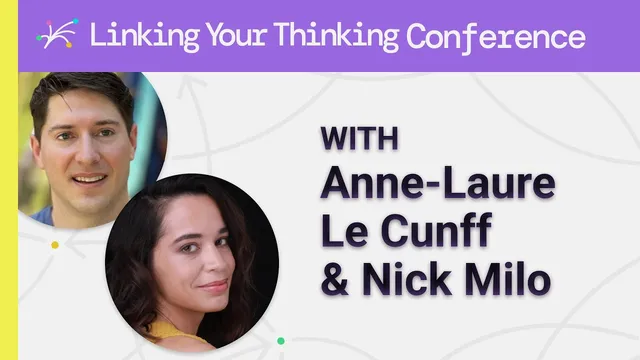
Anne Laure Le Cunff & Nick Milo: How can we do Combinational Creativity?
Based on Linking Your Thinking with Nick Milo's video on YouTube. If you like this content, support the original creators by watching, liking and subscribing to their content.
Creativity can be treated as a repeatable practice: combine existing ideas rather than waiting for a muse.
Briefing
Combinational creativity reframes creativity as a controllable practice: new ideas don’t arrive from a mysterious muse, they emerge by combining existing concepts. That shift matters because it turns creativity from a stressful test of “originality” into an active, repeatable process—one that can be practiced like a skill and used to learn, write, and solve problems.
Laura Lacombe’s path to that message starts with a neuroscience-backed learning insight she calls the “generation effect.” After years of studying by memorizing and regurgitating for exams, she discovered that generating one’s own version of what’s being learned improves both recall and understanding. That realization pushed her to stop treating knowledge as something to absorb passively and start producing her own outputs—first through a weekly newsletter, then through a growing community and her work at Nest Labs, which focuses on productivity and creativity while taking mental health seriously.
From there, Lacombe connects the generation effect to combinational creativity. The core idea: creativity is inherently combinational—taking two or more existing ideas and recombining them into something new. Instead of waiting for inspiration, people can “program” creativity by practicing structured combinations. She describes traditional creativity myths as passive and unpredictable, often tied to ancient imagery of muses and poets who despair when inspiration disappears. Combinational creativity replaces that fragility with a playground mindset: playful, mindful, and less judgment-heavy.
Practically, she offers three starting techniques—each designed to make combining ideas concrete. Chaining asks how one idea impacts another (for example, how mindful productivity could affect fasting, sleep, or mental health). Clustering looks for shared themes between two concepts, even when they seem unrelated—like creativity and mental health or cities and living organisms. Comparing and contrasting asks how ideas are similar and different, including cross-domain comparisons such as animal intelligence versus plant intelligence.
To make these combinations visible, Lacombe recommends concept maps: diagrams where the links between ideas are defined, not just drawn. She also shares real-world variations—using paper, whiteboards, or post-it notes on a wall—sometimes with color-coding to track certainty (confident claims versus open questions). The point isn’t the tool; it’s the ability to move ideas around, link them, and spot gaps.
In her own workflow, she often starts in Rome for note-taking and linking, then switches to paper for quick concept maps when a promising gap appears. Outlines and drafts move to Google Docs for writing, while her weekly newsletter is assembled directly in ConvertKit, with minimal new research at that stage.
The payoff extends beyond publishing. Combining ideas strengthens conversations, helps generate fresh angles for presentations and work problems, and supports cross-disciplinary thinking—especially valuable for “wicked problems” that don’t fit neatly within one field. Lacombe also stresses attribution: originality can be “undetected plagiarism,” so the ethical approach is to link back to sources and treat references as breadcrumbs into the larger combinational network.
By the end, the message lands as permission and method: creativity is an active role in shaping the world, and the fastest way to get there is to practice combining—alone or with others—until new connections start to feel natural.
Cornell Notes
Combinational creativity treats creativity as a skill built from combining existing ideas, not as a mysterious muse-driven event. Laura Lacombe links this to the generation effect: generating your own version of what you learn improves understanding and memory, which naturally leads to producing and sharing original work. She argues that this reframes creativity from stressful “be original” pressure into a playful, controllable practice. For execution, she recommends three techniques—chaining (how one idea affects another), clustering (shared themes), and comparing/contrasting (similarities and differences)—often visualized with concept maps. The approach can be used for writing, presentations, conversations, and cross-disciplinary problem solving, while still requiring proper source attribution.
What is the generation effect, and how does it connect to combinational creativity?
Why does combinational creativity reduce the fear of “not being original”?
How do chaining, clustering, and comparing/contrasting work as practical exercises?
What role do concept maps play, and what makes them different from mind maps?
How does Lacombe combine tools across a workflow (notes → mapping → writing → newsletter)?
How should creators handle attribution while practicing combinational creativity?
Review Questions
- In your own words, how does the generation effect change the way someone should study or take notes?
- Pick two unrelated topics you care about. How would you chain them, cluster them, and compare/contrast them to generate a new angle?
- What does it mean to define relationships in a concept map, and how would that improve your ability to spot gaps compared with a simple list of ideas?
Key Points
- 1
Creativity can be treated as a repeatable practice: combine existing ideas rather than waiting for a muse.
- 2
The generation effect supports the idea that producing your own versions of information improves recall and understanding.
- 3
Combinational creativity becomes less stressful when “originality” is reframed as recombination within a shared idea playground.
- 4
Chaining, clustering, and comparing/contrasting provide concrete ways to start combining ideas even when concepts feel unrelated.
- 5
Concept maps add value by specifying the relationships between ideas, helping patterns and gaps emerge.
- 6
Tools matter less than method: paper, whiteboards, post-it notes, and software all work if they let ideas move and link.
- 7
Ethical combinational creativity requires attribution—link back to sources so recombination doesn’t become plagiarism.