Answering viewer questions about refraction
Based on 3Blue1Brown's video on YouTube. If you like this content, support the original creators by watching, liking and subscribing to their content.
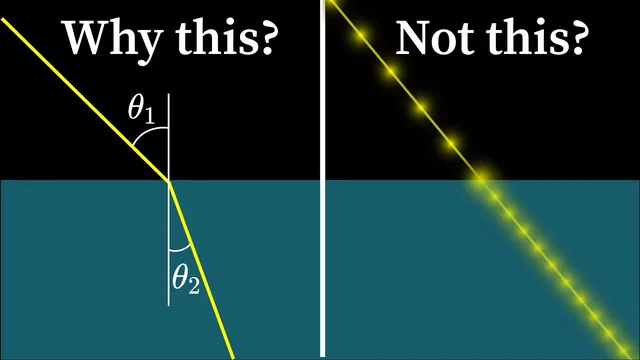
Refraction at an interface follows from how entering light compresses wave crests inside the medium, forcing a change in crest orientation to keep the beam perpendicular to those crests.
Briefing
Light bends at an interface because slowing down inside a material compresses the wave’s crests, forcing the geometry of those crests to change. When the incoming light enters glass, the lower parts of a wavefront interact with the medium first, so the wave becomes “scrunched up” and smeared during entry. The beam itself stays perpendicular to the wave crests, so the only consistent outcome is that the crests inside the glass tilt to a new angle. Matching where crests intersect the boundary on both sides leads directly to the same mathematical relationship as Snell’s law—once the wavelength change caused by the material’s altered wave speed is accounted for.
That bending story ties back to what refraction really measures: a phase shift produced by the medium’s charges. Each layer of material slightly kicks the phase of the passing electromagnetic wave. A continuous sequence of tiny phase kicks is mathematically equivalent to a wave that appears to travel more slowly. Microscopically, the incoming light drives oscillations in bound charges; those oscillations generate their own electromagnetic response, and the superposition of the induced field with the original field looks like the original wave but shifted in phase after the layer.
The size of that phase shift depends on resonance. Modeling the bound charges as simple harmonic oscillators with a linear restoring force shows that the oscillation amplitude—and therefore the index of refraction—grows when the light’s frequency is near the oscillator’s resonant frequency. In other words, the index of refraction tracks how strongly the light resonates with the material’s internal charge dynamics, which also explains polarization-dependent effects.
Birefringence, for example, arises in crystals where the restoring forces differ along different directions. Because the resonant frequency depends on direction, the index of refraction becomes different for two orthogonal polarizations, producing double images. Calcite is highlighted as a real-world case where one polarization bends differently from the other.
The same resonance logic connects to optical rotation in chiral substances like sucrose. If right-handed and left-handed circular polarizations couple differently to the molecular structure, their indices of refraction differ slightly. Since linearly polarized light is a sum of those two circular components, the relative phase lag accumulates over distance, rotating the polarization. The explanation leans on chirality: structures that are not superimposable on their mirror images can resonate more strongly with one handedness than the other. Helical antenna designs in radio engineering are cited as an intuition pump for how handedness-selective resonance can work.
The most counterintuitive question—how the index of refraction can be below one—is answered by separating phase velocity from causality. A medium can kick the wave forward in phase as well as backward; when the relevant oscillator response yields a negative amplitude contribution, the effective index drops below one. That means the wave crests’ phase velocity can exceed c, but the underlying propagation of influences between charges still respects the causal speed limit set by c. The net electromagnetic field can be described as a clean sine wave with an effective phase velocity, even though every microscopic influence travels at c. The discussion also stresses that this steady-state phase-velocity picture does not imply faster-than-light information transfer; pulses behave differently, and simulations show that even when crests move faster than c, the pulse envelope travels subluminally.
Cornell Notes
Refraction comes from a phase shift: bound charges in a material respond to incoming light and re-radiate, so the combined field looks like the original wave but with a changed phase. Modeling those charges as harmonic oscillators shows the index of refraction depends on resonance—how close the light’s frequency is to the material’s natural oscillation frequency. Because resonance can differ by direction or handedness, polarization effects follow: birefringence occurs when restoring forces differ along crystal axes (calcite), and optical rotation occurs in chiral molecules like sucrose when right- and left-circular polarizations experience slightly different indices. Even when the index drops below one (e.g., x-rays through glass), causality isn’t violated because phase velocity can exceed c without enabling faster-than-light information transfer; microscopic influences still propagate at c.
Why does light bending at an interface follow from the wave slowing down inside the material?
What microscopic mechanism produces the phase shift that becomes the index of refraction?
How does resonance determine the index of refraction?
Why does birefringence produce two indices and double images?
How does chirality in sucrose lead to optical rotation?
How can the index of refraction be less than one without breaking causality?
Review Questions
- In the crest-intersection argument for refraction, what changes inside the medium that forces the wavefronts to rotate, and how does that connect to Snell’s law?
- How does the harmonic-oscillator resonance model link polarization-dependent refractive indices to birefringence?
- Why does phase velocity exceeding c not automatically imply faster-than-light information transfer, especially for pulses?
Key Points
- 1
Refraction at an interface follows from how entering light compresses wave crests inside the medium, forcing a change in crest orientation to keep the beam perpendicular to those crests.
- 2
A medium’s index of refraction corresponds to a phase shift produced by induced oscillations of bound charges and the superposition of their re-radiated fields with the incoming wave.
- 3
Resonance controls the index: the induced oscillation amplitude grows when the light frequency approaches the material’s resonant frequency.
- 4
Birefringence arises when a crystal’s restoring forces (and resonant frequencies) differ by direction, giving different indices for different polarizations, as in calcite.
- 5
Optical rotation in chiral molecules like sucrose comes from different coupling to right- and left-circular polarizations, creating a polarization-dependent phase lag.
- 6
An index of refraction below one implies superluminal phase velocity is possible, but causality is preserved because microscopic charge interactions propagate at c.
- 7
Phase-velocity intuition from steady-state sine waves does not directly translate to faster-than-light signaling; pulse propagation must be treated separately.