Antimatter Explained
Based on minutephysics's video on YouTube. If you like this content, support the original creators by watching, liking and subscribing to their content.
Every fundamental particle has an antiparticle with the same mass and quantum properties but opposite charge.
Briefing
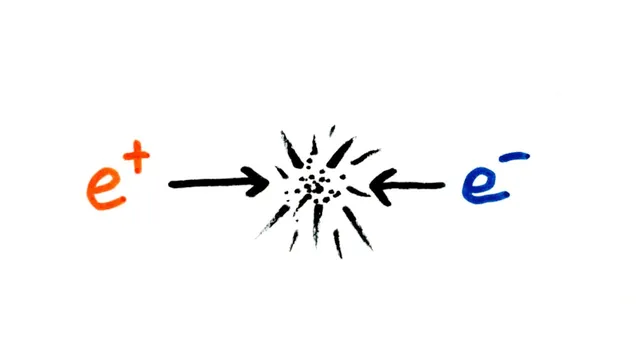
Antimatter is the “mirror” partner of ordinary matter: every fundamental particle has an antiparticle with the same mass and quantum properties but opposite charge. When a particle meets its antiparticle, the two annihilate—turning their energy into other forms of energy—so antimatter doesn’t just sit around. This is why antimatter can form anti-atoms and even exotic bound states like positronium, but it’s extremely difficult to build anything large from it.
At the core of the idea is quantum fields. Electrons, quarks, and rarer particles such as muons, tauons, and neutrinos are described as excitations of fields that permeate space. Antiparticles are also excitations of those same fields, carrying identical properties except for opposite charge. The transcript draws an analogy to solving x^2 = 4, where the solutions 2 and −2 have the same magnitude but opposite sign; likewise, particle and antiparticle match in “everything but charge,” so they cancel when they meet. That cancellation is not just conceptual: annihilation destroys both excitations, releasing energy.
Because antimatter behaves like matter aside from charge, it can assemble into structures that closely resemble ordinary ones. Antielectrons are called positrons, and antiquarks can form objects like antiprotons. In principle, antimatter could form anti-atoms, anti-molecules, and even larger antimatter composites. A concrete example is positronium: an atom-like system where an electron orbits a positron instead of a proton. Yet positronium is short-lived; the electron and positron annihilate in under a nanosecond.
The practical barrier is that antimatter annihilates on contact with matter. That makes containment and accumulation hard, limiting current production to only a few hundred antihydrogen atoms at a time. When annihilation occurs, the energy released must go somewhere—one reason matter/antimatter annihilation has long been discussed in the context of extreme energy release. Unlike uranium fission, which taps energy already stored in heavy nuclei, an “antimatter bomb” would require manufacturing the antimatter first, effectively paying the energy cost upfront by creating particle–antiparticle pairs using particle accelerators or high-energy photons.
Finally, the transcript highlights a major cosmological puzzle: the universe contains far more matter than antimatter. If matter and antimatter are near-identical mirror images, why did the big bang produce so much more matter? The small amount of antimatter that exists today is expected in part because any large antimatter population would have annihilated with surrounding matter, but the imbalance still demands an explanation.
Cornell Notes
Antimatter is the opposite-charge counterpart of every fundamental particle, arising as an excitation of the same quantum fields. When a particle meets its antiparticle, annihilation destroys both, releasing energy; this is why antimatter can form bound systems like positronium but cannot easily accumulate into large objects. Antimatter can assemble into anti-atoms and anti-molecules because it is otherwise similar to ordinary matter, yet it is hard to produce and store since it annihilates on contact with matter. Current experiments can trap only a few hundred antihydrogen atoms at a time. The biggest open question is why the early universe produced so much more matter than antimatter if they are mirror images.
What makes an antiparticle an “opposite” of a particle, and what stays the same?
Why does particle–antiparticle contact lead to annihilation rather than a stable mixture?
What is positronium, and why is it so short-lived?
Why is it difficult to make large amounts of antimatter?
How is antimatter produced in practice, according to the transcript?
What cosmological imbalance does antimatter raise?
Review Questions
- How do quantum fields and opposite charge define antiparticles, and what happens when particle and antiparticle meet?
- What limits the size of antimatter structures that can be built or stored, and how does positronium illustrate that limitation?
- What does the matter–antimatter imbalance in the universe imply, and why would a large antimatter presence be hard to detect today?
Key Points
- 1
Every fundamental particle has an antiparticle with the same mass and quantum properties but opposite charge.
- 2
Particle–antiparticle encounters cause annihilation because they represent opposite excitations of the same quantum field.
- 3
Antimatter can form anti-atoms and anti-molecules, including positronium, where an electron orbits a positron.
- 4
Positronium annihilates in under a nanosecond, showing how quickly antimatter disappears when bound to matter’s counterpart.
- 5
Antimatter is hard to store because it annihilates on contact with ordinary matter; current work traps only a few hundred antihydrogen atoms at a time.
- 6
Producing antimatter requires energy to create particle–antiparticle pairs, typically using particle accelerators or high-energy photons.
- 7
The universe’s strong matter excess raises a key question: why the big bang produced far more matter than antimatter.