Antimatter in Sci-Fi Rundown
Based on minutephysics's video on YouTube. If you like this content, support the original creators by watching, liking and subscribing to their content.
Antimatter is the oppositely charged counterpart of known particles and annihilates with normal matter, releasing energy.
Briefing
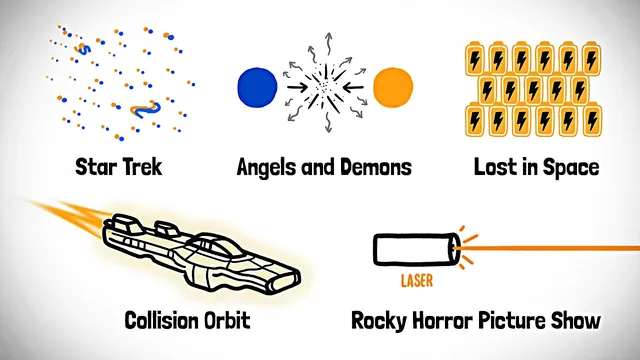
Antimatter is not an alternate-universe doomsday substance—it’s ordinary physics with a matching “anti” partner that annihilates when it meets normal matter, releasing energy. That core point matters because popular culture repeatedly frames antimatter as an existential threat, from Star Trek’s universe-ending annihilation to Angels and Demons’ theft-and-terror plot. CERN researchers instead treat antimatter as rare, volatile, and scientifically valuable, not inherently dangerous.
The briefing centers on what antimatter actually is: it was first discovered in 1932 and, when combined with an equal amount of normal matter, annihilates and releases tremendous energy. The catch is that antimatter doesn’t come from some parallel realm, and it isn’t “ready to explode” on contact in the way sci-fi implies. In current understanding, every charged particle has an oppositely charged anti-particle twin. Observations so far indicate antimatter behaves like normal matter in its fundamental structure—same physics, opposite charge.
A practical question follows: how would anyone even know if an object—say, an asteroid—were made of antimatter? Current theory says its atoms and molecules would follow the same laws of physics and would appear chemically and visually similar to their normal-matter counterparts, making detection difficult without producing and studying it directly. Since antimatter asteroids haven’t been found, it must be manufactured, which is why CERN’s antimatter work focuses on controlled experiments rather than “mining” it.
The transcript also tackles energy fantasies. While E=mc² suggests annihilation converts mass to energy, antimatter is not a convenient fuel source because producing it costs far more energy than annihilation yields. The only scenario where antimatter becomes an energy source in a meaningful way is when a tiny amount already exists and can be paired with matter efficiently. Even then, the quantities involved are microscopic: the system cites that about 20,000 hydrogen atoms and 20,000 anti-hydrogen atoms would release roughly 6 microjoules—about 1,000 times less than a typical electrostatic shock—nowhere near the scale required for catastrophic effects.
Safety concerns tied to blockbuster plots are addressed with similar scale arguments. The claim that a gram of antimatter could destroy a major landmark is treated as physically implausible because making a gram would take longer than the age of the universe and require more energy than Earth’s known reserves. The transcript further dismisses an “antimatter laser” concept by noting that lasers are made of photons, and photons are their own antiparticles.
Finally, the discussion pivots to the biggest unanswered question in physics: why the universe contains far more matter than antimatter. If matter and antimatter were produced in equal amounts at the beginning, they should have annihilated away. The lingering imbalance suggests some subtle difference between the two that hasn’t been discovered yet—precisely the mystery driving ongoing antimatter research at CERN.
Cornell Notes
Antimatter isn’t a sci-fi hazard from another universe; it’s normal matter’s oppositely charged counterpart that annihilates when it meets its twin. CERN research treats antimatter as rare and difficult to produce, and experiments focus on how antimatter behaves under light and gravity. The transcript argues that annihilation energy is real but not practically exploitable as fuel because making antimatter requires vastly more energy than it releases. Even dramatic claims—like destroying a city with a gram of antimatter—are framed as unrealistic due to production times longer than the universe’s age and energy demands beyond Earth’s reserves. The central scientific motivation is the matter–antimatter imbalance: something about the two must differ in ways not yet understood.
What is antimatter, and what happens when it meets normal matter?
Why would an antimatter asteroid be hard to detect?
Why isn’t antimatter a practical energy source?
How do researchers address “Angels and Demons”-style fears about using antimatter to destroy places?
What does antimatter research aim to learn beyond safety and energy?
Review Questions
- What evidence (as described) supports the idea that antimatter behaves like normal matter with opposite charge?
- Why does the transcript claim that annihilation energy doesn’t make antimatter a practical fuel?
- What mismatch between early-universe expectations and today’s matter dominance drives antimatter research?
Key Points
- 1
Antimatter is the oppositely charged counterpart of known particles and annihilates with normal matter, releasing energy.
- 2
Current observations suggest antimatter follows the same fundamental laws as normal matter, differing mainly in charge.
- 3
Antimatter is not naturally available in large amounts; it must be manufactured because antimatter-rich objects haven’t been found.
- 4
Annihilation energy is real, but producing antimatter costs far more energy than annihilation yields, limiting practical use as fuel.
- 5
Claims that grams of antimatter could cause large-scale destruction are treated as unrealistic due to enormous production time and energy requirements.
- 6
Antimatter lasers aren’t feasible in the way pop culture imagines because photons are their own antiparticles.
- 7
The biggest scientific driver is the matter–antimatter imbalance: the universe’s excess matter implies an unknown asymmetry between the two.