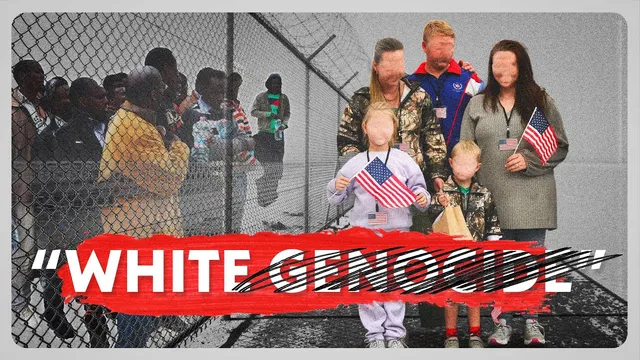
"Apartheid Version 2"
Based on Second Thought's video on YouTube. If you like this content, support the original creators by watching, liking and subscribing to their content.
The transcript frames a U.S. refugee resettlement plan for white South Africans as political messaging that contrasts with harsher immigration enforcement aimed at Black and brown migrants.
Briefing
A U.S. refugee resettlement plan bringing dozens of white South Africans into the country is being framed as “Apartheid Version 2”—a strategy that weaponizes liberal refugee and justice frameworks to advance white-supremacist politics while sidestepping material accountability. The claim centers on timing and optics: after tightening immigration enforcement and restricting entry for many Black and brown migrants, the administration is said to be creating a narrow exception for white African applicants, sending a message that only white people can be “integrated” and making discrimination against others seem more defensible.
Supporters of the critique argue the policy functions as a smoke screen. While ICE raids and deportations intensify, the resettlement program allegedly offers a public-facing narrative of humanitarian concern that obscures the administration’s broader priorities. The transcript points to an earlier step in the same direction—bringing 59 white South Africans on “priority 1” refugee status after new refugees were largely blocked—then suggests the administration is now accelerating the process, with the next group arriving as soon as the following week.
The argument then pivots from immigration policy to historical justice. It claims that white supremacists can present themselves as victims because mainstream liberal approaches to justice often treat past wrongdoing as something that can be acknowledged symbolically without requiring beneficiaries to give up material advantages. South Africa’s post-apartheid “Truth and Reconciliation” process (TRC) is used as the key example. The transcript describes the TRC as designed to establish a human-rights culture through public hearings and limited prosecutions, aiming to move forward by agreeing the past was evil while minimizing disruption to the existing social order.
In this telling, the TRC’s structure allowed white beneficiaries to separate themselves from apartheid’s violence: they could be cast as compassionate witnesses rather than implicated participants. Victims’ suffering is portrayed as reduced to trauma that can be “healed” through acknowledgment, while restitution is effectively blocked. At the same time, those who might demand deeper change are depicted as being framed as threats to the new legal order—making it easier for beneficiaries to imagine themselves as future victims if equality is pursued.
That logic is then applied to contemporary debates about reparations and historical injustice. The transcript criticizes the recurring liberal refrain that it is “too late” for reparations or that raising slavery and apartheid only divides people. It argues that this approach misunderstands how injustice works: history does not stop producing effects, and capitalism rewards inherited advantage, widening gaps over time. From that perspective, justice cannot be limited to feelings, guilt, or procedural fairness; it must include material equality.
Finally, the transcript contrasts liberal “trauma-only” justice with a “revolutionary” model of restitution. The proposed standard is that wealth and privilege—treated as relative status rather than a right—should not be allowed to grow at others’ expense. Even if exact accounting of historical suffering is impossible, the transcript argues there is enough evidence that inherited structures generate ongoing harm, so policy should tax extreme wealth, restrict land accumulation, and fund universal programs to prevent inequality from compounding. In short: the “Apartheid Version 2” label is used to argue that symbolic justice and selective humanitarianism can be exploited to preserve racial hierarchies while presenting them as moral progress.
Cornell Notes
The transcript claims a U.S. refugee resettlement effort for white South Africans is being used as political cover for a broader white-supremacist agenda. It argues that after immigration restrictions hit Black and brown migrants, exceptions for white applicants send a message that “integration” is reserved for whites. The critique then turns to South Africa’s Truth and Reconciliation Commission (TRC), portraying it as a liberal model of justice that acknowledges past evil while limiting prosecutions and avoiding material restitution—allowing beneficiaries to feel distinct from perpetrators. That framework, the transcript says, enables white supremacists to claim victimhood and delays reparations. The proposed alternative is material equality: justice should change present economic conditions, not just manage trauma or guilt.
Why does the transcript connect a refugee resettlement program to “white supremacy” rather than treating it as a neutral humanitarian policy?
What is the role of the TRC (Truth and Reconciliation Commission) in the transcript’s theory of how historical injustice gets neutralized?
How does the transcript explain the emergence of “white grievance” or “white victimhood” after apartheid?
What critique does the transcript make of the “too late for reparations” argument?
What does “revolutionary justice” mean in the transcript, and how is it supposed to differ from liberal approaches?
Why does the transcript insist that exact historical accounting is not required to pursue justice?
Review Questions
- How does the transcript use the TRC to argue that symbolic acknowledgment can block material restitution?
- What assumptions about capitalism and inheritance lead the transcript to claim that injustice “accumulates” rather than ending?
- According to the transcript, what practical policy changes would follow from treating privilege as a relative status rather than a right?
Key Points
- 1
The transcript frames a U.S. refugee resettlement plan for white South Africans as political messaging that contrasts with harsher immigration enforcement aimed at Black and brown migrants.
- 2
It argues the policy can function as a “smoke screen,” allowing broader priorities to proceed while humanitarian optics reduce scrutiny.
- 3
South Africa’s TRC is presented as a liberal justice model that acknowledged apartheid’s evil while limiting prosecutions and avoiding material restitution.
- 4
The transcript claims the TRC’s structure enabled white beneficiaries to see themselves as distinct from perpetrators and to block redistribution by invoking fear of future victimhood.
- 5
It criticizes “too late” and “don’t divide us” arguments about reparations as ignoring how historical injustice continues to shape present inequality.
- 6
The transcript argues that capitalism rewards inherited advantage, so inequality widens unless policy actively redistributes wealth and opportunity.
- 7
A “revolutionary” restitution approach is proposed as the minimum standard of justice: wealth should not grow through others’ loss, even if exact historical accounting is impossible.